Feeds:
Posts
Comments

Posts Tagged ‘nature’

Water Feature

Welp, the rains are here for the duration. I’ll still get in some gardening on the few days of sunshine and dry that intersperse the gray, depressing, and very, very, wet days. The rain isn’t what is depressing: the cloud cover and long, gray, days is. I tried those blue anti-depression lights, once. Blah. I’d rather coerce my husband into building a fire in the fire pit and bundle up in layers on those days that are dry (the clouds can still be there, but a fire, the outdoors, and wood smoke alleviate depression better than a lamp that pretends to be the sun).

Microsoft Word doesn’t like that I refer to our winter weather as “the rains” (plural) but it is an accurate description: it isn’t one single rain but many such storms and sprinkles that come overhead throughout October to June. Rains. Multiple rain storms. With lots of thick, gray, clouds. If we’re lucky, we’ll get a snow storm tossed in there. If we’re unlucky, it will be an ice storm that comes down in the guise of rain: freezing rain. Fun times.

Before the weather turned and the cloud pattern changed, I finished up my second water feature. It needs a little fine tuning that won’t get done until the weather begins to warm back up, but I’m still pretty proud of what I created.
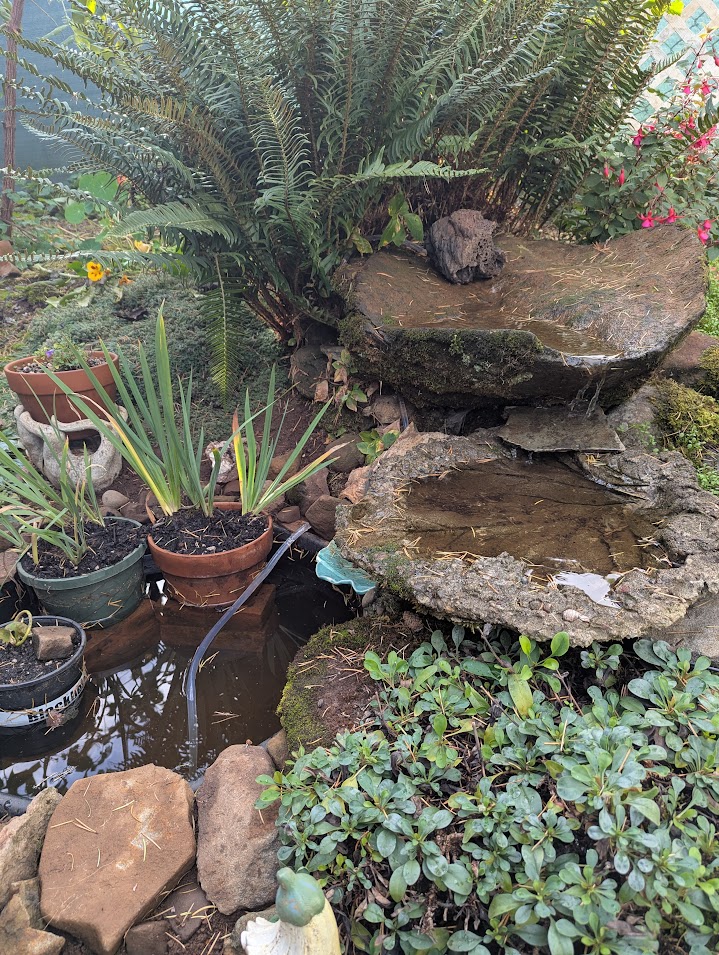
The rock that is the centerpiece came with the house. We live on top of a rocky bluff where tons (literally) of these sedimentary rocks formed when volcanoes were young and glaciers were receding. Boulders atop layers of lava rock, bluffs upon bluffs above the Willamette River, Our yard was cleared and farmed in the early 1900’s and most of the very large rocks were removed or sit buried under several feet of topsoil and clay. The corner of yard where my newest water feature is happens to be an area least developed and used as a rock and concrete dump for at least thirty years. I still find fat pieces of asphalt and broken concrete in the ground when I dig.

The native rocks are red, like the clay that makes up most of the earth around here. We just happen to be blessed with at least a foot of good topsoil atop that clay due to the farm that was established here in the 1930’s. At least everywhere except in this particular corner where everything was dumped before we moved in.

We removed most of the large chunks of concrete and asphalt and I started turning the area into a small garden. Don moved this big concave rock in the hopes of “someday” building a water feature in the corner. Twenty some years later, I built that water feature. I could say I got tired of waiting for him but the truth is more nuanced than that: he has his projects, the vegetable garden, a new shed, and more. I love to garden flowers, dig in the dirt, build walls, and rearranged things. It is only natural that I should take on the task of building a water feature after waiting for him to find time to do it.

I have the time and the will; he has neither.

I bought the round rubber animal trough at the local feed store. I ordered the solar pump. I dug the hole in the ground.

I didn’t find a lot of rocks in the way: I found the roots from the neighbor’s tall pine tree running through the ground, none of them larger than 1.5” diameter. I cut them out knowing they wouldn’t impact the life of the tree (which is dying anyway, but slowly, and due to a beetle infestation). I leveled the ground and installed the trough, planted the yellow flag irises in tubs, and filled the crater with water.

Oh, and sometime along the road, I made the semi-solid concrete feature that forms the second rock in the waterfall: concrete and a rhubarb leaf.
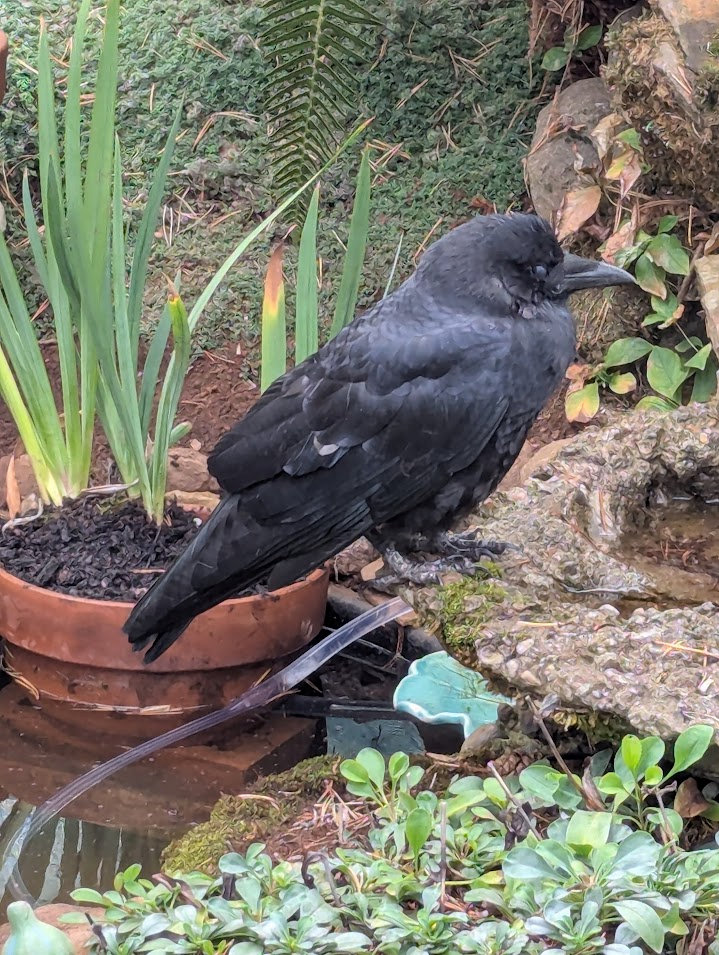
Me, me, me. And I’m only bragging about it because I will be 69 years old in a week and I’m still playing in the dirt and digging holes. Also, the birds already love it.

And, yes, I took a couple days off to recover after all that work.

Read Full Post »

I’m ashamed: I have not kept up on the blog. Well, I’m not really ashamed, but I am a tad bit regretful that I haven’t kept up. I think of things to write during the day when I am elbows deep in something, but evening comes, and all that inspiration has evaporated. Poof! Gone! Dissipated into the Nether.

We put in a new shed, replacing the homemade one that came with the house when we moved in here over 20 years ago.

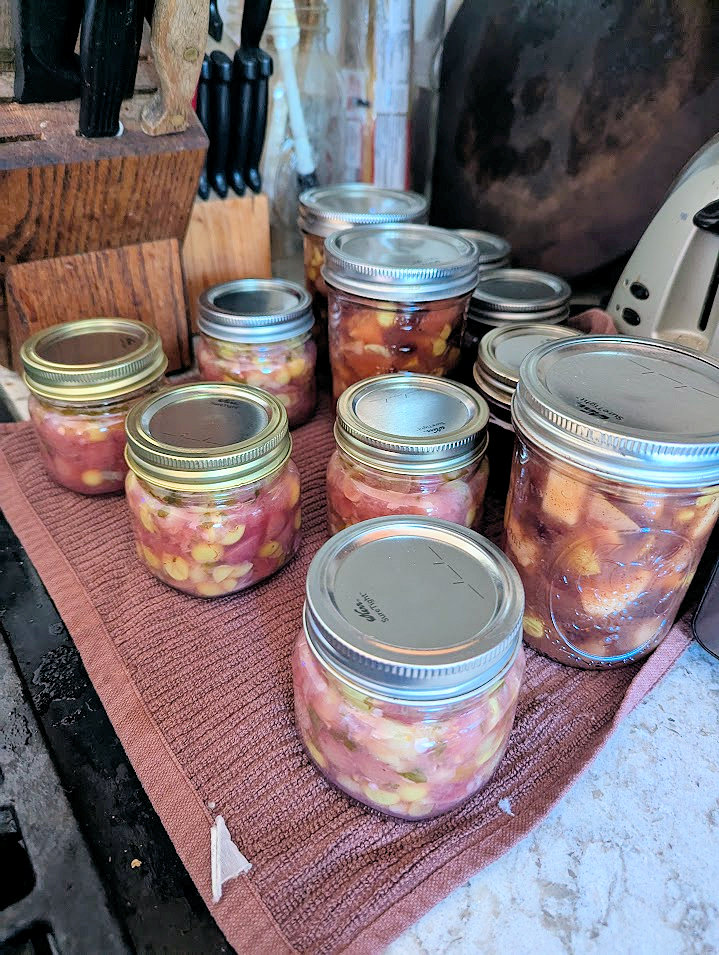
I have been busy canning enough for the two of us: salsa, compote, conserve, chutney. Herbs have been dried or are drying for herbal teas. We foraged huckleberries and elderberries from the National Forest (those are in the freezer, awaiting a moment of inspiration).

We also foraged some more native plants for the yard, some of which have already been planted in the ground and some which are waiting for me. They won’t have to wait long: I have been busy moving plants around and tilling new sites for more plants. I’m waiting for the next round of rain to pass through and will use the ensuing dry days to my advantage.

I have filled the hummingbird feeders and hung them out: I took them down during the hot days of late August when honeybees get lazy and swarm the nectar. I melted and mixed up a new batch of bird suet. That came down when the weather warmed up and the starlings started coming around. The starlings are gone now, moved to parking lots. The weather is cooler and the suet won’t melt or mold now. We’ve started feeding the corvids and small songbirds again. (Corvids: California scrub jays, Steller’s jay, and crows.)

I have cleaned up the space between our shed and the neighbor’s lawn. That’s a bit of a sore point: our garage is set back three feet as per the law, but the yard maintenance person insists on mowing our portion, including over my ferns and day lilies. ARGH. I have tried little fences, cardboard, and now I am merely tilling up the strip to plant more flowers. When we first moved in, the elderly woman who lived in that house asked me to do that so her lawn person wouldn’t have to mow that (because we aren’t the best at keeping up the lawn mowing, preferring to let our yard go “natural”). I wasn’t in a place to do it then, but I am in a place to do it now.

Too bad that Selma died several years ago and we have had renters living next door since. Renters who did not mess with our three feet until the landlord hired this current lawn guy. I have even posted a sign on the side of the garage: DO NOT MOW OVER THE FERNS, PLEASE. He still hits them. So I am in a passive-aggressive war with him (and by extension, the landlady to the property). Yes, I could make a phone call, but it is infinitely more fun doing it this way. Don’t judge me.

(If you’re thinking I’m afraid of confrontation, you’d be very, very wrong. Most people are afraid of confrontation with me. When I come into a confrontation, I come with both barrels loaded and a back-up cannon. The world is much safer when I resort to passive-aggressive flower planting.)

I hacked my poor hydrangea back by at least two feet. It used to be planted under the pine tree (Nature rest its branches and rotting roots). The pine tree fell over some seven or eight years ago. The hydrangea is now in full sun, and summers have heated up the past five or six years. I have covered it with umbrellas, sheets, and tablecloths, but it still gets sunburned. The flowers fade too quickly. It has grown spindly. I could either kill it outright or prune it way back and see if it survives.

A woman walking her dog by the house commented on it. I told her I hopes I hadn’t killed it by my merciless hacking. She said she’d watch it and if it lives, she’s hacking back her overgrown hydrangea next fall. That’s me: inspiring neighbors to bush cruelty.

I also cut the Rose of Sharon back quite a bit, the forsythia, and the mock orange. They aren’t as noticeable a hack job as the hydrangea that was five feet tall one day and less than three feet tall the next. Turn me loose with pruners and a saw…

I meant to do a blog on sprinklers, highlighting our eclectic collection, most of which we don’t actually use. I may still do that. It sounds like a wintertime post. Meanwhile, I am considering this post finished.

Read Full Post »

It is time to cut the milkweed out of my garden.

I planted it many years ago. It never sprouted. Four years later, there was a tiny plant that looked suspiciously like a milkweed growing next to some peonies. I clipped a leaf off to see if it would ooze the sticky white sap that gives milkweed its name: it oozed. Excited, I let it grow. The milkweed plants are limited to a “triangle” between the garage and two sidewalks. I cut them down when the seed pods appear: I don’t need more plants. Also, I don’t want to wait another four years for the seeds to sprout when the plant does just fine by sending out runners from those very sturdy rhizomes.

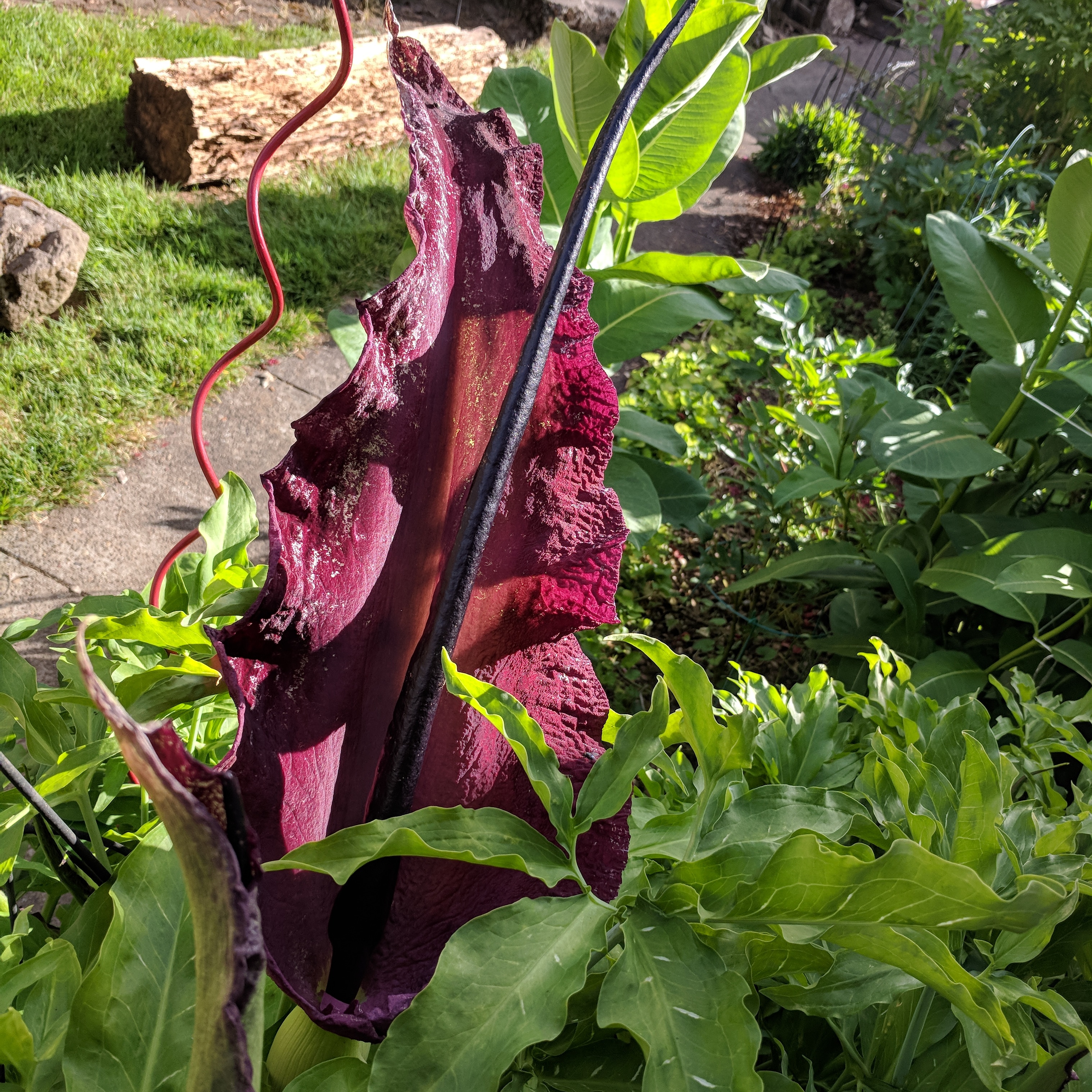
I was afraid the milkweed would crowd out the peonies and the asters. It doesn’t. The three plants grow together happily. What the milkweed did affect was my arum, dracunculus vulgaris, or “Dragon Lily”. The milkweed runners take up the space the lily’s bulbs are in and I’ve slowly lost many plants in that tiny garden space. There are a few left and this fall I will dig them up and move them to a better location, free of water- and space- hogging competition.

Unfortunately, milkweed does nothing to impede the growth of grape hyacinth, I don’t think anything short of a heavy-duty herbicide affects grape hyacinth (and I refuse to go that route). Every year I pull several hundred bulbs out of the ground and compost them. (Sometimes, I will give them away to a desperate gardener who doesn’t know better than to start them in their yard. I’m pretty sure I’m digging up bulbs to send to my brother in Reno this fall. “Hey, Bro, your yard needs some early spring color. I promise you won’t hate me in ten years…”)

Now, when the first purple grape flowers begin to bloom, I do my first – and only – weeding of the space. I cut hyacinths for a bud vase. I toss the ones that pull up with the ever-present grass. I do my best to rid the space of grape hyacinth bulbs while enjoying the aroma and color. Of course, I fail and the hyacinth prevails.

In the Spring, I cut back the old stalks of peony and aster just as the first new stems begin to push their way skyward around the fading hyacinth. Purple stems of peonies, green stems of aster, the spotted stems of Dragon Lily rise above the fading green and brown stems of faded hyacinth. Buds form on the peonies and soon the area bursts with pink and red peonies so thick I have to tie them to stakes to keep them upright.

The peonies fade and drop their petals just as the aster and the milkweed stalks begin to mature. The green of the aster is first to top out at 2-3’ tall. Milkweed will soon tower over the asters and all one will see will be the green stalks of milkweed.

But before it does, at the end of May and always on our anniversary on the 7th of June, the aroma of rotten hamburger wafts in the air: the Dragon Lilies have opened. Flies and beetles rush in to await their demise in bowl of this carnivorous beauty. The smell lasts a couple days. The flowers wilt and the entire plant begins to wilt and turn yellow.

Now it is the milkweed’s turn.

I have two varieties: Showy milkweed (Asclepias speciosa – native to Oregon) with pink florets and California milkweed (A. Californica) with white florets. The latter isn’t a native to Oregon, and it doesn’t grow as prolifically as the Showy milkweed does, but the blooms are pretty and the aroma is the same: sweet and enticing, the polar opposite of the faded Dragon lily.

I planted milkweed thinking I could attract migrating Monarch butterflies. I didn’t know then that this part of the lower end of the Willamette Valley is not on the migratory path for these beautiful and endangered butterflies. No worries: the value blooming milkweed has for other pollinators outweigh my misplaced intentions. Every early bee, butterfly, and tiny wasp brave the sticky edges of the flowers to get at the pollen inside. Occasionally, a honeybee will get stuck and will have to struggle free. A few plants wilt and die, host to the milkweed beetle which does exist in this half of the valley.

Below the tall stems that now tower between four and six feet, a junco might build a ground nest. The nests are soft grass circles, now much larger than the palm of my hand. We won’t know there’s a nest there until a fledgling bird hops out of the cover while the parent birds hover nearby.

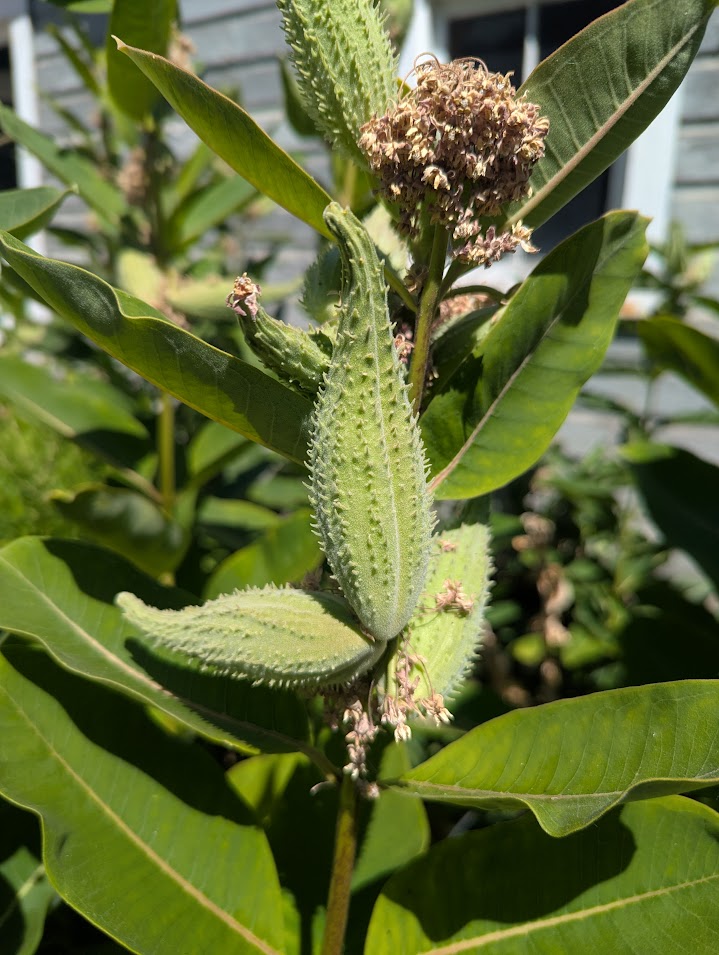
The bloom of milkweed lasts a couple weeks giving us quite a show of pink and white, and busy pollinator insects. But then the flowers fade and the few that were pollinated will start developing seed pods. These are green and soft, and quite edible if you are not allergic (I am). When the pods ripen, they turn brown and hard then pop open to release thousands of sees hanging from wispy “umbrellas”. The wind catches the seeds and like the dandelion – well, you know the rest of the story! The ground is soon covered in tiny, milkweed parachutes looking for a home.

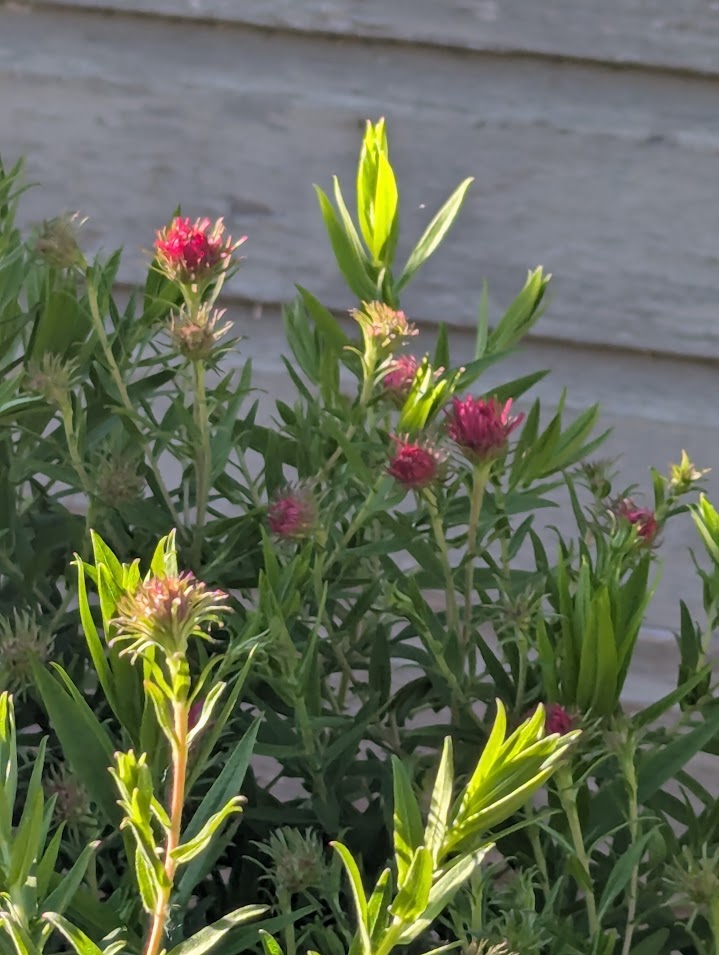
But I mow down the milkweed, not simply to avoid the parachutes, but because the milkweed towers above the asters. And the asters put on a late show of color lasting through August and into September. The tall asters are a riot of magenta pink. The aster that grows in the crack in the sidewalk puts out lilac-colored flowers. The tiny bees – those mining bees and other ground dwellers – love the asters.
The milkweed is gone now, and I wait for that last eruption of color. Too soon, the rain will come and everything will turn brown. (Photo is of a year I did not cut down the milkweed stalks and the seeds flew everywhere.)

Read Full Post »

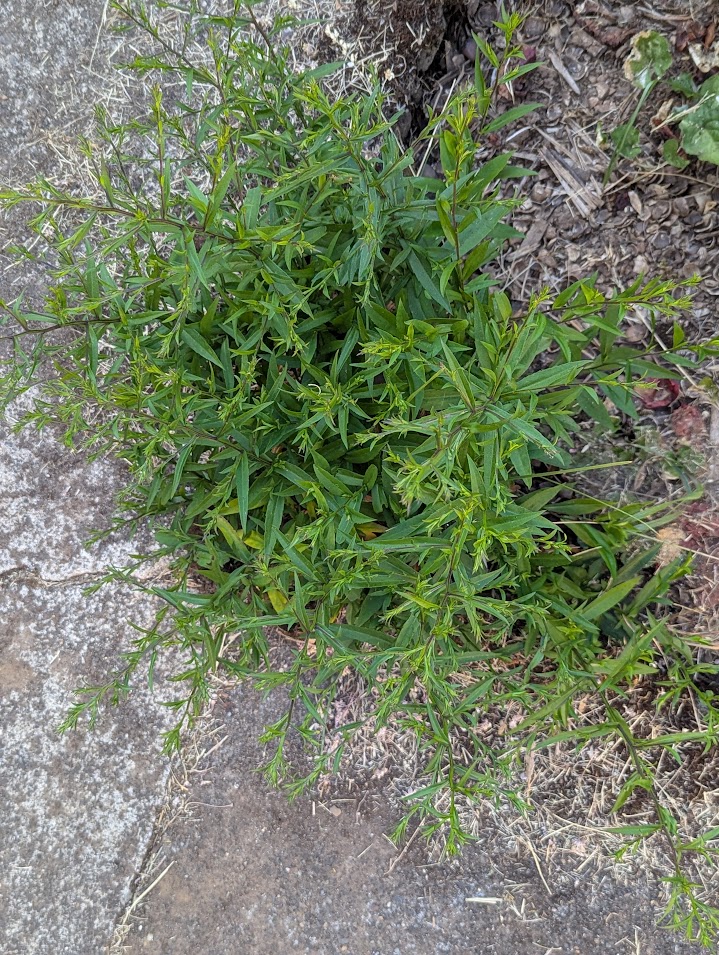
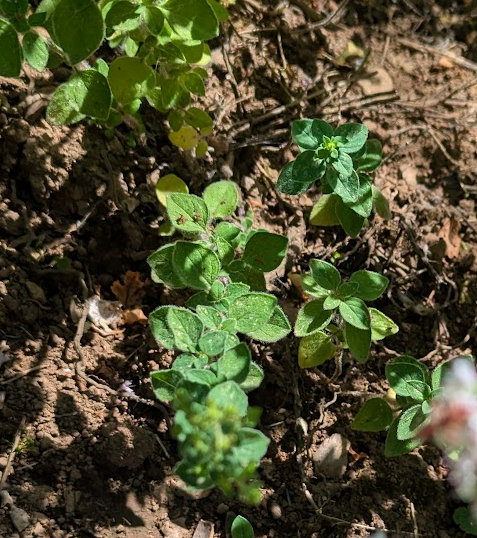
The Weed Called Oregano.           

I don’t remember when I first planted oregano in my yard. We moved here in 2002 and I started carving out the “island” in 2003, so it was probably 21 years ago?

The “bed” of oregano has gone through some changes over the years: choked with that pesky grass, fenced off from dogs and to keep it upright, and it’s current incarnation that is 10x the original plant. I didn’t bother to rein it in this summer, but I did get rid of (most) of the pestilence grass.

We don’t purchase dried oregano in jars. Sometimes, I cut a handful of sprigs before it blooms, hang them upside down to dry, and scrape the dry leaves into an old jar that still has the original label on it: “Oregano”. We use it fresh during the spring and summer months when we can step outside and clip what we need off the plant. By Autumn it is fading and come winter, only dead stalks remain that I cut down and compost.

In spring, the cycle begins again.

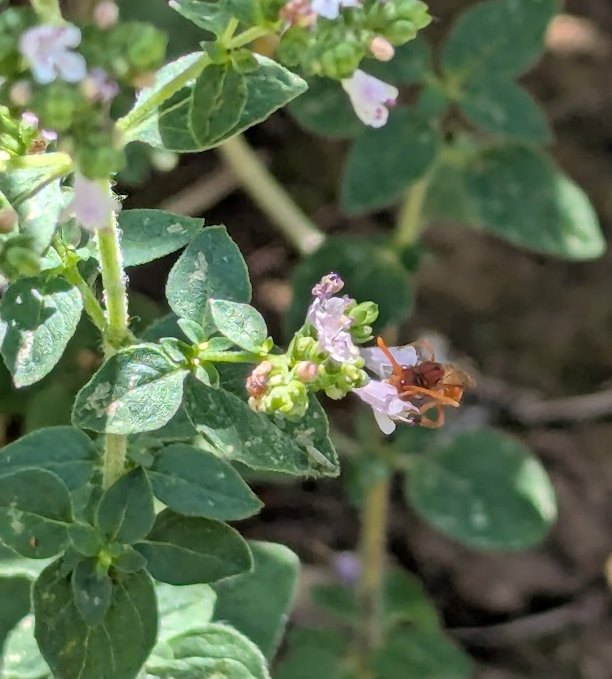
I find new plants growing everywhere in the yard: oregano is self-seeding. I pull it with the other weeds, savoring the aroma as I do. I could allow it to grow everywhere and some day when I am too old to do my weeding by hand, that is probably what will happen: it will grow around the peonies, the rosemary, the lavenders, and the evening primroses.

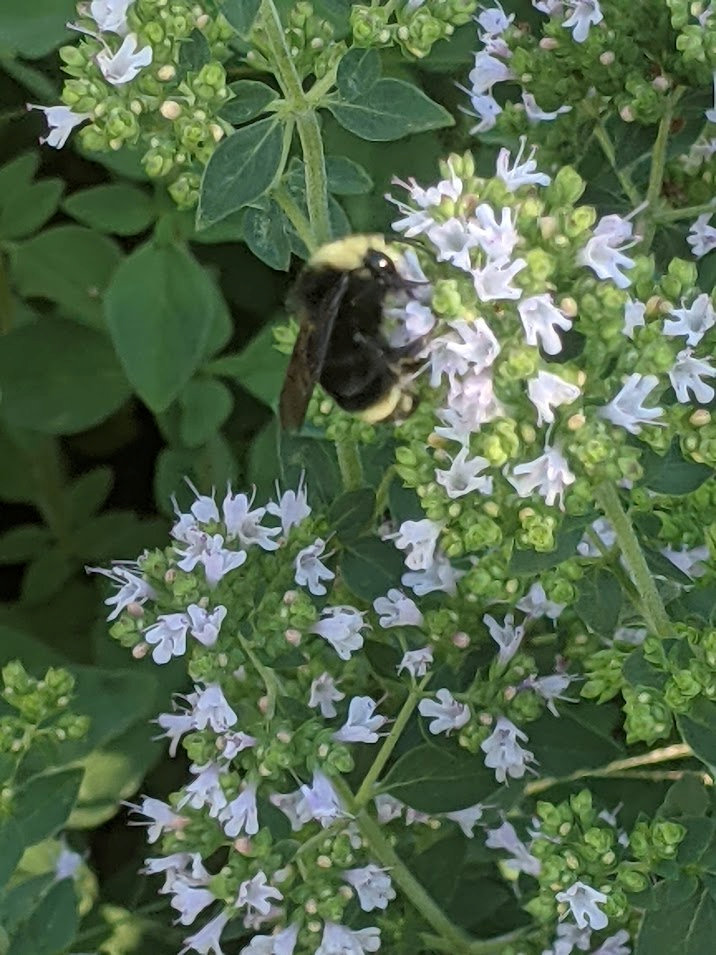
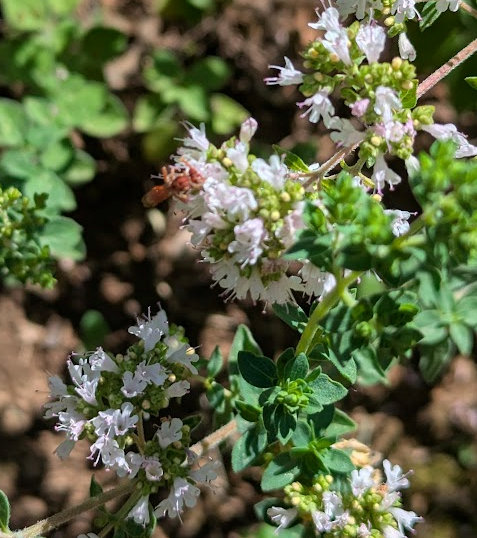
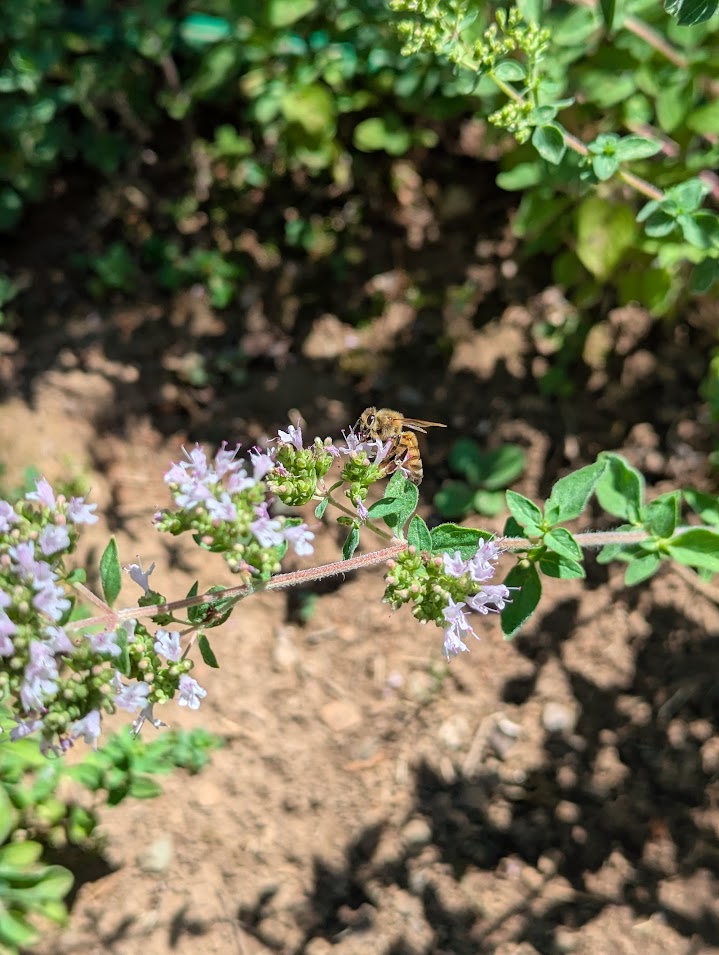
I wouldn’t mind and the pollinators would certainly benefit from the profuse tiny purple blooms. I wonder what oregano honey tastes like? Some honeybee keeper must know: as soon as it begins to bloom, the bed is covered with honeybees and other pollinators.

Our dogs (one at a time over the years) will stand with their noses deep in the aroma, snapping at whatever bees they see. They get stung and jump back, shaking the head furiously before wading back in to snap at another bee. Our mantra is, “Leave the bees alone <Ruger, Murphy, Harvey, Sadie>!” They leave, but they always return to the scene of the crime.

I wonder if the bees taste like honey or like a good Italian dish spiced generously with oregano?

Read Full Post »

Tiny pinks on long stems. This mallow started life in out garden as a tiny free specimen. I put it in a planter and it thrived. Moved it into the ground and it nearly died. It is in a large planter, soil mixed with sand, and it is happy once again. It is a bee favorite & common on the Coast.

stinging nettle – urtica dioica

I hope you know what plant that is without the ID below it: run into this without enough clothes on and you’ll wish you had never met it. I crawled into it once when I was a child. Nettle stings all over my face! Fortunately, the damage is never serious and the sting can be dealt with (in my case, I probably smeared mud all over my face. I was a clever child – HA!). I started growing it for the medicinal benefits of nettle tea. It is in a pot so it doesn’t escape into the yard and I deadhead the flowers before they produce seeds: this is all the nettle I need in my yard. Harvest with care: garden gloves, long sleeves. I dry the leaves in the dehydrator instead of hanging them to dry. I’ve read you can cook the leaves as a spinach substitute (I’m not fond of cooked spinach except on pizza). The leaves lose their sting when dry. I mix the leaves with feverfew and yarrow for a green tea that I can drink without sweetener.

Nettle may lower your blood pressure, help with blood sugar, hay fever, reduce inflammation, and help with enlarged prostate, and contains antioxidants and many vitamins. (I may write more on nettle in another post on herbs in the future.)

Wild irises.

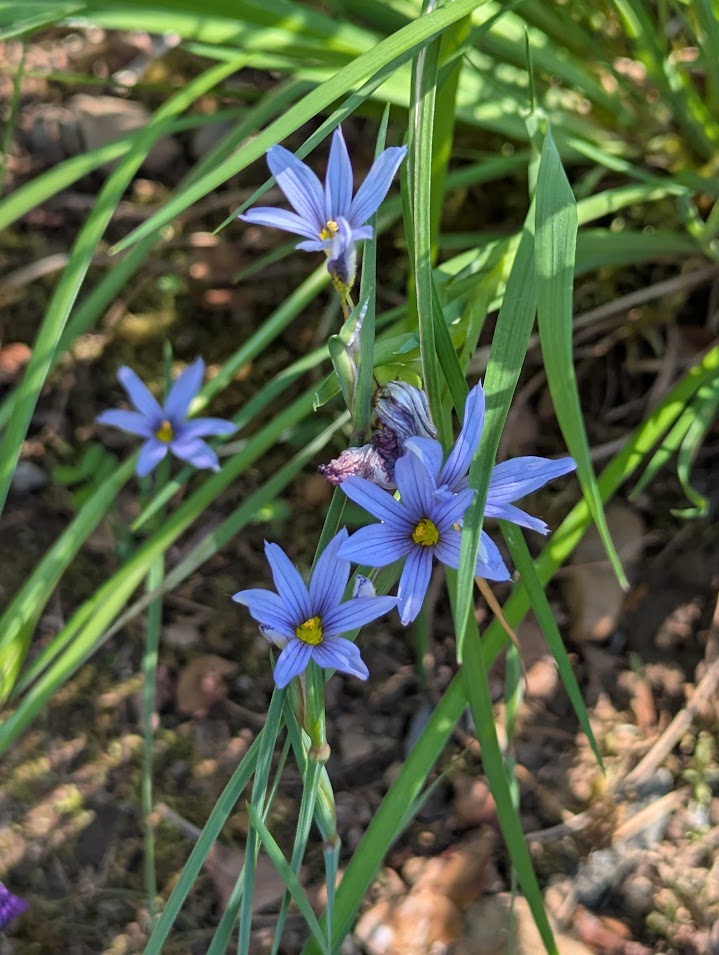
I love irises! These are my wild native irises (I have “domestic” irises as well). The first two iridacea shown love moist soil and are planted in a little shady swale next to the south fence of our yard along with the camassia. I need to divide the flag iris this fall. The Douglas iris is more like its commercial counterparts: dry soil is fine. They love sunshine. The blooms are larger than the flag iris but still delicate.

wild camas – camassia quamish

Wild camas (which is related to asparagus) is a beloved forage plant for the Indigenous peoples of the PNW. I loves marshy areas. I have not tried eating it: I have too few of the plants to forage just yet.

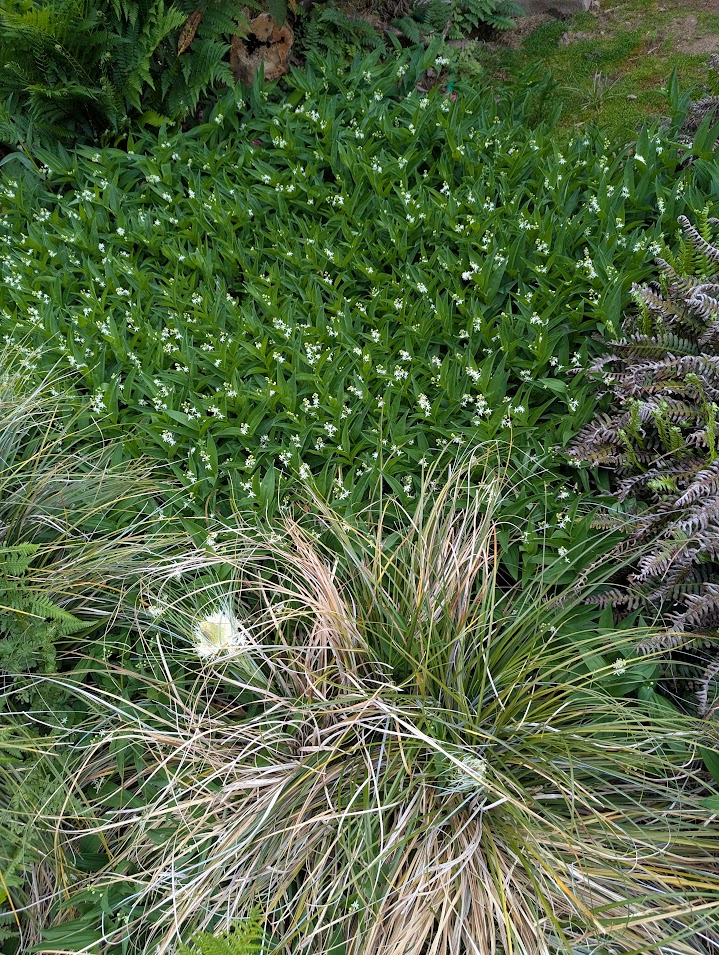
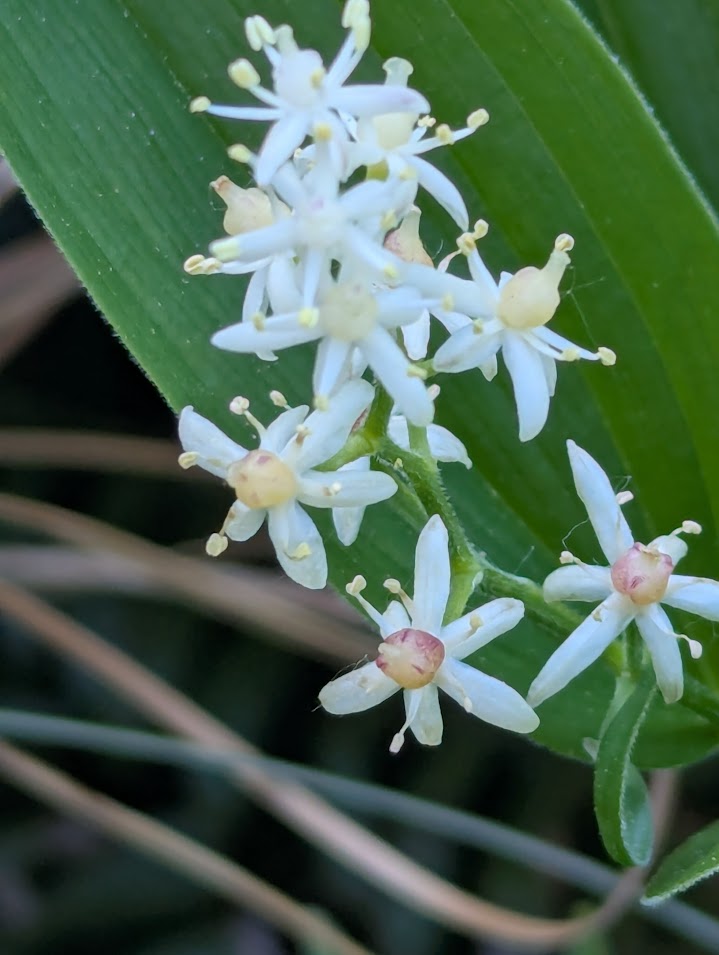
My husband brought me a gift of bear grass one year along with the deer ferns. Falso Solomon’s seal hitched a ride. My bear grass has never failed to bloom: the spikes tower above the heavy leaves. I think one of my plants is showing its age and beginning to die out, but it produced three beautiful spikes of flowers this year. And the false Solomon’s seal never disappoints, but it is gone by summer and the ground bare where it flourished in the wet of spring.

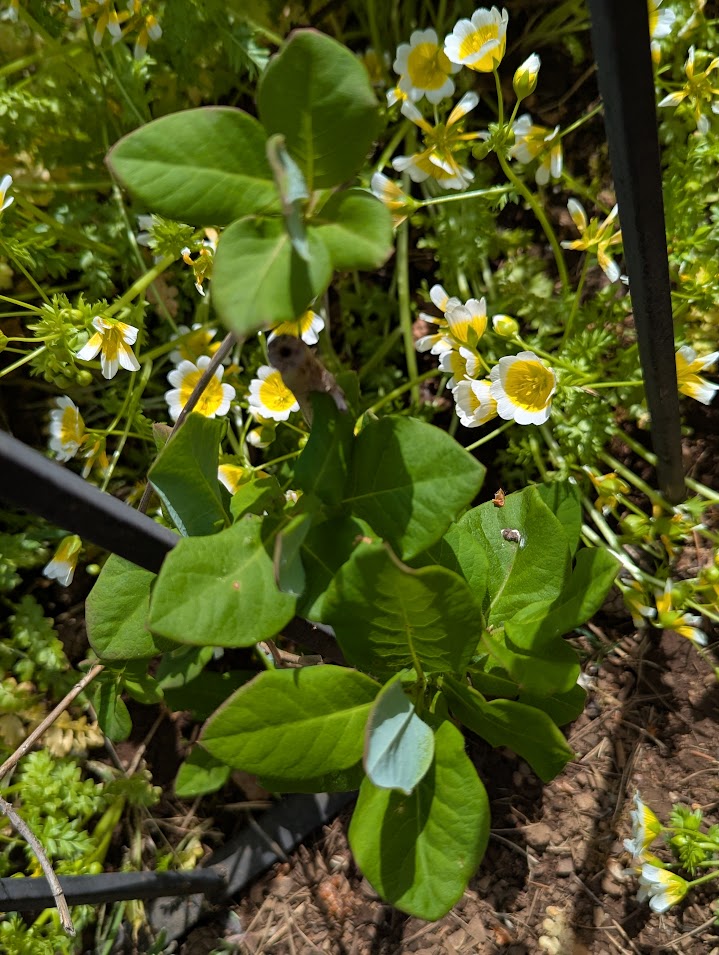
This beautiful ground cover was also a hitch hiker. I think it came with the yew and maple (long gone now). It spreads quickly, covers the ground beautifully, and attracts every bee, bee fly, and wasp. It greens up in the Autumn, overwinters green, and blooms in the spring – and then it is gone. The ground bare.

I have not tried too many other plants mixed in with the false Solomon’s seal to cover the bare spot in summer, but I have tried where the meadowfoam is. And meadowfoam does not like to be shaded out during the dormant stage! The bare spots in the photo are where i removed plants that shaded out the meadowfoam and it died back. However… it seems to love peonies and grows profusely around them despite the shade of summer, so I may try putting a couple peonies in there.

vine maple – acer circinatum

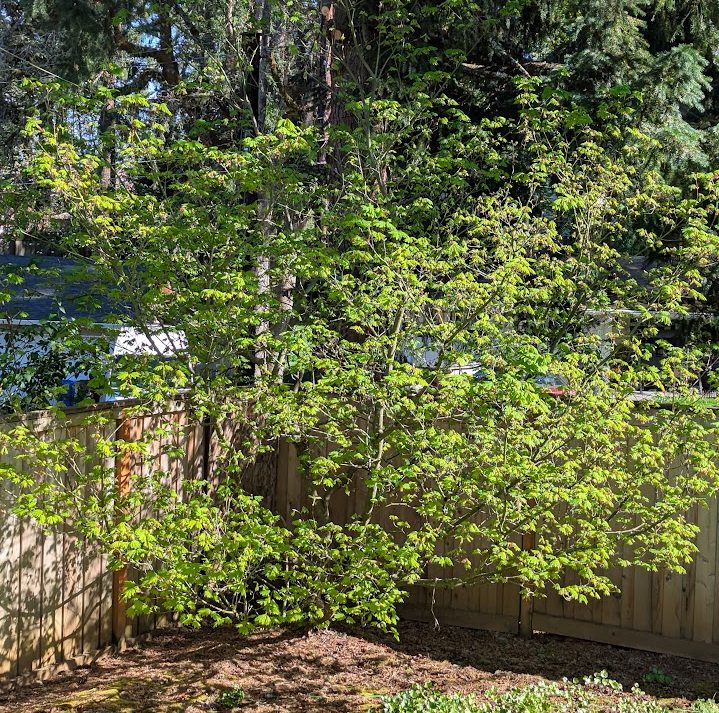
Don dug this out of a bar pit one year. he intended to make it into a Bonsai tree, but vane maple grows too quickly and he had to put it into the ground. It is as large as it is ever going to get. The leaves turn brilliant red in the autumn. The squirrels love the helicopter seeds. Very little grows under it but I am hoping some huechera (coral bells) will take off.

narrowleaf milkweed – asclepias fascicularis

Milkweed. I could write a blog post on this, the last of my Natives to show off. I planted it by seed: two kinds of native milkweeds, the showy (pink flowers) and a few of the narrowleaf. They didn’t grow. Well, to heck with that idea, right? I could purchase some starts but it just never seemed to happen. And four years after I tossed those seeds in the garden, I had a thick stem poking out of the ground. Suspicious, I broke a leaf off and watched as it oozed thick milky sap. Eureka! It only took four years for those seeds to grow! And grow they did: I now have to fight the plants to keep them contained in the corner of garden where I planted them: milkweed spreads by runners underground.

Bees, flies, butterflies (but never Monarchs – so far), and milkweed beetles love the plants. Invasive as the plant is, it grows well in the little corner of yard where it is, sharing space with peonies, asters, Voodoo lilies, and grape hyacinth. The hyacinth blooms first, then the peonies, followed by the voodoo lily. The milkweed rises up and blooms, fades and dies, and the asters bloom. A perfect full summer garden of bloom.

That is it for my native plants! My next posts will be about herbs in the garden, uses, recipes, and cautions. I’m excited for those posts!

Read Full Post »

Lewis’ or Oregon mock orange – philadelphus lewisii

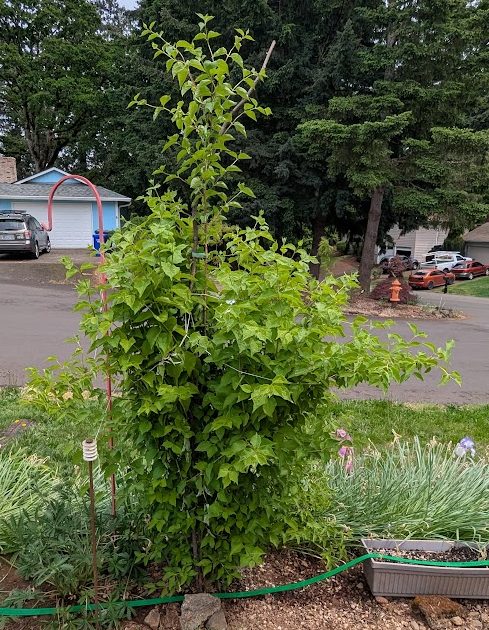
It has not bloomed yet, but I’ve only had it since 2023. It grows rather spindly – perhaps too much good soil and water and growing too quickly? But I found if i staked those spindly branches, they were much stronger the next year. One of my favorite wild bushes, blooms in June – July, smells amazing, and reminds me of rattlesnake draws in Eastern Oregon or Nevada where it commonly grows along a spring in the basalt.

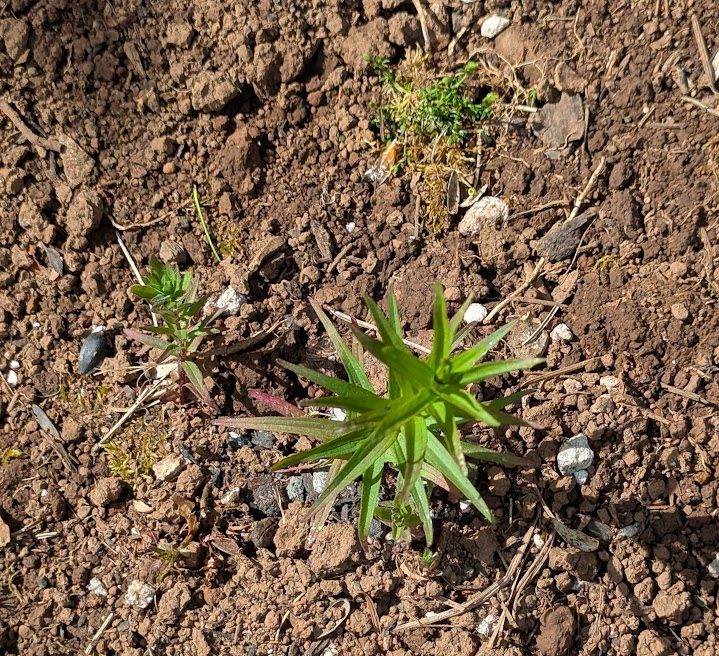
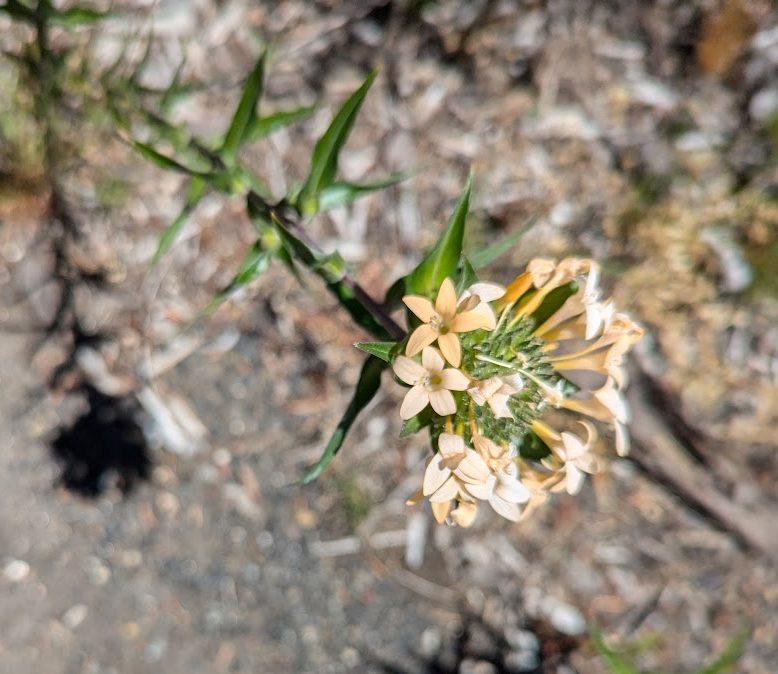
We discovered this growing along the roadside after a fire. It grows about 3-4′ tall. It is a native annual and we could purchase seeds (we tried seed collecting last fall, but beetles had devoured most of them!). This year, we dug one up (you can get a permit at the USFS). Hopefully, it makes it. Pic on the left is the one we dug up, pic on the right is a photo from last summer.

Penstemmons are hard to identify without a field guide and a key, but we love them. The one on the left is one we dug up on Saturday (we dug up two, we won’t know if they are the same species or not until they bloom. There’s a fourth one in the front garden, but it is still very tiny and hasn’t bloomed. The one on the right – I am fairly certain it is the Little Flower penstemmon: the flowers are tiny. It came with a yew and Rocky Mountain maple (both dead and gone now). Penstemmons make great ground covers, especially in those dry, rocky spots.

Note: we don’t know what killed the trees, but all the plants that came with survived. The trees thrived for about five years, the maple died off first. The yew lived a couple more years before suddenly dying on us.

Who doesn’t love paintbrush? It is parasitic which I didn’t know (and which explains why I’ve never succeeded in growing it in the past). The plant on the right is one I just purchased from a native plant nursery, complete with instructions on how/where to plant it and what plants it might want to attach to. The second one is one we just dug up. Unfortunately, it is attached to an oxeye daisy – a native daisy, but one that is a bit of a weed. I prefer my Shasta daisies which stay in their place, but they aren’t natives, so…

I planted the purchased paintbrush near a large leaf arnica (also a native, no photo). I will plant the new one nearby as well.

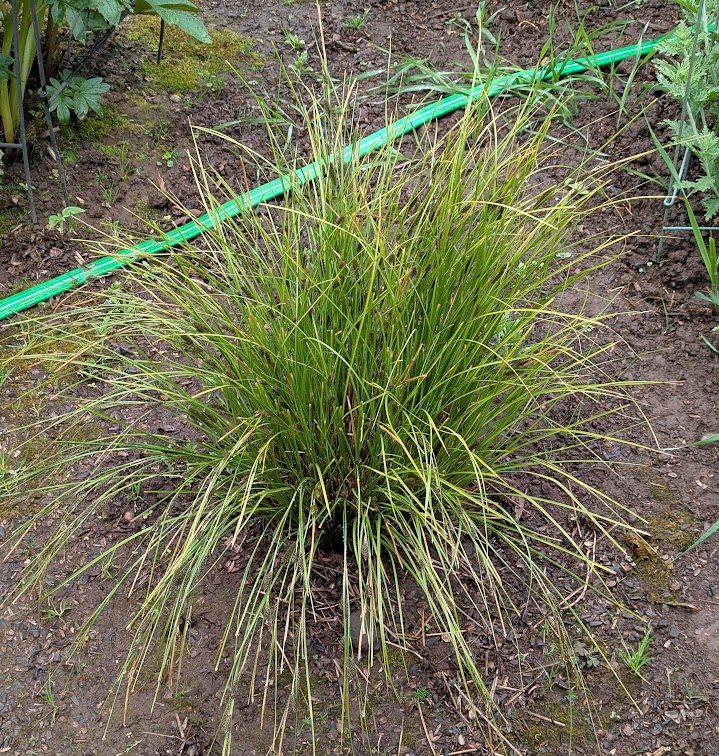
I’ll be honest: this could be an ornamental sedge. I don’t know. Birds planted it in our yard. I made the decision not only to keep it, but to move it to a better spot. I’d be happy if I learned it was a native dense sedge as my husband thinks.

black hawthorne – cretaegus douglasii

Ah – the Hawthorne! Long ago we lived in a trailer park next to a large open space full of nasty Himalayan blackberries (very invasive) and a lot of native plants (including the afore-mentioned oxeye daisy). This little tree was bulldozed a couple times by our landlord and chewed on a lot by the local black tail deer population. When we purchased our house, my husband dug this up (it was about 3′ tall at the time) and planted it in the ground. I believe he was planning on making a Bonsai out of it, but it just loved its new location.

trumpet honeysuckle – lonecera cilosa

I bought a honeysuckle from a nursery. It is pretty. The aphids love it. But I *really* wanted a native one. Last summer, my husband and I made a foraging trip into the Cascades and found this growing there. No, I don’t have pics of the flowers (yet), but we know it is a hummingbird plant and it is what I wanted.

But the real story is about the bear. I have only seen one in real life, and that was a grizzly in Yellowstone when I was ten (1965). I take that back: I saw a black bear once as it raced across the road in front of us in Central Oregon. I was in a car. I’ve hiked, camped, and hiked some more, and never seen a bear in the wild that I could count. Until we were digging the honeysuckle. A young black bear was making its way downhill toward us as we finished up our lunch. Not a scary thing, but we had the dog with us (unleashed – we weren’t anywhere near other people or dogs). So we quickly packed up to leave and we let the bear wander off in another direction as we secreted the dog out of the area.

fireweed – amaenerion angustifoliam

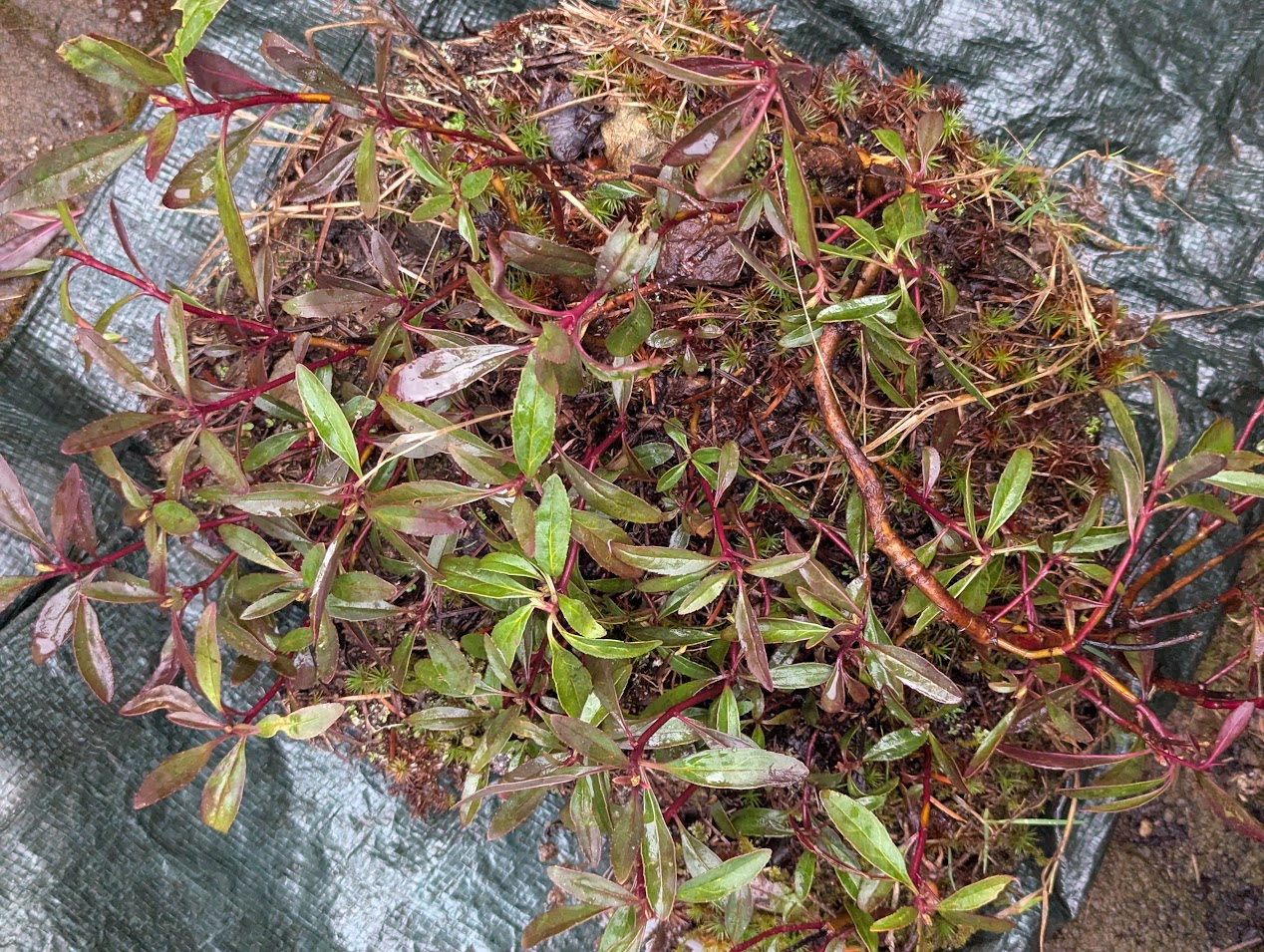
I have seen this for sale at garden shows. That factoid makes me laugh: fireweed is invasive. Once you have it in your yard, you will never get rid of it. I know: I planted it. And I ripped it out. It is pretty, I will grant you that. Alaska’s State flower (my daughter tells me that you can tell when winter is near because the fireweed quits blooming in Alaska). It blooms all summer. I found this survivor of the fireweed I killed nearly ten years ago (hahaha!) hiding behind the shed. And I am letting it go because it is better than English Ivy, black nightshade (Solanum americanum), and Himalayn blackberries – all of which we also have (only the nightshade is native).

California bay – umbelluria californica

The birds planted this. I fell in love with it. I trim it up and will allow it to grow, It is not the same as a Bay Laurel, but it smells the same and you can use the leaves the same. Pretty yellow flowers in the early spring. Easy keeper.

This is just the beginning of a blog post I have been mulling for quite some time: what native plants do we already have in our garden? It began as a small idea but I soon discovered I have more native plants than I previously thought – and some plants I thought were native are really “naturalized” introductions (foxglove, common mullein, ground or creeping juniper). It also grew with the photos ♥

Read Full Post »

      A quick post tonight: my right eye is beginning to itch, and I will have to give it a rest soon. With all this sunny unseasonably dry weather, pollen has been high. The kind of pollen I am allergic to, to be exact: some pollen doesn’t affect me at all. But let it be haying season somewhere up the Valley and my nose knows. Or when the cottonwood fluffs are in the air – my eyes swell shut.

I have been taking OTC meds, eye drops, and drinking herbal teas. I have been putting cool compresses on my eyes (I learned a cottonball soaked in milk on the closed eyes for ten minutes works wonders at stopping the itch. Conversely, used chamomile tea bags are hell on my eyes: my eyes are apparently allergic to chamomile tea leaves). I’ve been getting in some gardening in mornings and heading to bed early to rest my eyes, blow my nose, and check out mentally. ‘Tis the season to go through boxes of tissues AND carry a hanky around the garden, even after taking the prescribed dosage of “24-hour relief” antihistamines. More like 12 hours, if I’m lucky.

 Toss in the dog’s antics this past week, and life has truly been a riot.

Yes, he is wearing the Cone of Shame. On Easter Sunday he decided socks were a better treat than hard-boiled eggs hidden by a bunny. Two socks came right back up, covered in undigested dog food and bile. But he didn’t get better and by Tuesday we were headed to the vet and a huge surgery bill. The THIRD sock was stuck in Ruger’s gut and had to be carefully removed.

The Cone of Shame really is FOR SHAME. Bad Ruger.

Socks now must be placed as high as possible when not on the feet they were made for. Also tissue and toilet paper, but at least those don’t come back up or block the intestines: he merely poops those out.

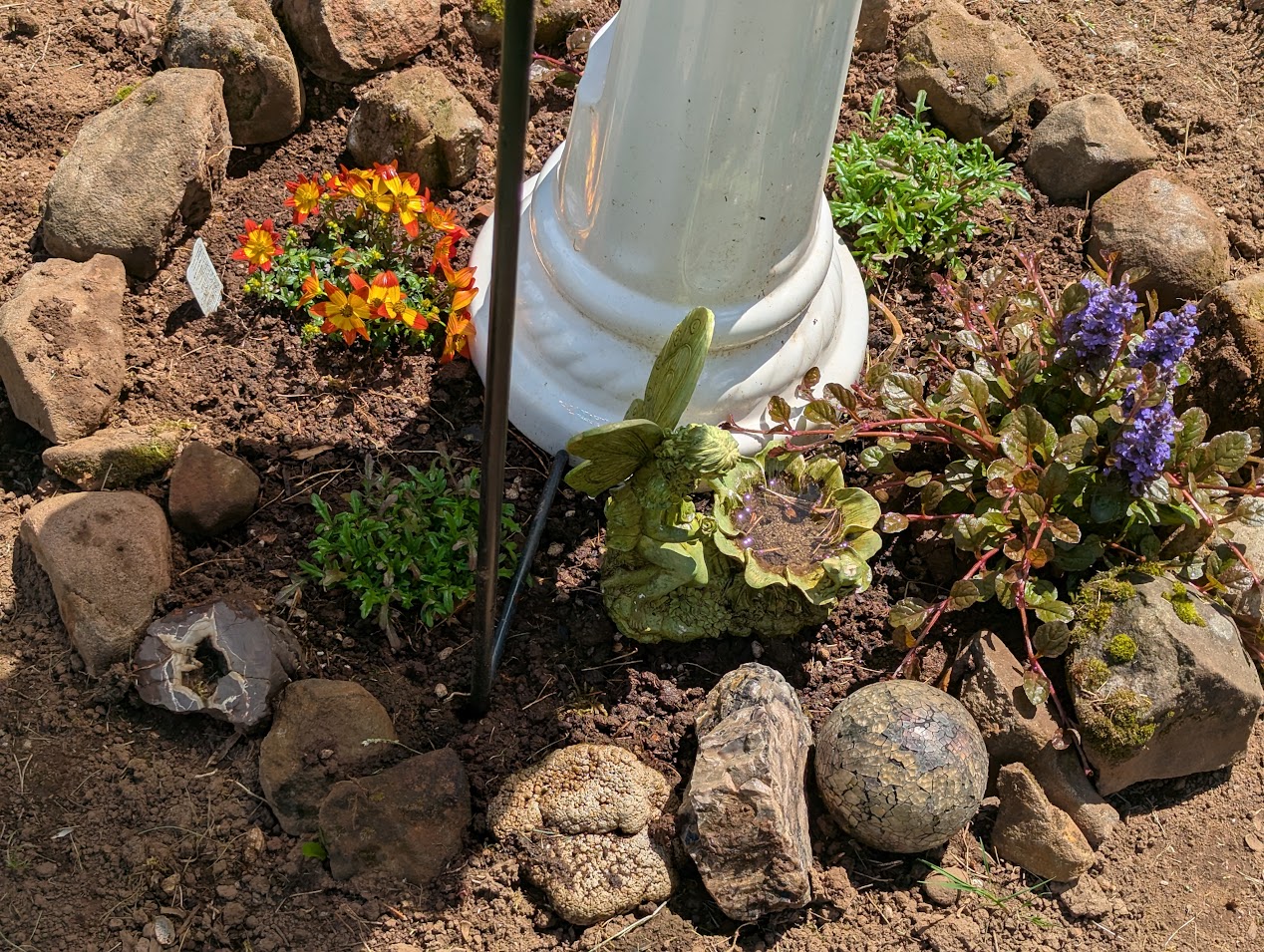
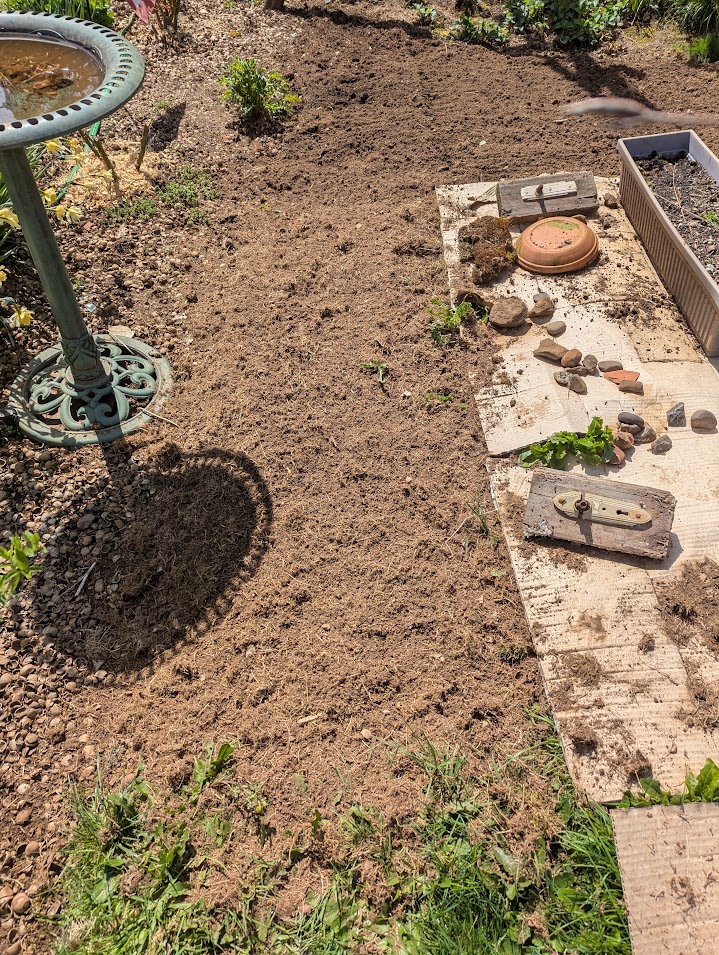
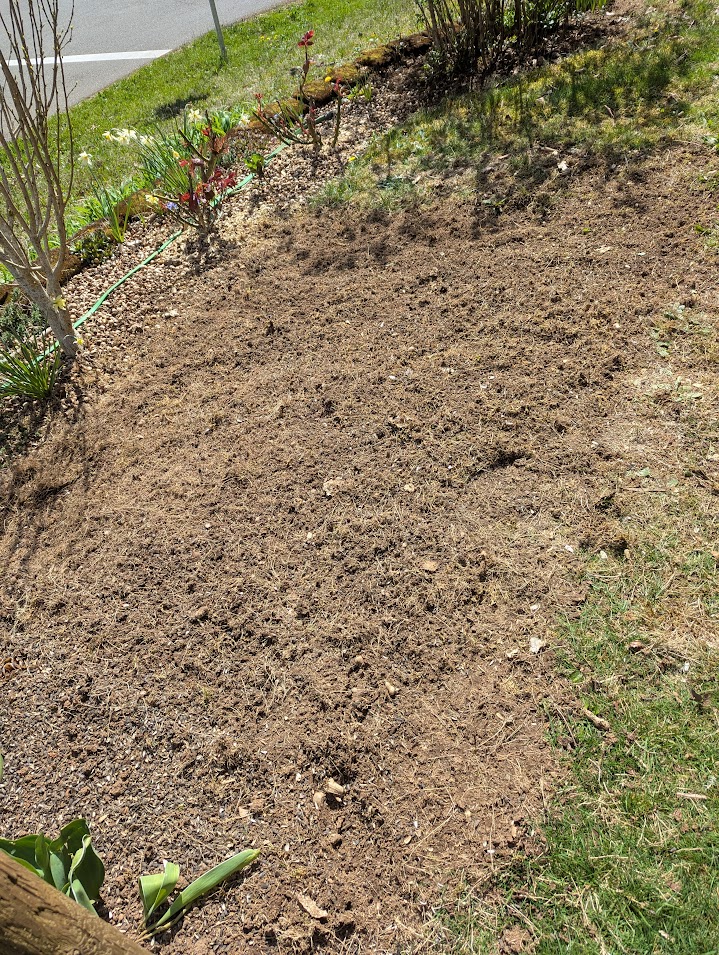
Still and all, I planted my herb plants out front. Spread some early seeds out as well (we’re pretty much past the last frost date – we hope). I need to edge my new beds. Plants need to grow a bit. The yard art is just what I do: I consider it “faerie gardening” and hope it entices some of those wee creatures along with the pollinators and birds. You never know.

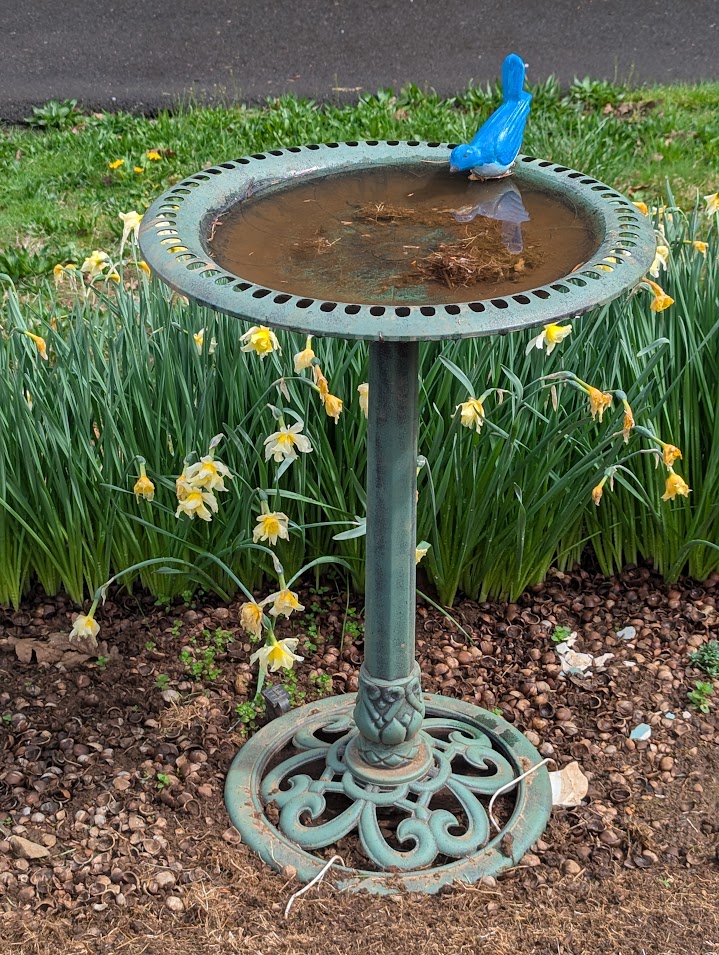
I found a third plant to put around the base of the pedestal birdbath: a tickseed (the yellow and red flower). A Bidens something – I’d never heard of this perennial, but I’m excited to add it to the base of the pedestal along with the bugleweed (ajuga) and my mystery plant.

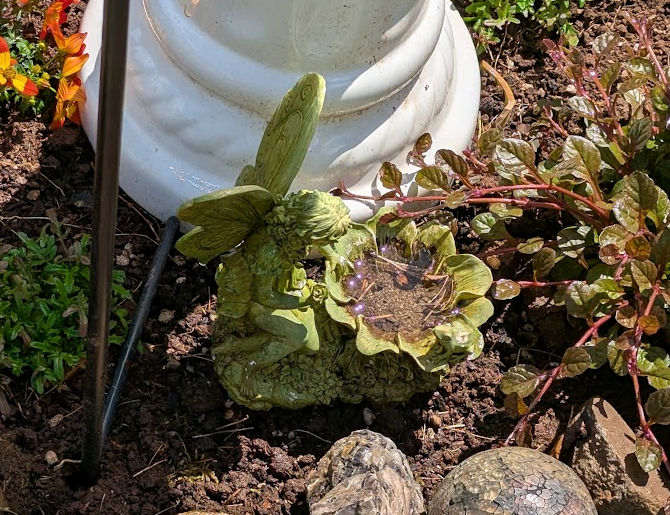
I love the faerie lights in the little garden statuette at the base. 😊

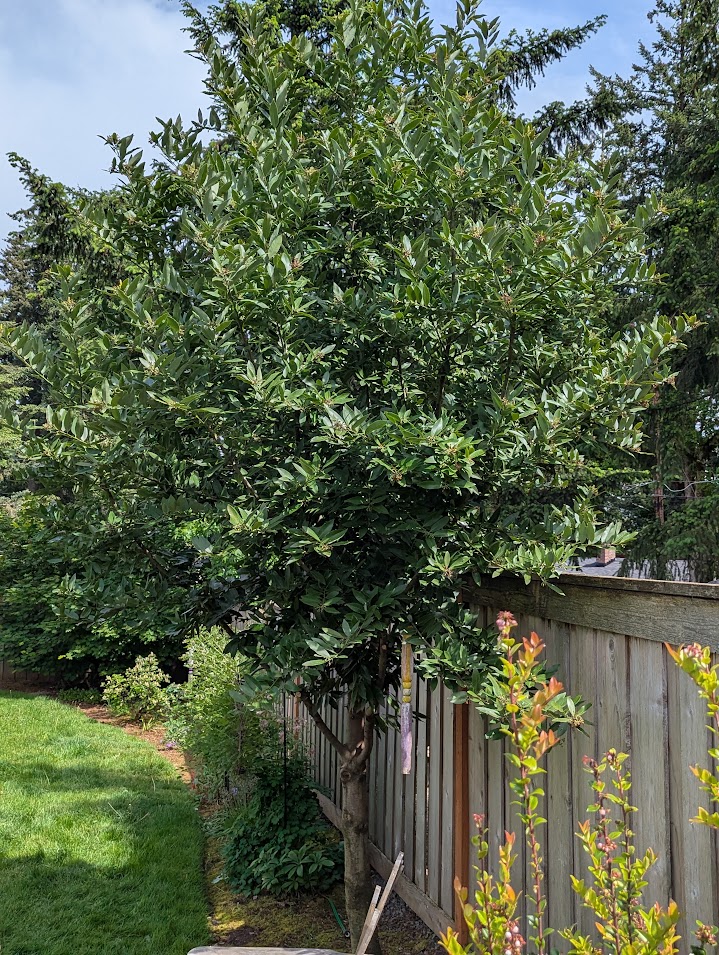
(Cover photo: my bottle bush (fothergilla) is looking very nice this year!)

Read Full Post »

It has already been two weeks since we went to the “biggest” early garden sale of the year. Where does time go, we ask. Well, we have had unusually DRY weather, and I have immersed myself in gardening, not writing. Then allergies hit and I am presently confined to the inside of the house, my eyes itching, my nose dripping, and my life a prisoner to tree pollen. I have no idea which trees: ash, alder, birch? Not evergreens: I can watch the yellow pollen coat the cars and everything in the yard with nary a sneeze. But these deciduous trees try to kill me. Every year.

There was no allergen in the air on the day we went to Garden Palooza. I carried my list of plants and set a budget. No annuals: it was still much too cold during the days and nights for me to fill my planters with my favorite annuals: petunias. Petunias are a nod to a woman who was very influential during my childhood (my best friend’s mother). This year will be especially poignant: Marie passed away at the age of 98. I love petunias because she grew them every year and they were beautiful and sunny.

I wanted Native plants and perennials and a good ground cover. Something to plant around that pedestal bird bath, something that would bloom throughout the summer. I had it in my mind to get a couple creeping phlox plants, but learned they only bloom in the springtime. Well, shoot. But I found something else that blooms all summer and snagged those up.

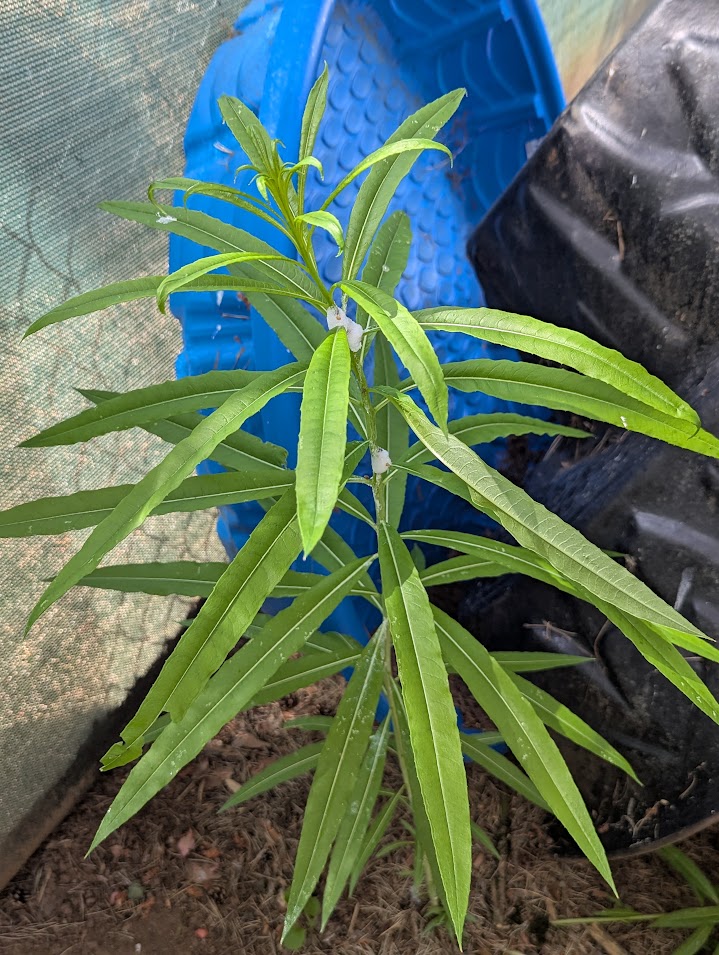
Problem is: the vendor pulled the identification tags out of the pots when he sold me two of them and now I have no idea WHAT I was buying!

I did find a Native plant nursery that had one of the plants I want, but the owner read through my list and told me he would have several plants on my wish list later in the season – just call and ask in a couple weeks. Woot! He sold me a clarkia: “Farewell to Spring”.

I grabbed a peppermint to put in a planted by the front door to discourage rats from hiding beneath the stairs. Most of our house has been “rat proofed” but there are a few points where they *might* get under the house and peppermint works as a great deterrent. I’ll just pot it (to keep it from getting away – it can be invasive) and place it by one of those points. Lovely scent as well.

Rue for out front in the bed I am preparing for an herb garden. I’ll also plant holy basil, hyssop, English thyme. More, but I haven’t given that much thought (yet – it’s early for seeds). The English thyme was another purchase: I have one in a planter, but it would be nice to have one in the ground as well. My live-in chef uses a lot of fresh thyme in his cooking. (My husband, folks, I’m nowhere near rich enough to pay for a chef. Gourmet cooking is his retirement hobby, and it keeps me overweight and sated.)

Another creeping thyme for planting between pavers out front. It’s a yellow thyme, very eye-catching, and – I hope – drought tolerant and prolific.

Last was the mystery plant.

I tried my plant app, but it wanted to identify the plant as arugula. It is NOT arugula. We have that growing wild and unkept throughout the vegetable garden beds. I’m not a huge fan of arugula, but the aforementioned chef loves it. He let it get away. I know what arugula is.

Google lens wanted to make it arugula as well. What the heck!? Why did that vendor take the tag out!? (Well, I know why: inventory, plain and simple. The other vendors used two tags in the pots and kept one but left the other for me. This particular vendor only had one tag per plant.) Dang-nab it!

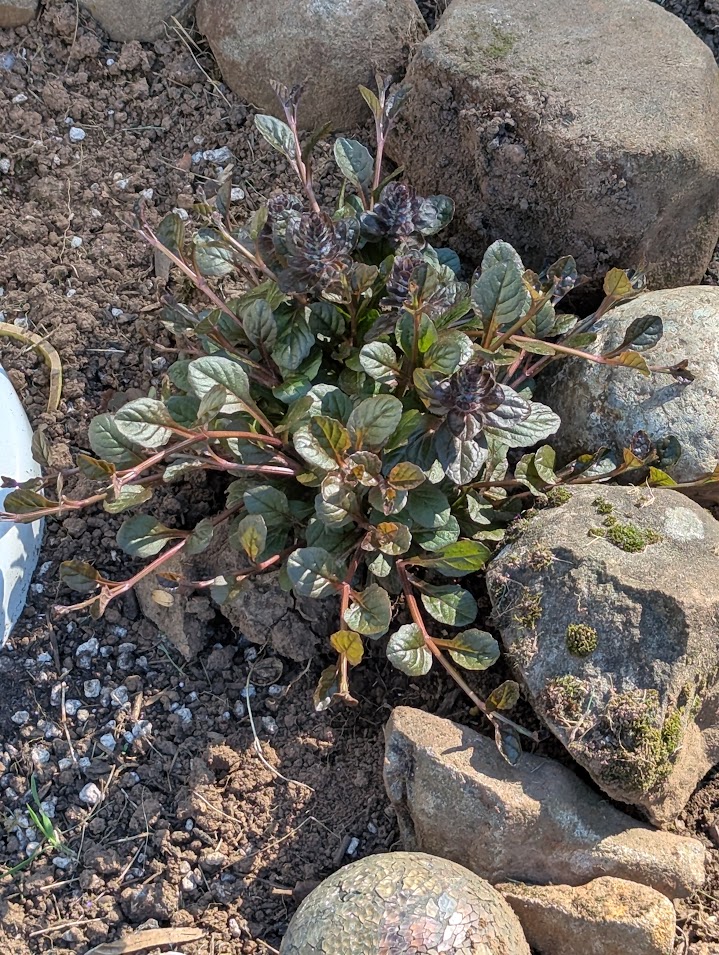
Soooooo – until it flowers, I have no idea what I purchased to put around the bird bath. In the meantime, I placed some bugleweed around it. I’ve been trying to get rid of the bugleweed since I planted it twenty years ago, but it returns every year in a new place. Might as well make use of it. It blooms early and has pretty purplish leaves. Whatever it was that I bought at the garden sale blooms late and has green leaves. Fingers crossed I can identify it sooner than later.

Oh, and I bought a few nasturtium starts. I prefer the trailing kind, but I had a weak moment and suddenly four starts were in the cart and paid for. Yummy nasturtiums. Pretty nasturtiums. I have since purchased seeds for the trailing kind so I can run them up trellises.

Also: I stayed under budget so I have more to spend later.

PS – yes, those are silk flowers. Some day I will explain those. Maybe.

Read Full Post »

Yesterday’s post ended in a pile of dog poop. It was a photo of one of our birdbaths where the crows like to rinse off the dog poop in search of undigested nuggets. Crows can be so fun (sarcasm font).

I started with just one bird bath in the yard many years ago, but the crows kept soaking dead baby birds in it. I started feeding the crows to keep them from raiding neighboring nests and depositing the fledglings in the bird bath – and that has worked quite well. But after I added the central one to the back yard last year, dog poop has become the primary crow issue.

I love crows… Until I don’t.

I have added several more bird baths over the years, some of which are no longer: ice and winter have a way of breaking up ceramics. The original bird bath was destroyed in a nasty winter storm. My husband purchased a new one for me the next Christmas.

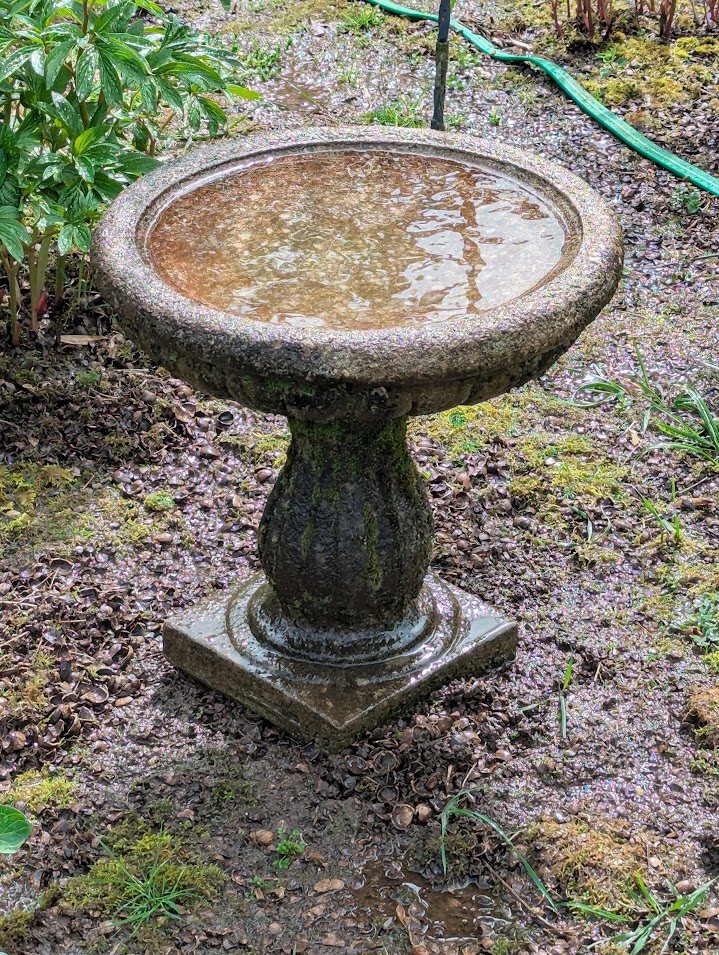
It’s concrete. The bowl surface is rough, giving small birds and insects a fighting chance if they get stuck in the deeper water. The small birds and wasps love it. I placed it in the backyard where the crows don’t use it. They don’t use it mostly because of its proximity to outdoor seating, an issue that the wee song birds don’t seem to have. And it has worked well. I need to clean it a few times in the summer and I ignore it through the winter.

Last year, I added this plastic monstrosity to the front yard. It is there specifically for crows. They put everything into the water before they eat it: peanuts, bread and hamburger buns that other people toss them, and things I probably do not want to think about. I have yet to find a fledgling bird in there but fried chicken… Oh, yes. I hose it out over the retaining wall and think no more about it: whatever is in it drops behind the wall of orange daylilies, out of sight – out of mind.

I have often perused the aisles of thrift stores for bowls or platters that are the right depth for bird baths. A lot of them don’t make it through the winter: ice is hell on porcelain and glass. And I forget to haul them inside for the season. I have a variety of plant stands (wrought iron) and plant hangers that I use to suspend the make-shift bird baths (and bee watering holes). And we have gone through a variety of cheap dishes.

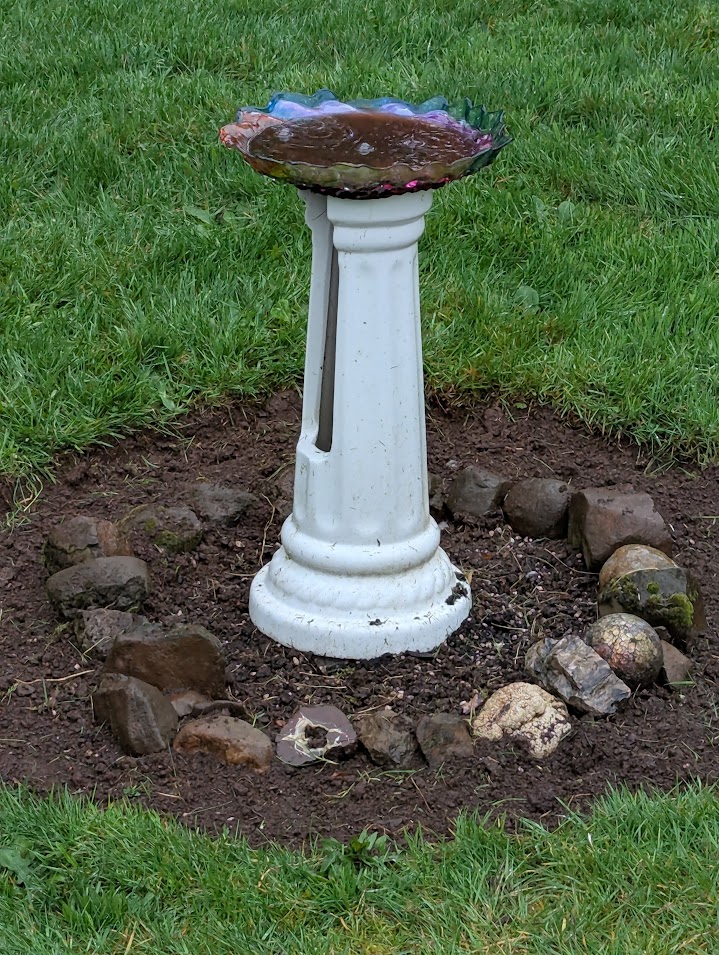
Last year, we remodeled our bathroom, and I grabbed the porcelain pedestal to our former sink. I spent some time thrifting until I found the “right” bowl to glue onto the porcelain (E6000 – the best crafter’s glue!). It lasted the season before the glue gave out and I hauled the bowl into the house for the season. The only caveat: dog poop, undigested peanuts, and crows. I’ll return to this eyesore in a moment.

A couple years ago, we hit a yard sale with plant hangers and more for sale. I got my Rose of Sharon there and four of these funky home-made plant hangers. The bush is doing quite well, but I discovered the plant handers are much too heavy for shepherd’s hooks when plants are added to the mix. But I had four of them and they are so cool. (Did I just date myself with that phrase? Probably. But they *are* “so cool”.)

Two became bird feeders. I wired a screen onto the first one. It’s easy to clean and the small birds love it. So do the squirrels, but that’s another issue I haven’t quite dealt with (yet). I converted one of those frames for hanging plants into a basket to hold the other bird feeder platform: an inverted aluminum canning lid sainted white and punctured with holes for the rain to soak through. The crows and squirrels occasionally knock this one off the hanger, but it works quite well otherwise.

I have found small platters or bowls to place on the other two that can be used by birds or bees as watering places. I only have one in use right now. The last is languishing in the shed waiting for inspiration or a new cheap porcelain bowl for the birds.

Somewhere in that timeline, we wandered through a town-wide antique fair and I came across a very unique hanger. The seller was offended that I wanted to use it for birds (“It’s a hanger for Aladdin lamps!” he protested). Yes, but it has no lamp, and you want more money than it is worth. We compromised on the price (I paid too much but it was the principle of the argument). $5 got me this hanger that I use for watering bees and wasps. Yes, I do need to clean the lower bowl, and the marbles contained therein, but its not like bees or wasps are thirsty right now. The guy selling it wanted $10 but he didn’t have a corresponding lamp to go with it and I know you probably can’t find one. At least not one you’d want to hang outside in the weather.

Which circles me around to the original subject: the birdbath I had to clean today. I mentioned to my husband that I needed a hose out to clean it, he thought I was whining, muttered something about “the hoses are on hose reels with wheels”, and proceeded to dig the hoses on wheels out of the shed for me. I did not mean he had to do it instantaneously and he forgets that a hose reel with a 100’ farm hose on it weighs more than I can easily move. So, we were both irritated with each other. Isn’t marriage fun?

Yes, yes it is. I’d sooner have a growling contest with someone I know will stay with me regardless than have to haul those heavy hose reels out on my own. In the rain.

Last night before I fell asleep, my brain hashed over the challenge of the crows. I came up with several non-viable ideas before I thought of this one: using one of those wire flowering basket hangers they sell at the supermarket laden with flowers. I was going to use this particular basket for something else (even purchased the coconut fiber liner) but… It looks nice and I’m hoping it goes a long way toward discouraging crows without making enemies of them – and keeping the integrity of the bird bath in place for the smaller birds that would like to use it.

This solution is To Be Determined.

Read Full Post »

Rain, rain, rain. Weeds, grass, plant sales. March and April are months when the sun comes out and warms the earth, then the rain comes down and soaks the ground. We still have frost some mornings and other days we can break out the shorts and t-shirts. I keep trying to find good subjects to write about.

A summary of my weeks:

The Native Plant “Sale” was not a plant sale. Tables of pamphlets and flyers from every conservation and forestry group within fifty miles, a few tables hawking garden tools, a lot of free evergreens (Noble fir and Douglas fir for the most part), and one single, lowly table with a few native plants that I have already dug up in the woods and started at home. Waste of time.

On dry days, I have argued with the different grasses, but the soil is saturated and weeding just isn’t productive.

Veteran gardeners in the area know that you don’t start setting out plants or sowing seeds until after Mother’s Day (a few cold crops are excepted but I’m not a vegetable gardener). It is far too muddy to rototill the veggie plot and make the beds, at least in our yard. We did get some pruning done, but I have already posted about that.

We had a three-day streak of lovely dry weather last week, but three days is not long enough for the saturated earth to dry out sufficiently for weeding or tilling. I did pull up cardboard from a couple areas in the hopes the ground would dry enough for me to try my nifty new electric hand tiller. It was not long enough. But I still tried.

The tiller works reasonably well on sod, but the mud clings to the tines and I had to stop three times, unplug the tiller, and clean out the tines for another go at it. The tiller tends to bounce along the surface, not really digging into the hard clay so I can see myself making several run throughs to get the ground broken up enough to plant. But where I’ve already done the work of removing the sod – oh, that tiller LOVES to dig.

Native bees are starting to come out of their hives: a field of mining bees in the neighbor’s yard was buzzing with happy bees in the sunshine and our paper wasps have returned for another year of building nests and pollinating flowers. We have even spotted a few tiny butterflies, too small and too quick to identify. I was attacked by thrips one afternoon (apparently, they like beer and human flesh). Hm. Will need to watch for plant damage from those pests!

The turkey vultures have returned. I love the turkey vultures. The bald eagles are sitting on a nest in the nearby wild park, but we see them soaring on thermals on nicer days. The crows are rebuilding a nest across the street. And three pairs of small songbirds have scoped out the little birdhouse under the grape arbor!

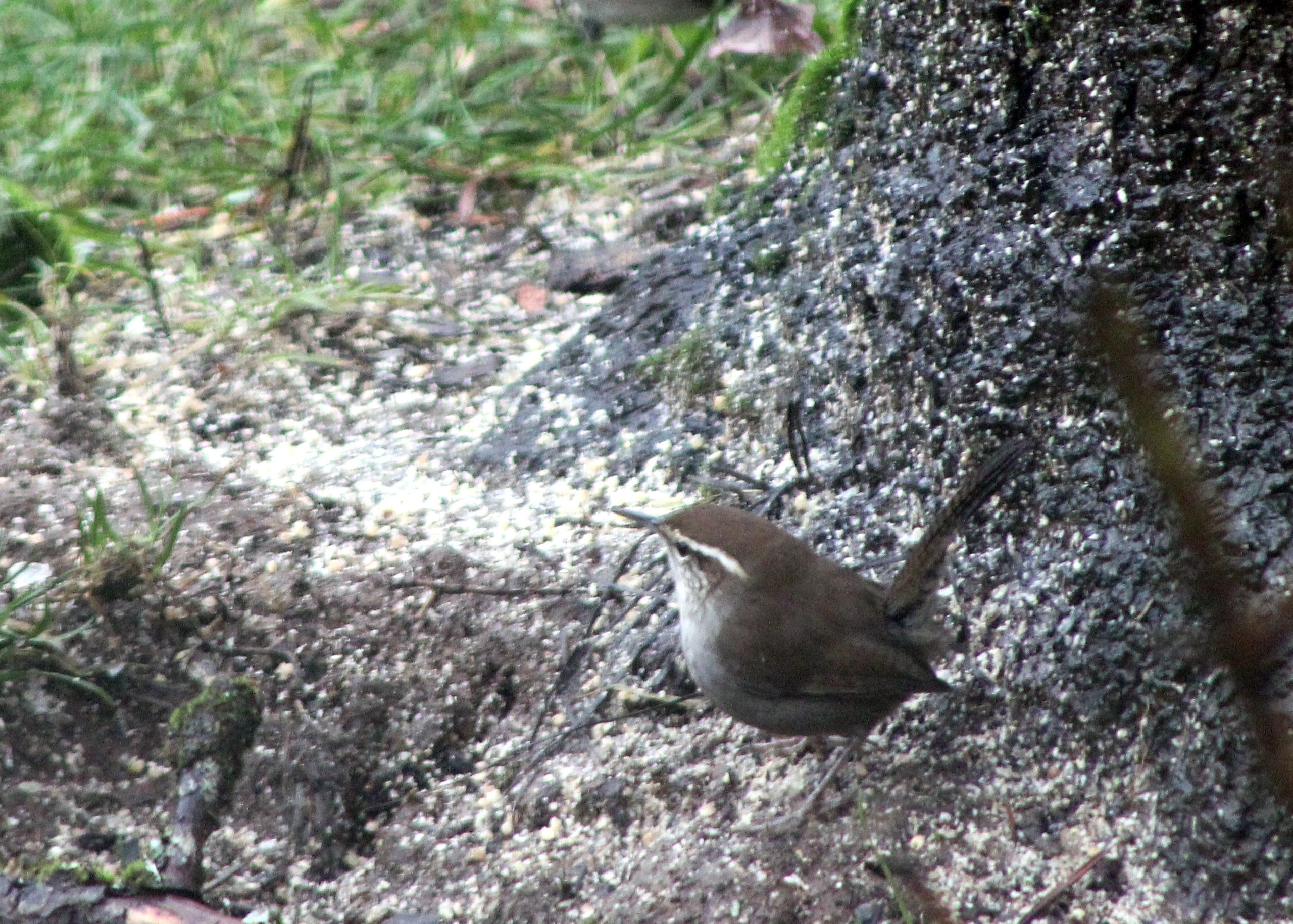
We’ve seen white-breasted nuthatches look at it, and yesterday the chestnut-backed chickadees tried to claim it (the black-capped chickadees raised a brood in it a few years ago – photo on the right is from then). But the Bewick’s wrens (photo on the left) have first dibs this year! When the chickadees used it, they didn’t bother with a nest or any filler: those little eggs and hatchlings grew up on the hard wood floor. But Bewicks have carried grass, stems of last year’s goldenrod, and feathers into the little house until the lip of the nest is even with the little hole on the side.

I don’t think the birdhouse is actually meant for birds, just for backyard decoration. There’s no hinge to lift for easy cleaning in the fall, for one thing. We’ll have to completely dismantle it this fall in order to clean out the nest debris. But we love that it gets used and now I think I need to find a couple more similar sized bird houses for the nuthatches and chickadees!

Finally, we have a huge plant sale coming up the end of this week, and this one really IS a plant sale: “Garden Palooza” out at Bauman’s Farm. We go every year and every year we find unique plants to add to the garden as well as the few annuals I like to grow (petunias and nasturtiums). They aren’t very strong on native plants, but I would like to find some creeping phlox and some “walkable” ground covers to grow between pavers. I have some more room for sempervivums in my rock garden as well.

Last, because it was nice out, I glued to decorative bowl back onto the porcelain pedestal for a pretty bird bath. The crows found it as soon as it filled with water and they immediately picked up peanut-laced dog poop to wash in it. As I have no hoses out yet, the water remains gross and smelly.

I love crows…Until I don’t.

Read Full Post »

Older Posts »