163 years ago, my great-great uncles were marching to the Atlantic Ocean with General Sherman. I really do want to record their service in the Union Army, but the season has moved from Winter to Spring, and I am spending MY days in the garden in my own yard pulling weeds,
Willard, Wilber, John, and Thomas were penning letters home in July of 1863. Telling of victories, illnesses, and losses. Wilber and John would not return home. Willard and Thomas would return home broken men.
I have found it too difficult to follow the letters home that I have in my collection, some from the brothers and some from the in-laws (Barnards, Miranda Wilcox married into the family). The war was gruesome, terrible, unrelenting, and it took a heavy toll on the men and women who lived through it.
I may pick this thread up again when the weather turns once again, but for now I am finished with the American Civil War. God rest my ancestors.
Battery A, 1st Chicago Light Artillery was stationed at Camp Smith, two miles from Cairo for five months.
Camp Smith, June 11, 1861
The furniture of our tents consist of a soap box apiece to put our clothes in, some wooden stools to sit on when we eat, and a board table. We have a stand in our tent to write on. We made the stool, table, and stand ourselves. We have to put all our things but all the boxes out of our tent when we sleep. The first meal we had in Cairo was a passanle (sic) breakfast. At dinner they gave us some beef that needed better teeth than I have; hard bread. Cold potatoes without washing; river water without filtering.
Willard J. Wilcox
Passanle – passable, I would guess.
Sept. 6 Battery A was moved to Paducah where it remained until Feb. 4, 1862. Moved to Ft Heiman and participated in the battle of Ft Donelson, Feb 14 and 15, 1862, and the battle of Shiloh, April 6 and 7, 1862. Then moved to Corinth and from there to Memphis, reaching Memphis June 17, 1862.
BATTLE OF FT. DONELSON.
Battery A was with Thayer’s Brigade.
Feb. 13,1862. Skirmishing; Feb. 24, repulse of Union gunboats; Feb. 16, rebel assault on Union forces; Feb. 16, fort surrenders.
“At night amid snow and sleet, with no tents, shelter nor fire, and many with no blankets, the hungry exhausted troops on both sides lay down in ditches and behind logs and tried to sleep. Many of the Wounded froze.”
“In the battle of the 15th, during the rebel assault, McClermand’s (sic) forces were driven back, an officer shouted, “We are all cut to pieces.”
“An order was dispatched to bring Battery A forward at full speed. Col. John A. Thayer, commanding the Brigade, formed it on the double quick into line. The battery came up on the run, and swung across the road, which had been left open for it. Hardly had it unlimbered before the enemy appeared, and firing began.”
“The new front thus formed covered the retiring regiments, helpless from lack of ammunition. The enemy coming up the road and through the shrubs and trees on both sides of it, making the battery and the 1st Nebraska the point of attach (sic). They met this storm, no man flinching, and their fire was terrible. To say they did well, is not enough – their conduct was splendid. They, alone, repelled the charge. Too much praise cannot be given Lieut. Wood and his company and Lieut. McCord and his regiment.”
-Report of General Lew Wallace.
April 1st, 1862
“The 8th Missouri and 11th Indiana regiments did not like it because we had to leave their division, but the 9th Illinois was pleased to have us in their brigade.” W.J. Wilcox
*I have left the punctuation as written.
General McClernand had not properly secured his flanks. And his men were driven back almost two miles.
I am transcribing this from a 40-page typewritten photocopied document that was among my father’s research. I do not know the veracity of it all nor do I know how many posts the series will take up. What is in italics is what I transcribed. My notes are not in italics.
In 1861 the war began. Four of her (Sarah Lord Wilox’s) sons enlisted; only two came back, one of the two shattered in health from a long imprisonment.
Sarah Wilcox died October 2nd, 1883.
Immediately after the firing on Ft. Sumpter (sic), came President Lincoln’s first call for troops. Wilbur I. Wilcox was at this time teaching. Willard J. Wilcox was engaged in making brooms. They immediately dropped their employment, and enlisted in the first company and first regiment that left Illinois for three months’ service – Co. A, 1st Regiment, Chicago Light Artillery. Willard was then 26, Wilber, 24 years of age. Saturday they went to Chicago and enlisted; Sunday they were journeying toward Cairo. They returned home on a furlough at the expiration of their enlistment, but re-enlisted for three years, or during the war, before returning home. After a few days at home they started again for Cairo and rejoined their battery.
Cairo (Kay-ro), Illinois, was where U.S. Grant based his operations out of.
Willard fell from a caisson in Dec. 1861. As soon as (he) was able to travel after this injury, he visited his mother, remaining with her until after the marriage of his sister Mary on Jan. 1, 1862.
Before his furlough had expired he was recalled to his company. He was with the company which moved from Cairo, Jan. 10, 1862, on a reconnoisance (sic) into Kentucky, returning Jan 22nd. At the battle of Shiloh, Willard and Wilber were both wounded. Willard carried a minie ball* in his head the remained of his life in consequence of this injury.
During the advance on Corinth, Willard and others were sent out after horses, at which time Willard was again wounded, receiving six buckshot wounds in the shoulder, and back of the head.
The Battle of Shiloh was a Union victory at heavy cost. It was one of the bloodiest battles in the war with nearly 24,000 casualties. My brain can’t fathom that number! Corinth is a short distance from Shiloh, across the border in Mississippi, and was a Confederate stronghold.
Wilber was Sergeant when killed July 22, 1863. (Vicksburg?)
Willard re-enlisted in the veteran corps after three years’ service. He received four hundred dollars and a 30-days’ furlough. He was sergeant when mustered out in July, 1865.
Thomas Wilcox enlisted Aug. 11, 1862. He joined Co. A Chicago Light Artillery at Memphis. He was taken prisoner at the battle of Atlanta, July 22, 1864. He was released at the close of the war.
John Wilcox enlisted Sept. 4, 1862, 1st Sergeant Co. K, 88th Ill. Infantry/ He was killed at the battle of Chickamauga, Sept 20, 1863. He is buried with the unknown dead at Chattanooga.
Unknown Civil War Dead Chatanooga (credit: Pixabay – giselaFotografie)
Daniel E. Barnard enlisted Sept. 4, 1862, Capatin Co. K, 88th Ill, Infantry; mustered out at the close of the war.
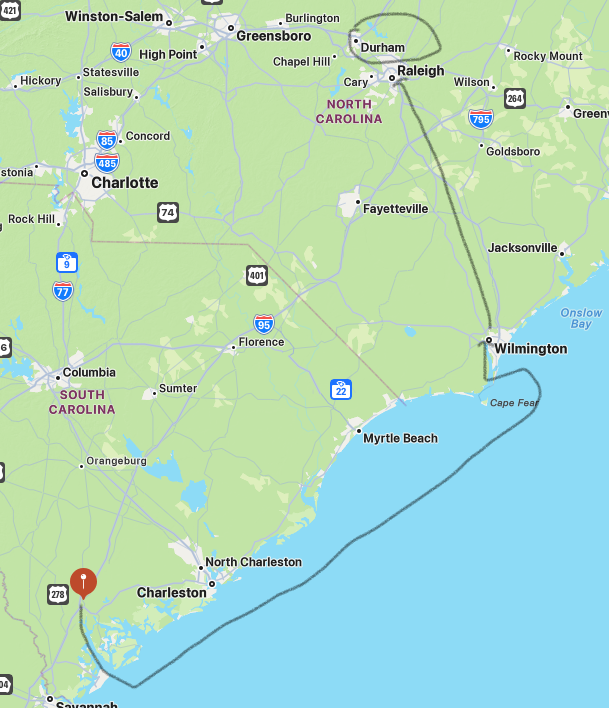
Erastus A. Barnard was drafted Sept 27, 1864; assigned to Co. H, 30th Infantry; mustered out June 4, 1865. He marched with Sherman’s army to the sea.
E.A. Barnard was taken ill during the march to Savannah. He remained with the army until Savannah was entered. He was in the hospital there from Dec. 24, 1864 to April 1, 1865. Thence he went to Pocotaligo; from there by boat to Wilmington; then marched to Raleigh and joined his regiment the day before Johnston surrendered.
General Joseph E. Johnston surrendered to General Sherman at Bennett’s Place, Durham’s Station, N.C., in April of 1865.
Erastus A. Barnard married Mary L. Wilcox. Daniel E. Barnard was his brother.
William Orson Wilcox (my ancestor) did not serve. I do not know why except, perhaps, he was left in charge of Sarah and his brother’s respective families.
*The Minié ball, or Minie ball, is a type of hollow-based. Invented in 1849 shortly followed by the Minié rifle, the Minié ball was used in the American Civil War where it was found to inflict significantly more serious wounds than earlier round musket balls. (Source: Wikipedia)
I have some typed family history notes written by Alice Barnard.
Alice gives her relationship in her “Sketch of … Three generations”. She was the daughter of Miranda Wilcox, sister of William Orson Wilcox. Miranda and William Orson were among the seven children of William Wilcox and Sarah Lord.
Captain Thomas Wilcox and Abigail Shipman begin the narrative, although the author (Alice) is unsure is he served in the American Revolution or not I have more digging to do there, but I will sort it out. Eventually. I do know, by Alice’s account, that his heart gave out and Abigail died of consumption, having smoked most of her life. Alice write of how her mother, Miranda, would like Abigail’s pipe in her dotage. Thomas and Abigail were the parents of William who was the father of Miranda and William Orson.
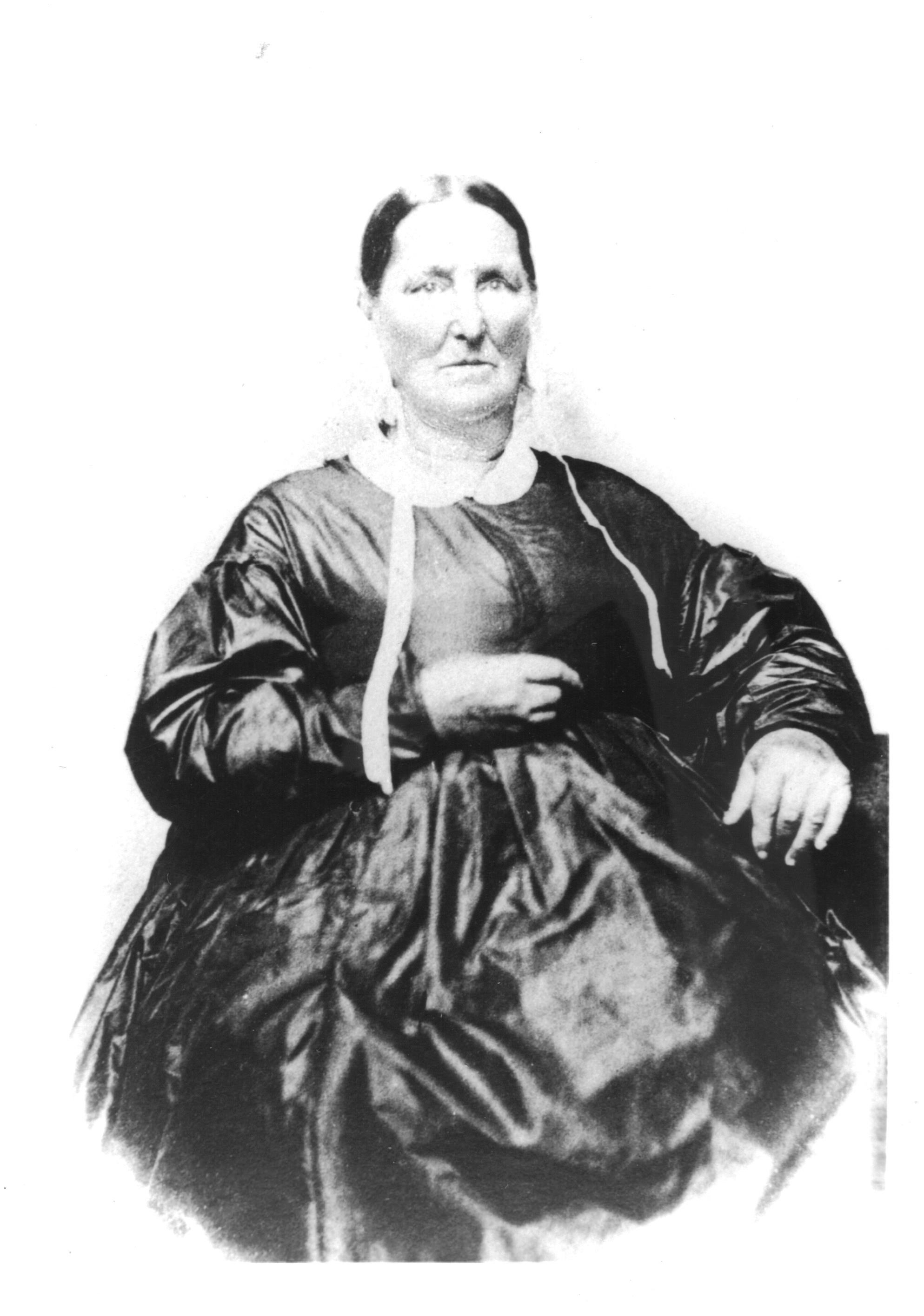
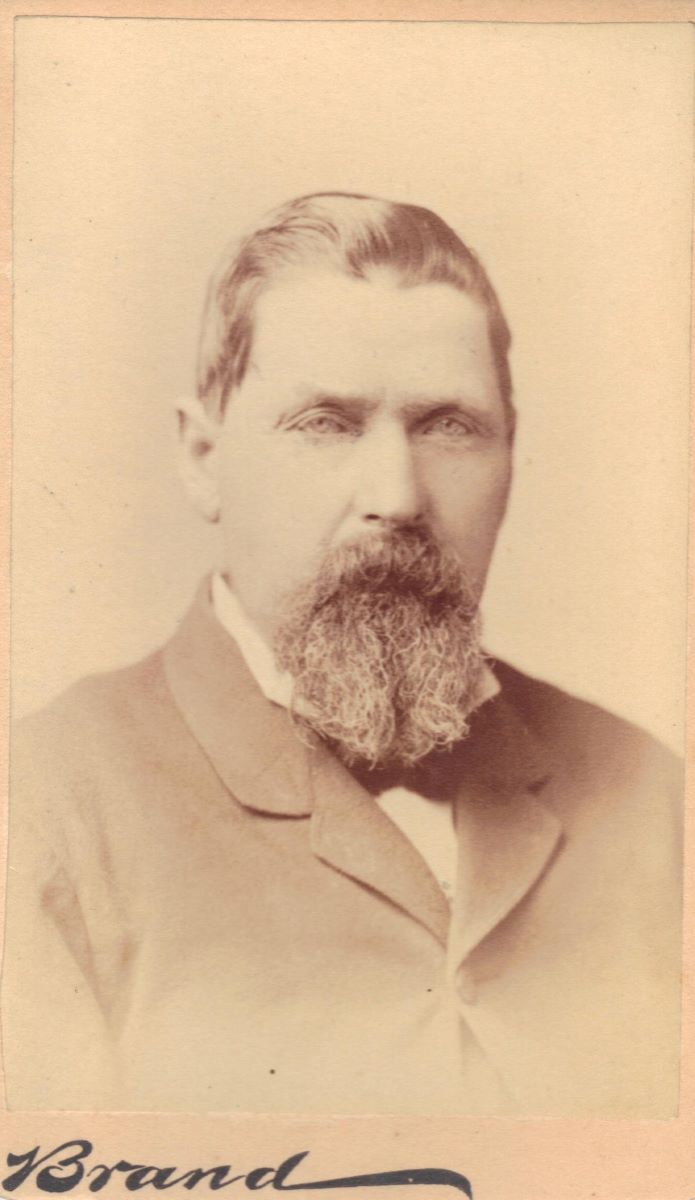
William emigrated from the East Coast to Illinois by wagon in 1844. His wife, Sarah, was an accomplished weaver. Sadly, William died within the year, leaving Sarah to raise seven children in a new territory with no friends or relatives. She must have done a stellar job because her photograph has been passed down generations and she’s always listed in the family tree as Sarah Lord.
William and Sarah’s children were: John, Jerusha, Thomas, Miranda, William Orson, Willard, Wilbur. And Mary L. Someone like the name “Will”… a lot!
Alice wrote her “sketch” in 1929 at the age of 75, so some of her memories were dim. She did not marry, so I have no cousins along her line, but she had siblings: William Wilcox Barnard, Emma Barnard (m. George Graham), and Mary E. Barnard (m. Edward G. Howe). Alice’s father was William Barnard (1821-1900). Alice’s Aunt Mary Wilcox married Erastus A. Barnard but their only listed descendant, Amy, died at the age of 20 in 1888.
Sarah Lord
Most of Alice’s memories center around Sarah Lord Wilcox. Sarah was one of many children but was apparently raised by her childless aunt, along with a brother, Levy. When her husband died, she lost nearly everything to his brother, Willard. She then took in boarders while her sons hunted for sustenance. They also kept sheep and farmed. Sarah had a stroke at the age of 65 but lived another 20 years.
Alice was my second cousin once removed: my great-grandfather’s first cousin. The paper I have (a copy) was in a letter to my great grandfather, John T. Wilcox, son of William Orson.
Here we are, less than 24 hours from a massive rain storm and I am writing about sprinklers. It’s not like we’ll need them for the next eight to ten months as all the water will be coming from the skies. Well, tomorrow they say it might be coming in sideways with gusts up to 60MPH (that’s 96+ KPH for my friends who use the metric system, or 52+ knots per hour if you speak nautical). It’s going to be gusty and very, very, very wet.
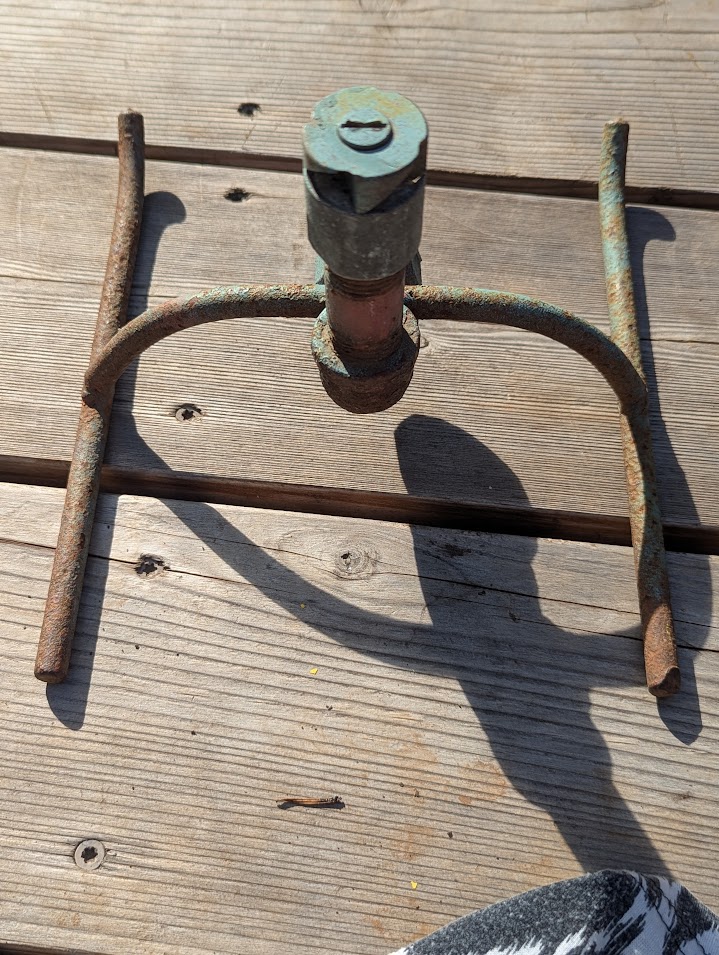
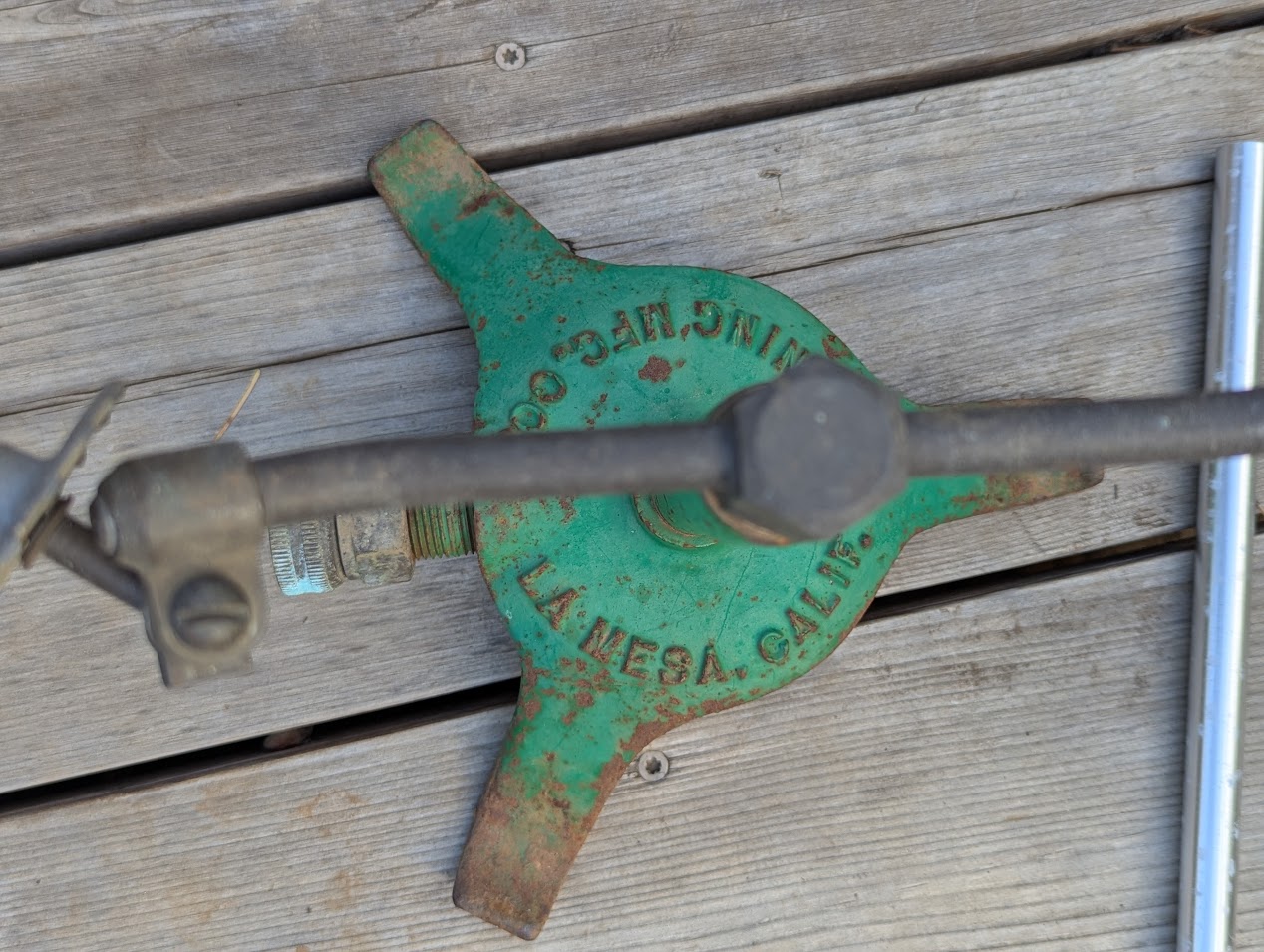
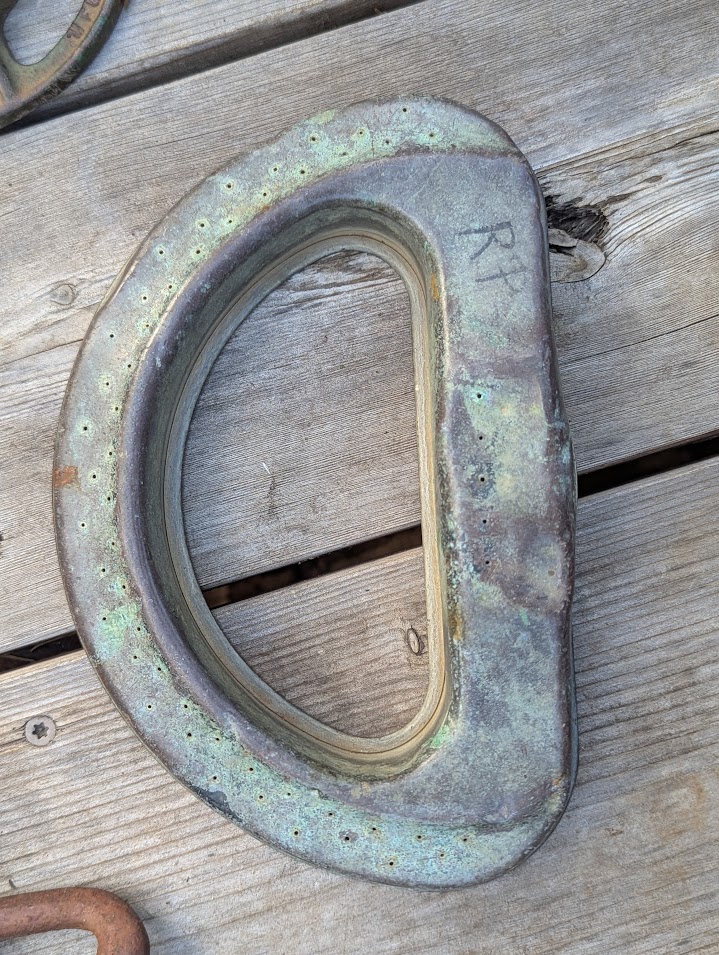
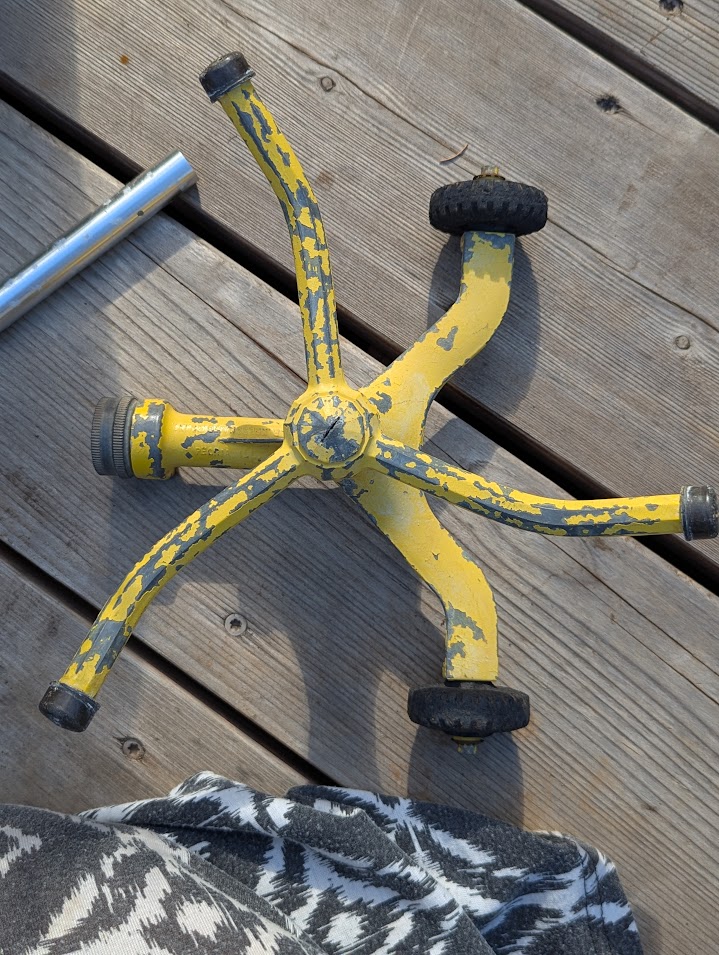
We collect vintage sprinklers. One of those is homemade – can you identify it?
They aren’t worth a lot according to Google Lens, but some of them (and they aren’t all shown here) are worth a little bit of money. I doubt we paid more than $5 for any one of these and some were outright freebies. As to whether or not they work… Well, some better than others.
Those are the ones that don’t work well. Bad design, just old, or they don’t work in the space I have. The one on the top row that is heart shaped can be found on eBay or Etsy selling for around $65.
Nope, doesn’t work. Homemade, just didn’t make the cut.
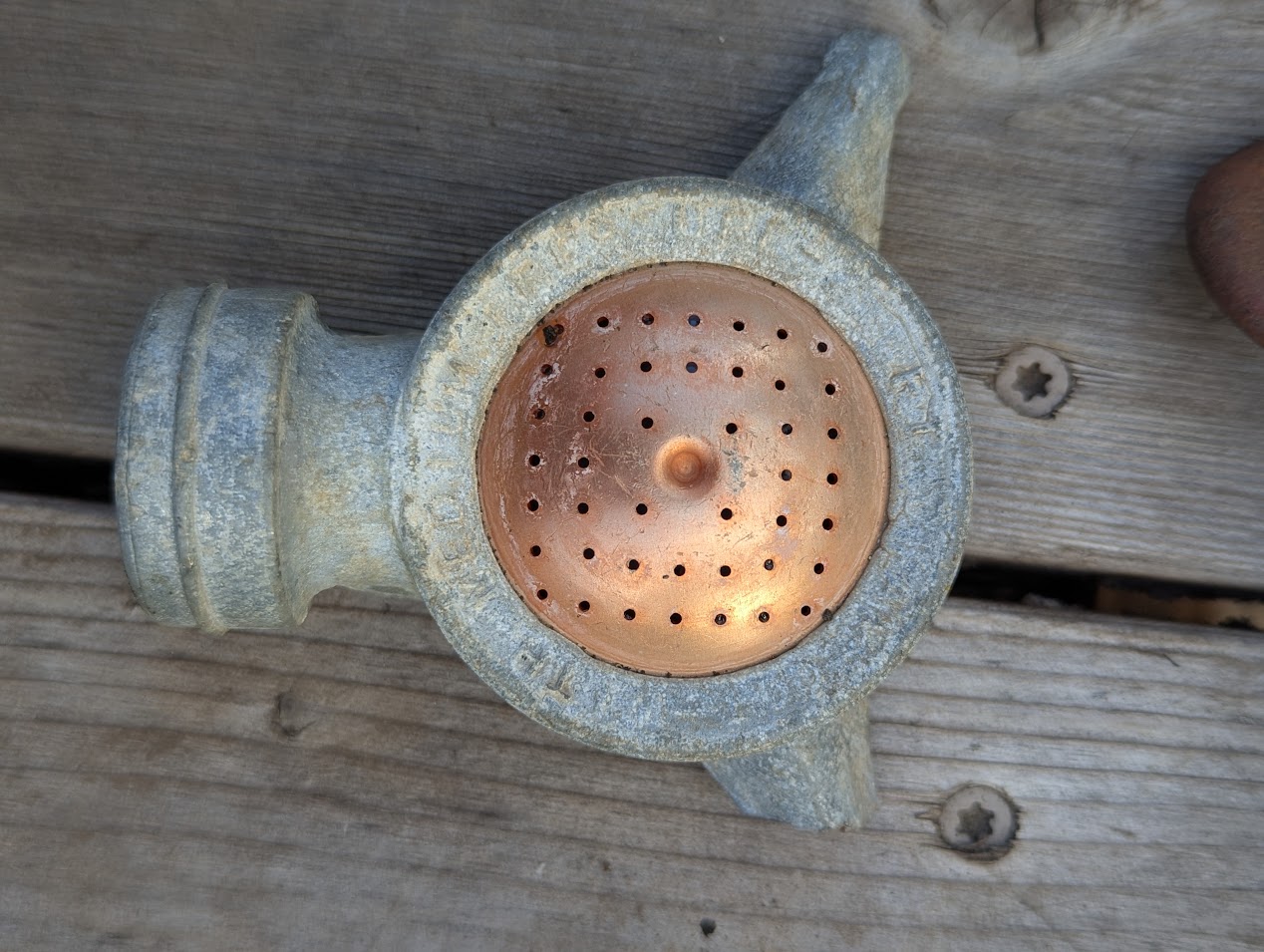
These are some of the best sprinklers we have. The green one (top left) sells for around $30, center top row for about $20, the older yellow (top right) for around $10 (and it work so-so). The yellow one on the bottom row is one of my favorites and I found it selling for $20. The owl-eye sprinkler works in small spaces and I found it for around $30. The pot metal with brass center works quite well but it pretty much worthless as a resale item, plus I broke one of the points.
These are the last three. I never use them. Modern technology has given us better hand sprinklers although modern technology has given us spray wands that break easily and dies after a couple years of use. The two on the outside of this trio still work and will work for years to come. The red one might be worth $10 – $15.
The middle item is the most interesting to me. You may have already noticed it is not a sprinkler, but is a siphon. A heavy duty brass siphon that sells for around $30. I think I paid $0.50.
There you have it: our sprinkler collection (sans the all metal yellow oscillating sprinkler which was probably in use when I was busy taking these photos).
4 ounces fresh leaves and flowers. ½ tsp crushed anise seed and 3 crushed cardamom seeds. 2 ½ cups of water. Put all that together and simmer 20 minutes, then run through a fine filter until all you have is the flavored water. Over a low heat, dissolve 2 cups white sugar and 1 ½ cups brown sugar in the liquid. Boil over medium heat until “a drop in cold water forms a hard ball” (read below for my notes). Pour immediately into a well-oiled pan to cool. Score when partially cooled.
I decided to try making candy. I used to make it when I was younger and lived in a drier climate but that fell by the wayside along with my desire to become an herbalist when we moved to the Willamette Valley. Candy requires low humidity or it fails. I won’t go into all the weather around here: it rains in the Willamette Valley nine months out of twelve. We don’t get the most rain or the most humidity, but the days when I wanted to make candy were usually too humid. So I just didn’t bother.
Besides, you need a really good sense of when “a drop in cold water forms a hard ball” stage is reached. I don’t have that so I rely on thermometers when – and IF – I decide to make candy.
I love to make candy. I’ve made a killer penuche and I’m no mean hand at making divinity, or I was when we lived in dry country, and I frequently made candy. I even made a great horehound candy once. That was BC (Before Children) and Before the Willamette Valley, so a Very Long Time Ago. I’m ancient, you know.
I grew horehound this year with the intent of repeating that long ago success. It grew, blossomed, and I trimmed it back using a recipe I found in an herbal remedies book (the original recipe having been lost in multitude moves over the decades).
It failed. But I will try again! Below are my errors and the recipe, should you wish to try your hand at this.
4 ounces fresh leaves and flowers.
I trimmed back the horehound as far as I dared. With stems, I only procured 3.5 ounces. Well, it should still work.
½ tsp crushed anise seed and 3 crushed cardamom seeds. Don’t have either, but I can substitute nutmeg and cinnamon to taste.
2 ½ cups of water. Put all that together and simmer 20 minutes, then run through a fine filter until all you have is the flavored water. Over a low heat, dissolve 2 cups white sugar and 1 ½ cups brown sugar in the liquid. Boil over medium heat until “a drop in cold water forms a hard ball” or approximately 252° F (according to Betty Crocker). Pour iimmediately into a well oiled pan to cool. Score when partially cooled.
NOTE: The candy is a bit too soft. I should have used the Interwebs instead of a dated Betty Crocker and the candy should be cooked to Hard Crack stage, or 300° F (149° C). That’s a minor mistake. The candy is still usable and storable (use wax paper). But I would prefer a harder candy.
It is also a bit bitter. Let’s be honest: lot bitter, really. It might be OK if you have a bad sore throat and a linger cough, but… It’s not Ricola™ by any means. It would probably be less astringent if I had not used the stems. I’m pretty certain the stems ruined it.
The substitution of cinnamon and nutmeg was a negligible factor, but I think the next time I try this recipe (and there will be a next time), I will use the cardamom and anise seeds.
Tiny pinks on long stems. This mallow started life in out garden as a tiny free specimen. I put it in a planter and it thrived. Moved it into the ground and it nearly died. It is in a large planter, soil mixed with sand, and it is happy once again. It is a bee favorite & common on the Coast.
stinging nettle – urtica dioica
I hope you know what plant that is without the ID below it: run into this without enough clothes on and you’ll wish you had never met it. I crawled into it once when I was a child. Nettle stings all over my face! Fortunately, the damage is never serious and the sting can be dealt with (in my case, I probably smeared mud all over my face. I was a clever child – HA!). I started growing it for the medicinal benefits of nettle tea. It is in a pot so it doesn’t escape into the yard and I deadhead the flowers before they produce seeds: this is all the nettle I need in my yard. Harvest with care: garden gloves, long sleeves. I dry the leaves in the dehydrator instead of hanging them to dry. I’ve read you can cook the leaves as a spinach substitute (I’m not fond of cooked spinach except on pizza). The leaves lose their sting when dry. I mix the leaves with feverfew and yarrow for a green tea that I can drink without sweetener.
Nettle may lower your blood pressure, help with blood sugar, hay fever, reduce inflammation, and help with enlarged prostate, and contains antioxidants and many vitamins. (I may write more on nettle in another post on herbs in the future.)
I love irises! These are my wild native irises (I have “domestic” irises as well). The first two iridacea shown love moist soil and are planted in a little shady swale next to the south fence of our yard along with the camassia. I need to divide the flag iris this fall. The Douglas iris is more like its commercial counterparts: dry soil is fine. They love sunshine. The blooms are larger than the flag iris but still delicate.
wild camas – camassia quamish
Wild camas (which is related to asparagus) is a beloved forage plant for the Indigenous peoples of the PNW. I loves marshy areas. I have not tried eating it: I have too few of the plants to forage just yet.
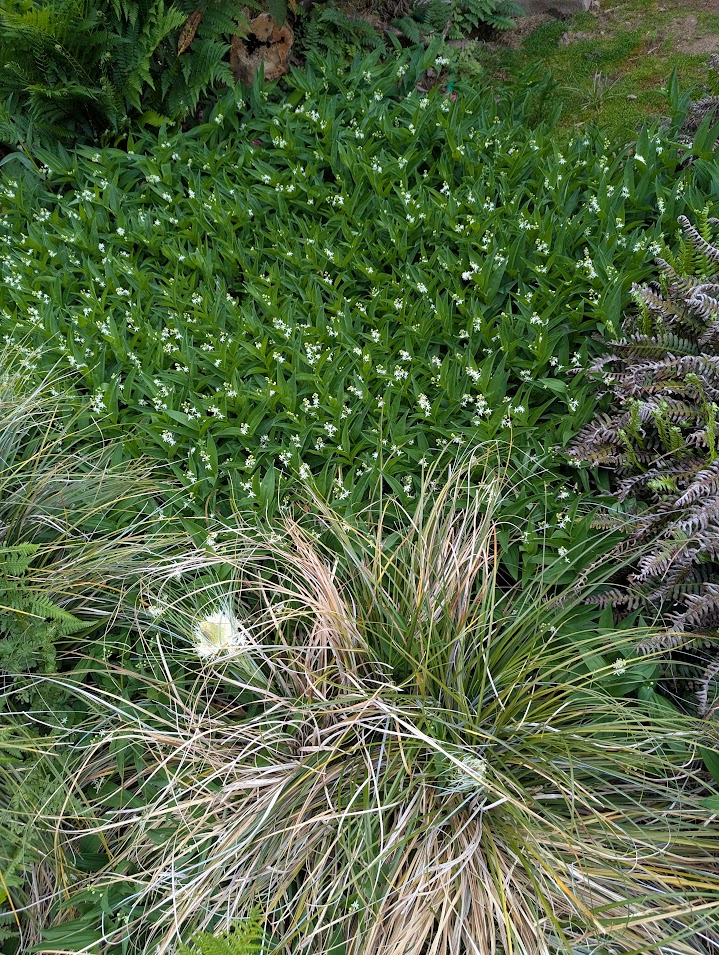
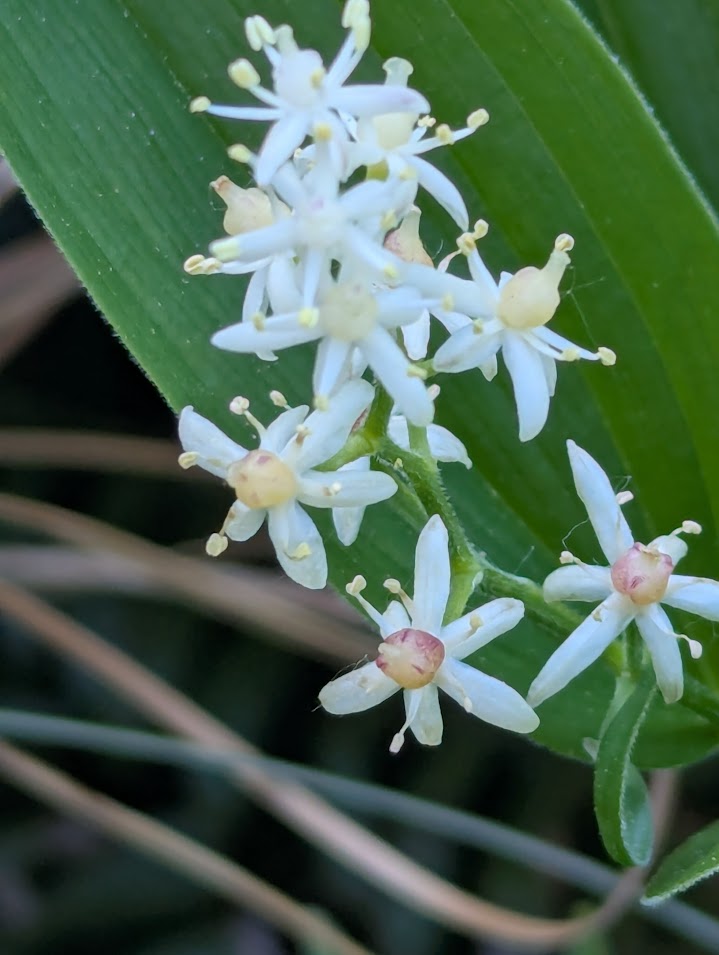
false Solom0n’s Seal (m. stellatum) & bear grass (xerophyllum tenax)bear grass – xeropyllum tenaxfalse Solomon’s seal – m. stellatum
My husband brought me a gift of bear grass one year along with the deer ferns. Falso Solomon’s seal hitched a ride. My bear grass has never failed to bloom: the spikes tower above the heavy leaves. I think one of my plants is showing its age and beginning to die out, but it produced three beautiful spikes of flowers this year. And the false Solomon’s seal never disappoints, but it is gone by summer and the ground bare where it flourished in the wet of spring.
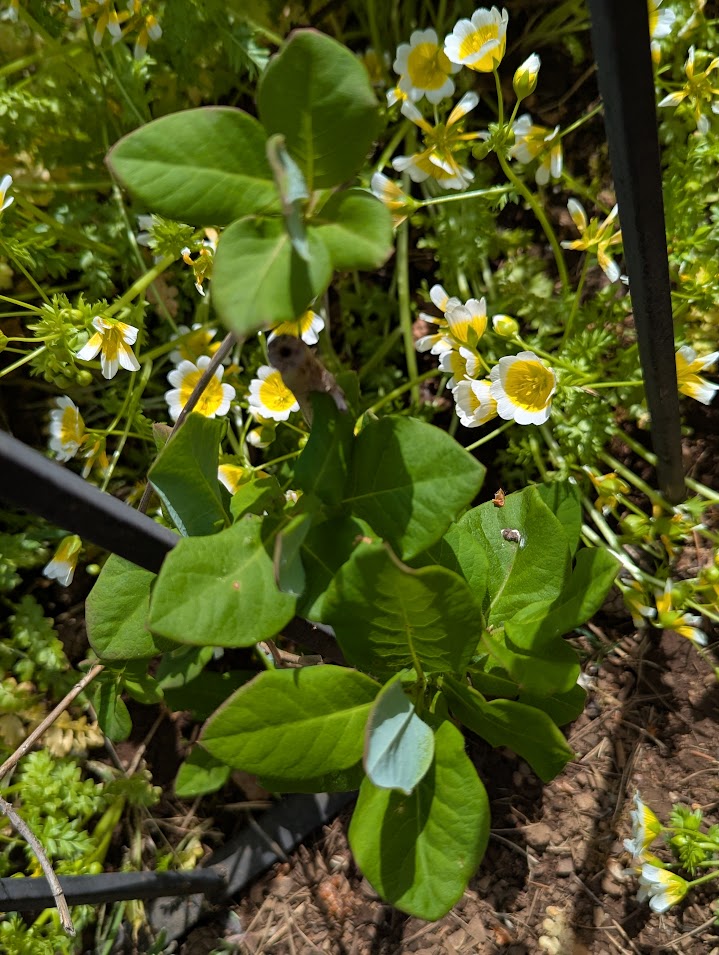
This beautiful ground cover was also a hitch hiker. I think it came with the yew and maple (long gone now). It spreads quickly, covers the ground beautifully, and attracts every bee, bee fly, and wasp. It greens up in the Autumn, overwinters green, and blooms in the spring – and then it is gone. The ground bare.
I have not tried too many other plants mixed in with the false Solomon’s seal to cover the bare spot in summer, but I have tried where the meadowfoam is. And meadowfoam does not like to be shaded out during the dormant stage! The bare spots in the photo are where i removed plants that shaded out the meadowfoam and it died back. However… it seems to love peonies and grows profusely around them despite the shade of summer, so I may try putting a couple peonies in there.
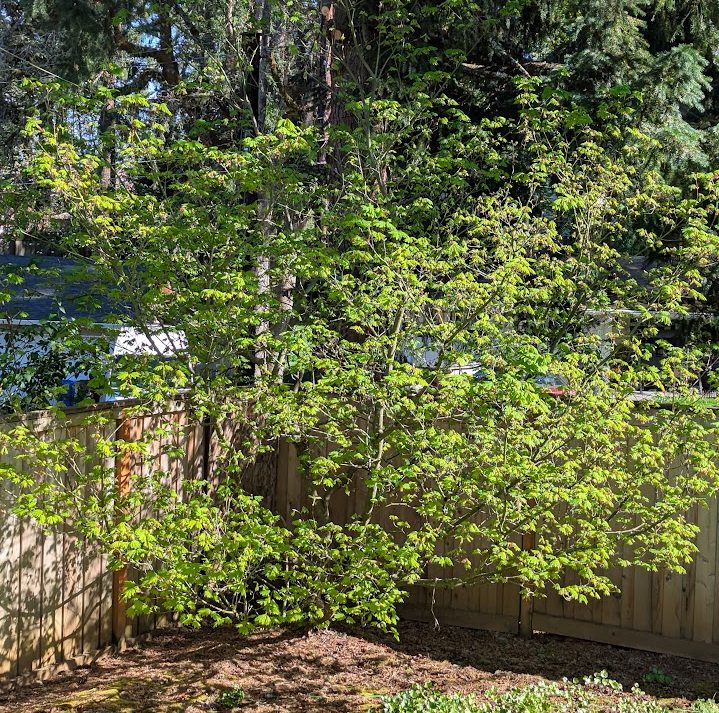
vine maple – acer circinatum
Don dug this out of a bar pit one year. he intended to make it into a Bonsai tree, but vane maple grows too quickly and he had to put it into the ground. It is as large as it is ever going to get. The leaves turn brilliant red in the autumn. The squirrels love the helicopter seeds. Very little grows under it but I am hoping some huechera (coral bells) will take off.
narrowleaf milkweed – asclepias fascicularis
Milkweed. I could write a blog post on this, the last of my Natives to show off. I planted it by seed: two kinds of native milkweeds, the showy (pink flowers) and a few of the narrowleaf. They didn’t grow. Well, to heck with that idea, right? I could purchase some starts but it just never seemed to happen. And four years after I tossed those seeds in the garden, I had a thick stem poking out of the ground. Suspicious, I broke a leaf off and watched as it oozed thick milky sap. Eureka! It only took four years for those seeds to grow! And grow they did: I now have to fight the plants to keep them contained in the corner of garden where I planted them: milkweed spreads by runners underground.
Bees, flies, butterflies (but never Monarchs – so far), and milkweed beetles love the plants. Invasive as the plant is, it grows well in the little corner of yard where it is, sharing space with peonies, asters, Voodoo lilies, and grape hyacinth. The hyacinth blooms first, then the peonies, followed by the voodoo lily. The milkweed rises up and blooms, fades and dies, and the asters bloom. A perfect full summer garden of bloom.
That is it for my native plants! My next posts will be about herbs in the garden, uses, recipes, and cautions. I’m excited for those posts!
One small plant Don dug up in the forest has turned into a spreading clump of wild ginger ground cover. It is nestled beneath the forsythia, one of the rhododendrons, and a sword fern. I don’t think there is any use for it (I could be wrong, but it is not the same thing as the ginger root used in cooking – that’s from Asia). It does smell the same!
bunchberry – cornus canadensis
We just purchased this. I’ve tried to grow bunchberry several times and failed miserably, but this time I hope to succeed! Planted in a shady place with lots of rotten wood to latch onto. It has pretty white flowers like a Dogwood tree, but is a wild ground cover.
California poppy – escholzia californica
It is not blooming yet. But I have quite a little collection of this – one of my favorite roadside wildflowers. My husband is not a fan, but what does he know?
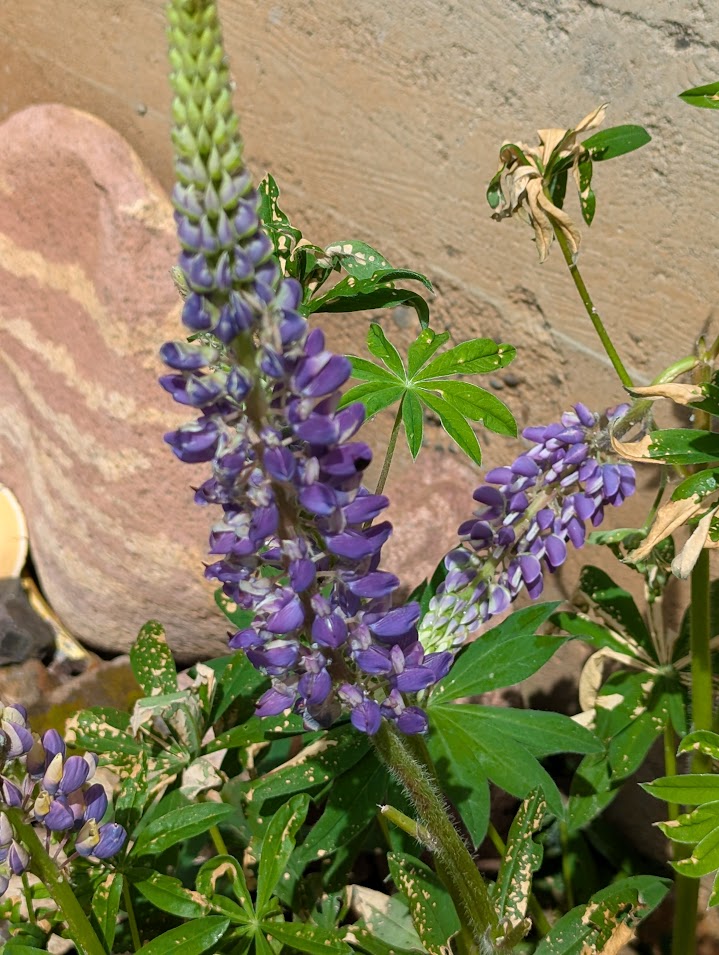
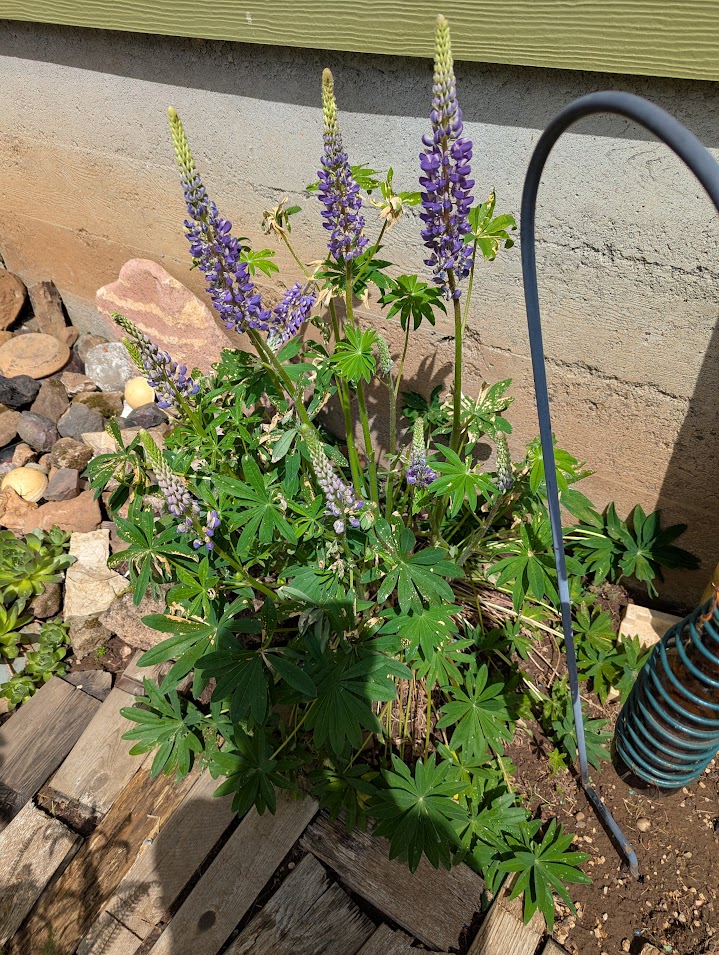
I can’t swear to the identification. It came in the same wildflower seed packet as the California poppy, and was just labeled “lupine”. Lupines are among my favorite wildflowers, and there are so many varieties! Unfortunately, it was infested with white aphids earlier and I sprayed it with an herbal concoction that burned the leaves (dang!). A better solution was to spray the nasty things off with a small stream of water. I keep checking and they have not re-infested, so… Here’s hoping. I have several of these throughout the yard as well.
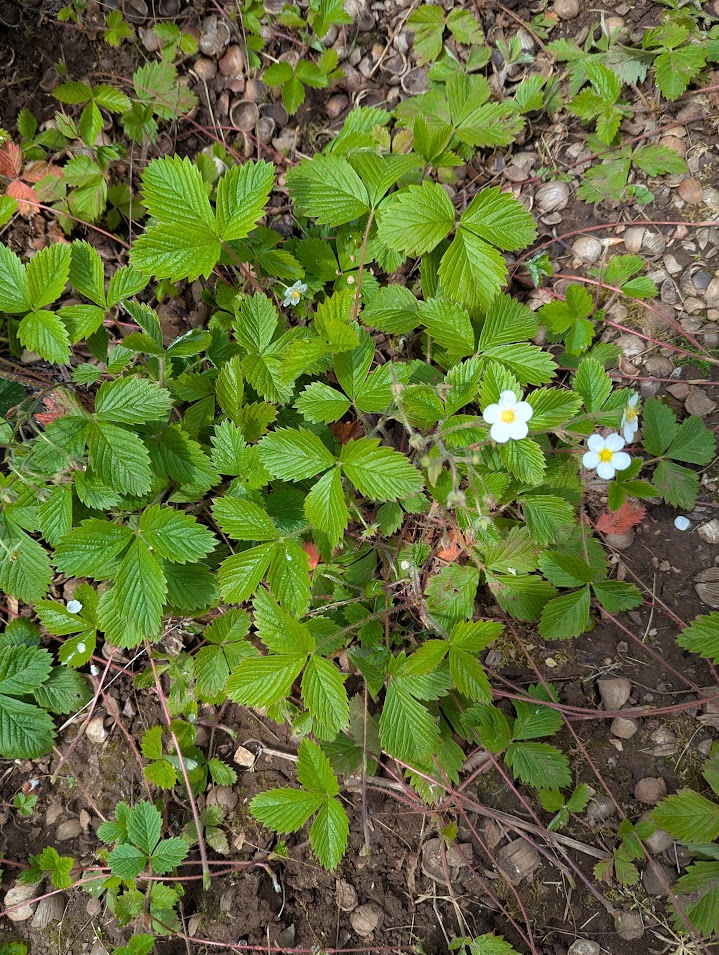
woodland strawberry (Fragaria vesca)
Another little ground cover that has exceeded! Don brought this home and I was dubious because of how quickly it spreads, but it hasn’t crowded out anything and sometimes there are actual tiny berries on it.
pearly everlasting – anaphalis margaritacea
I wish I had a photo of this in bloom! This makes a great dried flower in the fall with its tiny white flowers with yellow centers. It spreads through rhizomes and I have to be careful weeding out the insidious grass that entangles it in the winter and spring. But when it blooms, the flowers are well worth it.
Columbia Plateau Pricklypear – Opunta columbiana
This one is a bit of a stray. I have moved it several times, trying to find the right spot for it to thrive – and maybe bloom! Those long thorns are nasty little suckers! We dug this baby out of the roadside between Arlington and Hermiston, Oregon, on the Columbia Plateau. It is planted in sand, in a well-draining planter. I moved it to its present location (very carefully!) a year ago, and it seems very happy here. Whether or not it will ever bloom is a question: we might get too much rain for it to be that happy,
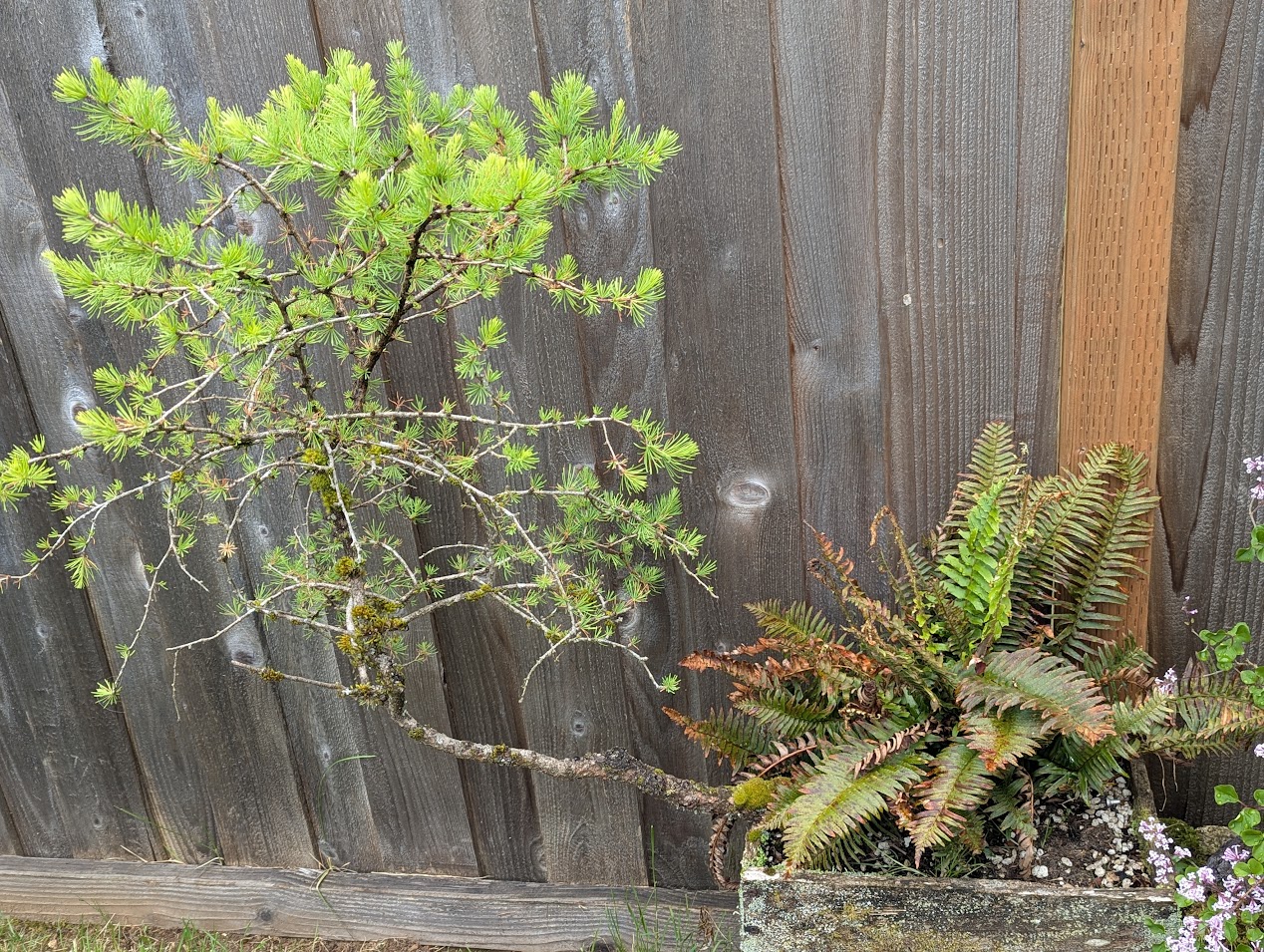
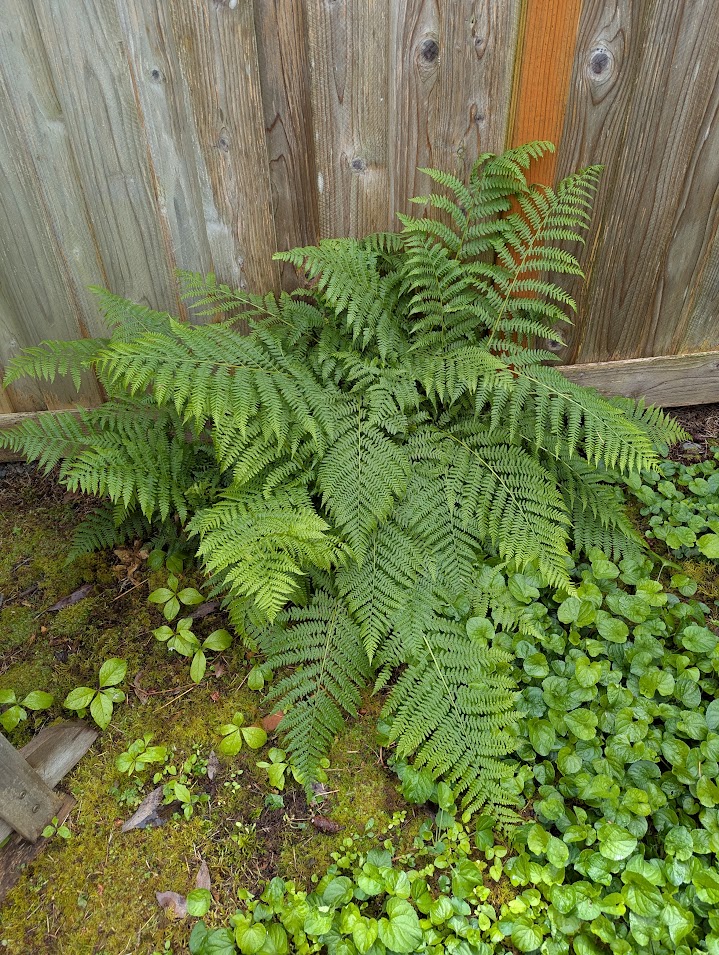
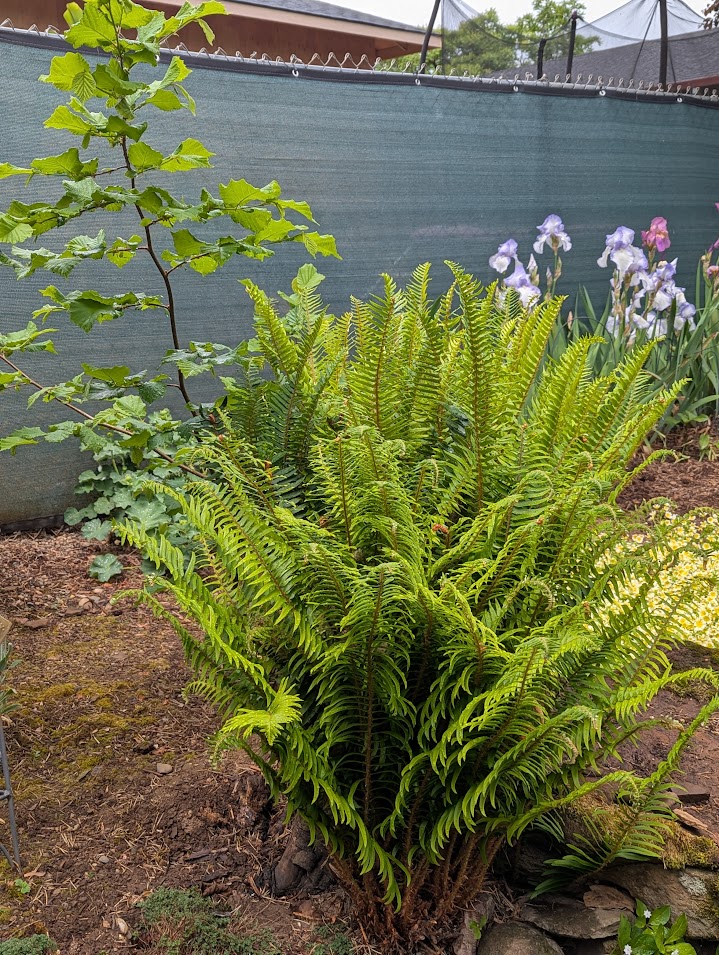
Western larch ( larix occidentalis) & Western sword fern (polystich munitum)Lady fern – athryzim fillx-feminadeer fern – blechnum spicanthazelnut (corlyus cornuta) & Western sword fern (polystichum munitum)
I don’t think you can have a yard or garden in Western Oregon without having to fend off the Western Sword fern! It can grow quite large. I have several that came with the house and I am slowly moving some of the off-spring to the north side of the garage where we have a rather inaccesible 3′ set back. It was lawn, but who wants to mow a lawn you can’t get to easily? Ferns are an easy answer: they grow naturally in this part of the world, they fill in the space, and don’t need extra watering! They can be ignored.
The Lady fern came from a single plant my husband brought home. It dies back completely every fall and comes back even bigger every spring. The deer fern is just an interesting border plant, also something my husband dragged home for me to adopt. I think I helped him with that one. ;P
And the western larch (known colloquially as a Tamarack) is just one of those Bonsai trees Don dug up in the middle of a USFS road and made into a Bonsai. I added it to this gallery because of the fern in the pot: how easily the Western sword fern attaches itself!
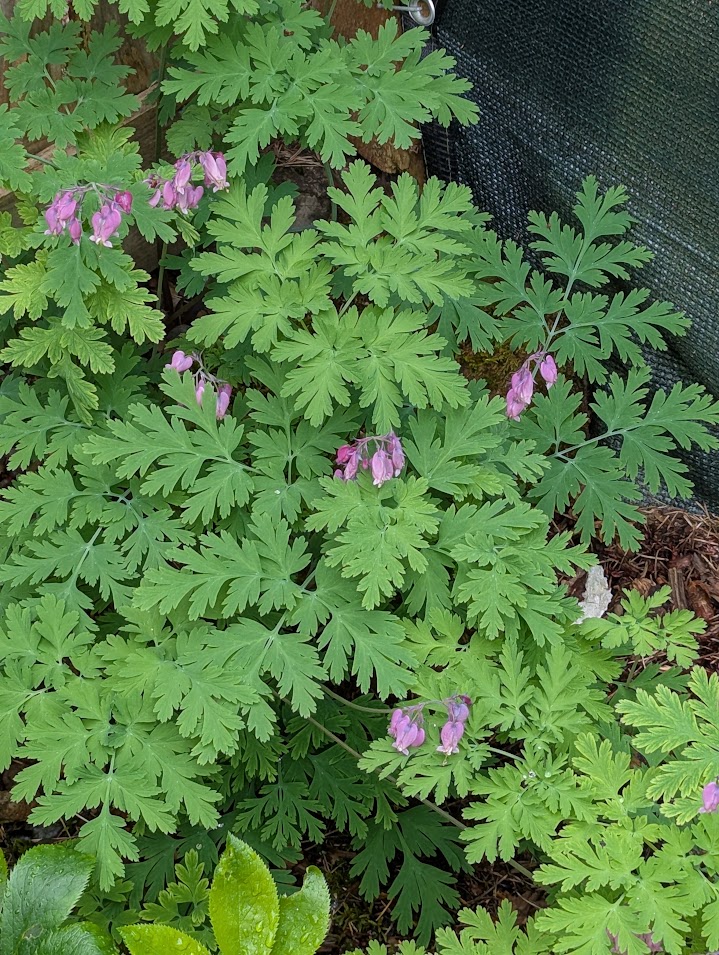
Pacific bleeding hearts – dicenta formosa
Where ferns grow, Pacific bleeding hearts grow. They spread via rhizomes and they spread profusely. Some may even refer to them as weeds. I rip them out enthusiastically when they grow into areas where I don’t want them. They look best in late winter and early summer, then the heat comes and they fade quickly: wild bleeding hearts like the moist, cool, shade of the Western half of Oregon. And I happen to like them better than their commercial cousins with the larger and more colorful blooms.
Blue elderberry – sambuca nigra subsp. cerulea
It is easy to get a red elderberry around here, but I grew up with blue ones. I don’t know if there is any use for red elderberry outside of herbal ones (I could be so very wrong on this, just speaking from my experience, not knowledge). Blue elderberries: syrup, wine, jelly… My husband swears they make the best syrup, I swear by chokecherry syrup (but we don’t have chokecherries in this climate). I’m not going to go into the benefits, but a great place to start looking is on WebMD. I do think I will try dyeing with my elderberry this year (hoping I get flowers and berries! It looks very healthy).
oregon hazelnut – corylus cornuta
I am going to stop this post with this plant: Oregon hazelnut. A filbert tree. Oregon and Turkey are the leading producers of hazelnuts. Roast them, dip them in chocolate, use them in your beer brewing. This bush planted by birds. It is around 20′ in height, has been pruned back by neighbors and us, and all the shells are empty of meat. You need two trees to have nuts form inside the shells, something we learned after watching this on take over our corner for nearly 20 years. A year ago, my husband brought home two small hazelnut starts from the woods, and (hopefully) (the squirrels and jays are praying) we will eventually get nuts.
I have more Natives in the yard. I just planted several. And I haven’t started on the herbs. 🙂
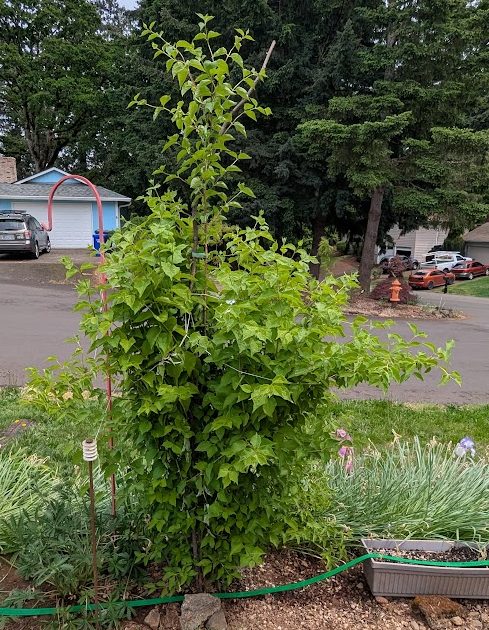
Lewis’ or Oregon mock orange – philadelphus lewisii
It has not bloomed yet, but I’ve only had it since 2023. It grows rather spindly – perhaps too much good soil and water and growing too quickly? But I found if i staked those spindly branches, they were much stronger the next year. One of my favorite wild bushes, blooms in June – July, smells amazing, and reminds me of rattlesnake draws in Eastern Oregon or Nevada where it commonly grows along a spring in the basalt.
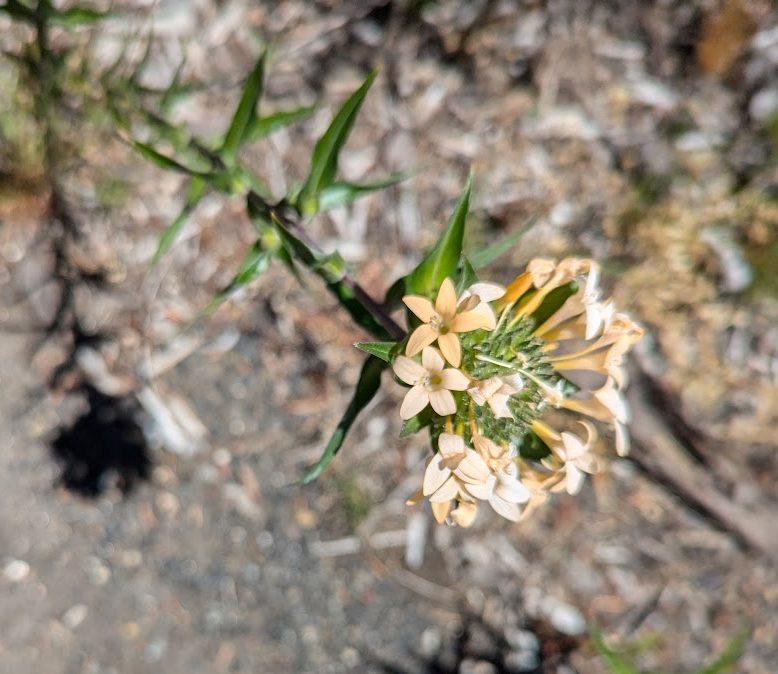
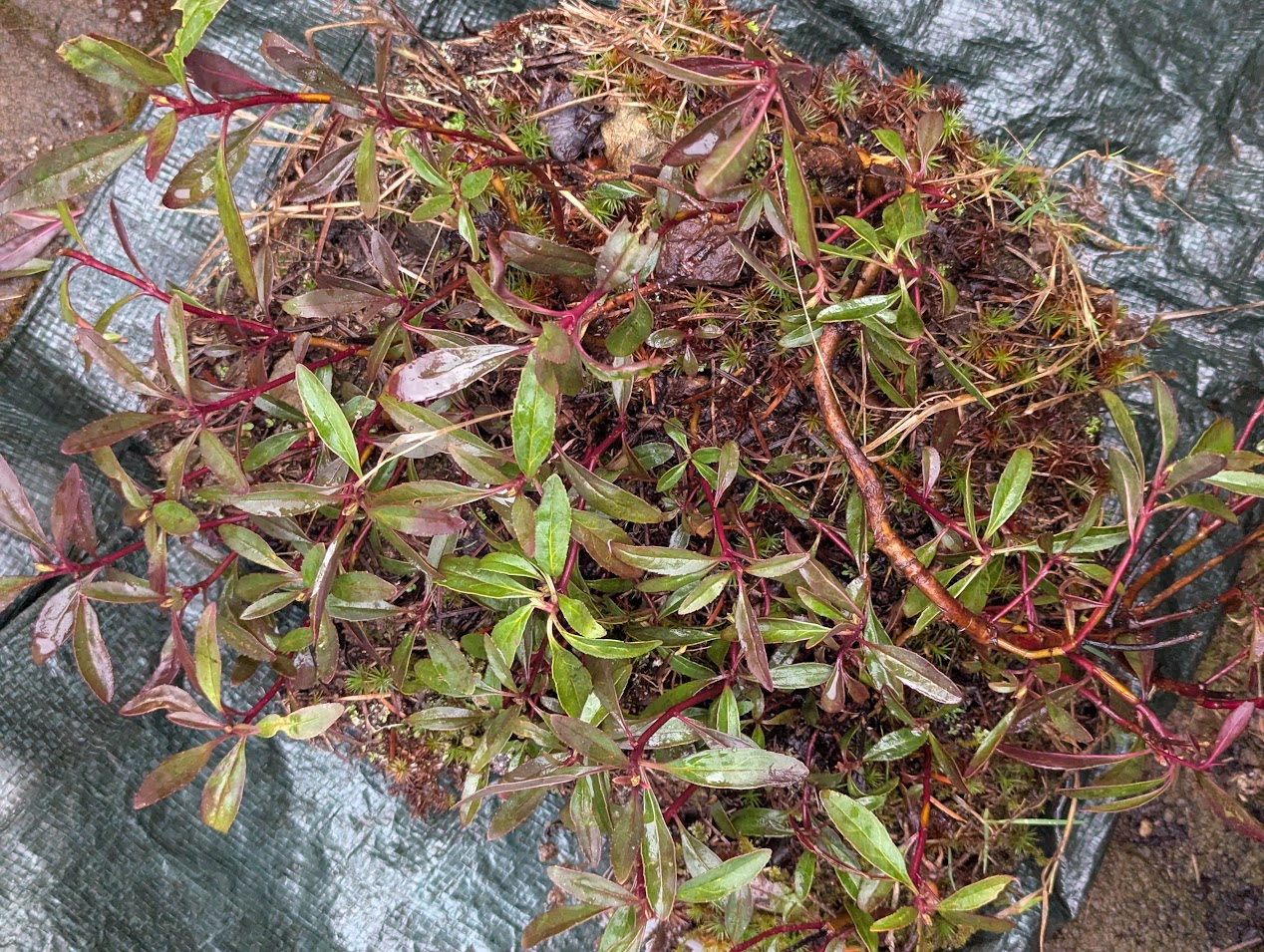
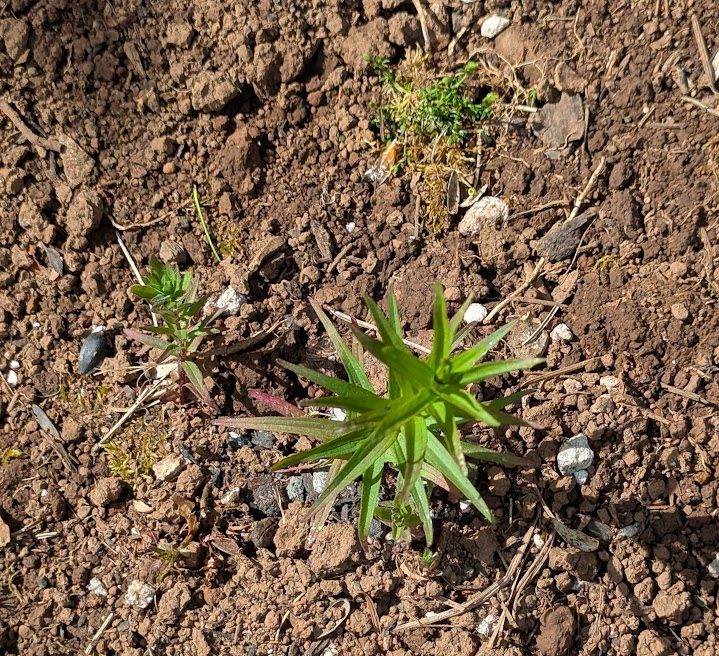
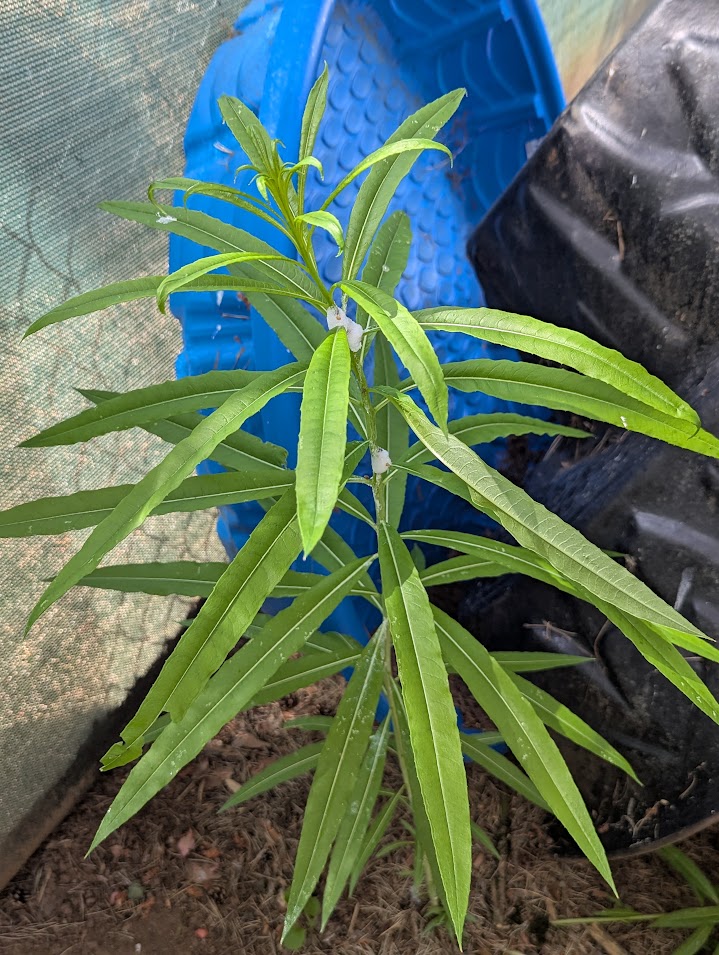
We discovered this growing along the roadside after a fire. It grows about 3-4′ tall. It is a native annual and we could purchase seeds (we tried seed collecting last fall, but beetles had devoured most of them!). This year, we dug one up (you can get a permit at the USFS). Hopefully, it makes it. Pic on the left is the one we dug up, pic on the right is a photo from last summer.
penstemmon – what variety???Little flower penstemmon – penstemon procerus (?)
Penstemmons are hard to identify without a field guide and a key, but we love them. The one on the left is one we dug up on Saturday (we dug up two, we won’t know if they are the same species or not until they bloom. There’s a fourth one in the front garden, but it is still very tiny and hasn’t bloomed. The one on the right – I am fairly certain it is the Little Flower penstemmon: the flowers are tiny. It came with a yew and Rocky Mountain maple (both dead and gone now). Penstemmons make great ground covers, especially in those dry, rocky spots.
Note: we don’t know what killed the trees, but all the plants that came with survived. The trees thrived for about five years, the maple died off first. The yew lived a couple more years before suddenly dying on us.
Indian paintbrush – castelleja affiniscrimson paintbrush – castilleja
Who doesn’t love paintbrush? It is parasitic which I didn’t know (and which explains why I’ve never succeeded in growing it in the past). The plant on the right is one I just purchased from a native plant nursery, complete with instructions on how/where to plant it and what plants it might want to attach to. The second one is one we just dug up. Unfortunately, it is attached to an oxeye daisy – a native daisy, but one that is a bit of a weed. I prefer my Shasta daisies which stay in their place, but they aren’t natives, so…
I planted the purchased paintbrush near a large leaf arnica (also a native, no photo). I will plant the new one nearby as well.
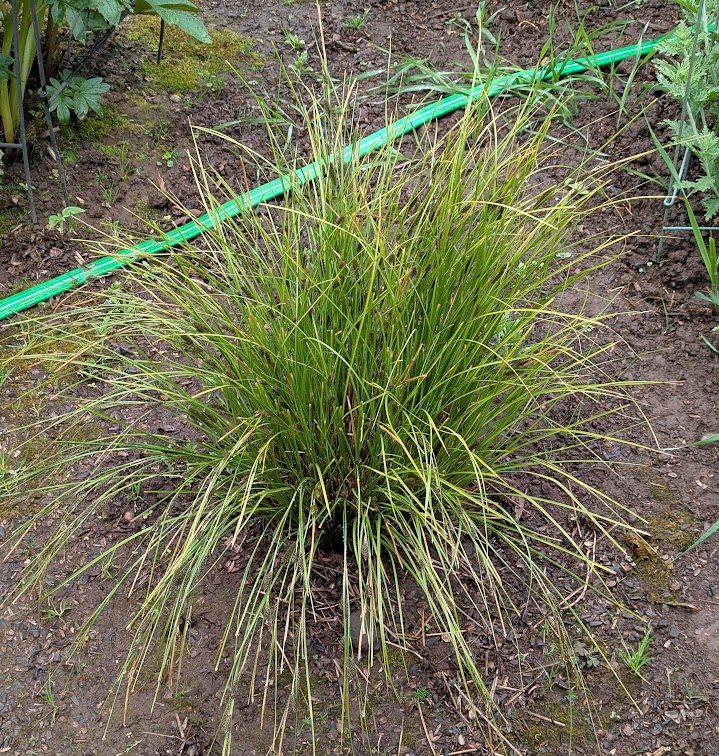
I’ll be honest: this could be an ornamental sedge. I don’t know. Birds planted it in our yard. I made the decision not only to keep it, but to move it to a better spot. I’d be happy if I learned it was a native dense sedge as my husband thinks.
black hawthorne – cretaegus douglasii
Ah – the Hawthorne! Long ago we lived in a trailer park next to a large open space full of nasty Himalayan blackberries (very invasive) and a lot of native plants (including the afore-mentioned oxeye daisy). This little tree was bulldozed a couple times by our landlord and chewed on a lot by the local black tail deer population. When we purchased our house, my husband dug this up (it was about 3′ tall at the time) and planted it in the ground. I believe he was planning on making a Bonsai out of it, but it just loved its new location.
trumpet honeysuckle – lonecera cilosa
I bought a honeysuckle from a nursery. It is pretty. The aphids love it. But I *really* wanted a native one. Last summer, my husband and I made a foraging trip into the Cascades and found this growing there. No, I don’t have pics of the flowers (yet), but we know it is a hummingbird plant and it is what I wanted.
But the real story is about the bear. I have only seen one in real life, and that was a grizzly in Yellowstone when I was ten (1965). I take that back: I saw a black bear once as it raced across the road in front of us in Central Oregon. I was in a car. I’ve hiked, camped, and hiked some more, and never seen a bear in the wild that I could count. Until we were digging the honeysuckle. A young black bear was making its way downhill toward us as we finished up our lunch. Not a scary thing, but we had the dog with us (unleashed – we weren’t anywhere near other people or dogs). So we quickly packed up to leave and we let the bear wander off in another direction as we secreted the dog out of the area.
fireweed – amaenerion angustifoliam
I have seen this for sale at garden shows. That factoid makes me laugh: fireweed is invasive. Once you have it in your yard, you will never get rid of it. I know: I planted it. And I ripped it out. It is pretty, I will grant you that. Alaska’s State flower (my daughter tells me that you can tell when winter is near because the fireweed quits blooming in Alaska). It blooms all summer. I found this survivor of the fireweed I killed nearly ten years ago (hahaha!) hiding behind the shed. And I am letting it go because it is better than English Ivy, black nightshade (Solanum americanum), and Himalayn blackberries – all of which we also have (only the nightshade is native).
California bay – umbelluria californica
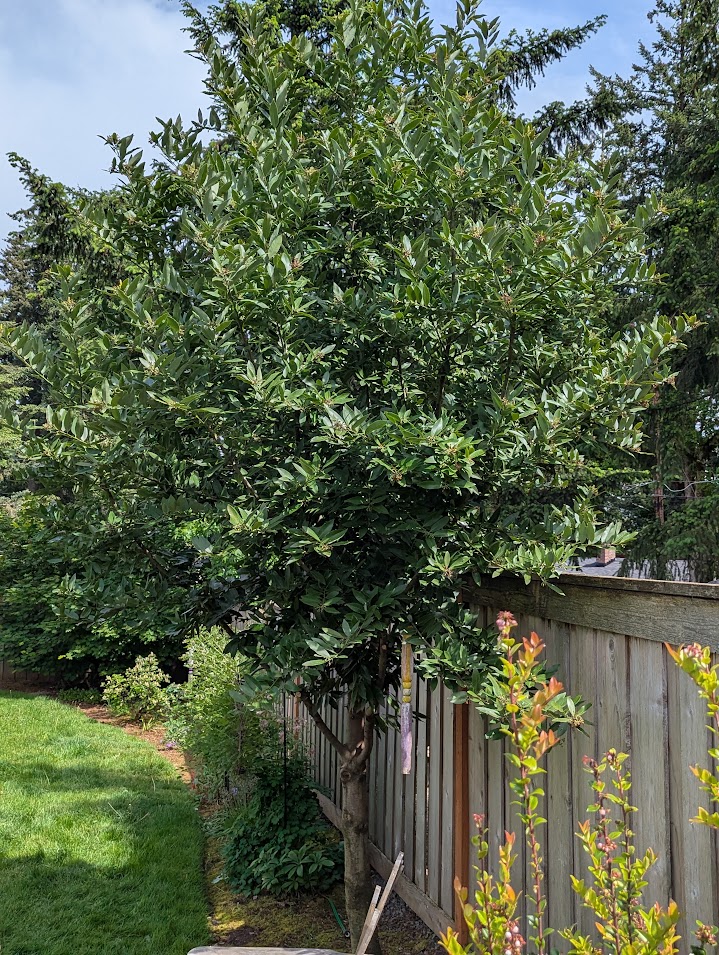
The birds planted this. I fell in love with it. I trim it up and will allow it to grow, It is not the same as a Bay Laurel, but it smells the same and you can use the leaves the same. Pretty yellow flowers in the early spring. Easy keeper.
This is just the beginning of a blog post I have been mulling for quite some time: what native plants do we already have in our garden? It began as a small idea but I soon discovered I have more native plants than I previously thought – and some plants I thought were native are really “naturalized” introductions (foxglove, common mullein, ground or creeping juniper). It also grew with the photos ♥
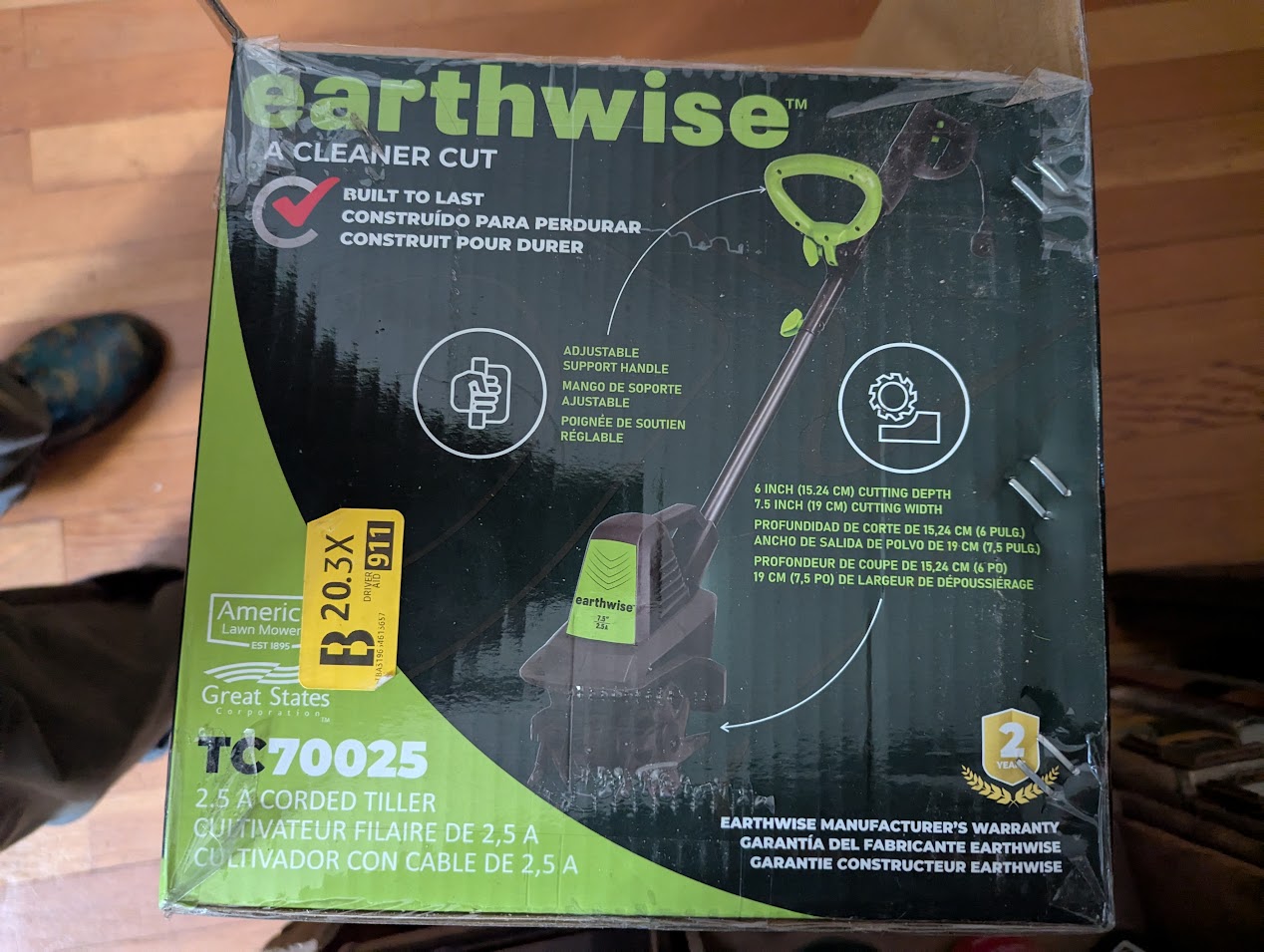
Inexpensive and probably not highly rated, but perfect for all I want it to do, which isn’t much more than knock down the sod so I can plant more things.
But I had a heck of a time putting it together until I handed it to my husband and he had it assembled in 15 minutes. i hate men.
I tested it on a muddy section of yard (it is far too muddy to be doing anything right now, but this was just a test patch).
That’s what I want to achieve. So – I have the small rototiller I want and it works like I want and I should be able to post more about how I have opened up areas to more garden space. It does bounce around and work my back, but not like the old way of doing things with the manual edger. Yay.
ANNNND I ordered three roses from Jackson-Perkins. Their roses run from $35 – $44 but the day I decided to order two more roses, they had a special going for “3 roses for $75”. OY. Can’t pass that up! I have two yellow and one white English Tea roses coming.
Last year, for whatever reason, they sent me my rose in February and it was too cold to plant. I’ve never had this issue with J&P before. It was strange and the rose died, but I’m giving them a second chance since they have always been reliable over the last 40 years I have ordered from them. I will post when they come in and I plant them, but I am pleasantly surprised that they have not shipped them too early. I think last year was a fluke.






























 Jaci Dawn