Feeds:
Posts
Comments

Posts Tagged ‘pruning’

The weather cooperated in time for the annual pruning of the apple trees and the Hawthorne. I forgot to take “before” pictures of the apple trees, but, hey, “after” pictures work.

We purchased espalier apples in 2003 to use as a “fence” around the vegetable garden site. There are six varieties on each tree, some do better than others, and we always have more apples than we can use. I think of investing in a cider press off and on: we could make a lot of vinegar, juice, and cider!

Certain varieties do better than others: the dominant apple (the base to the espalier) does best (yellow trasparent). But we still get a decent crop of Granny Smith and Red Delicious off these trees, and – maybe – someday we will figure out why the other three varieties struggle.  The fence around the apple trees is twofold: the dog can climb under the apple trees and get into the garden and the dog likes to pick apples off the tree (ripe or not ripe). Apples are not good for the dog (apple pips are poisonous). He still manages to get apples off the trees, which he then plays with as a cat would play with a mouse, until we take the apple from him and toss it into the yard debris bin.

Pruning takes place before the leaves unfurl and the blossoms swell. Then we hope there won’t be a late hard frost. It is all you can do.

The Hawthorne is a little more involved. Apples don’t have thorns. The apple trees are not over five feet tall.  That darn Hawthorne…

We didn’t buy the Hawthorne. We dug it out of the horse pasture when we gave my horses away (to a good home) and moved into town. It was all of three feet tall and had been run over by a Caterpillar multiple times and browsed by deer almost as often. It is a Native tree. And it absolutely loves its new location.

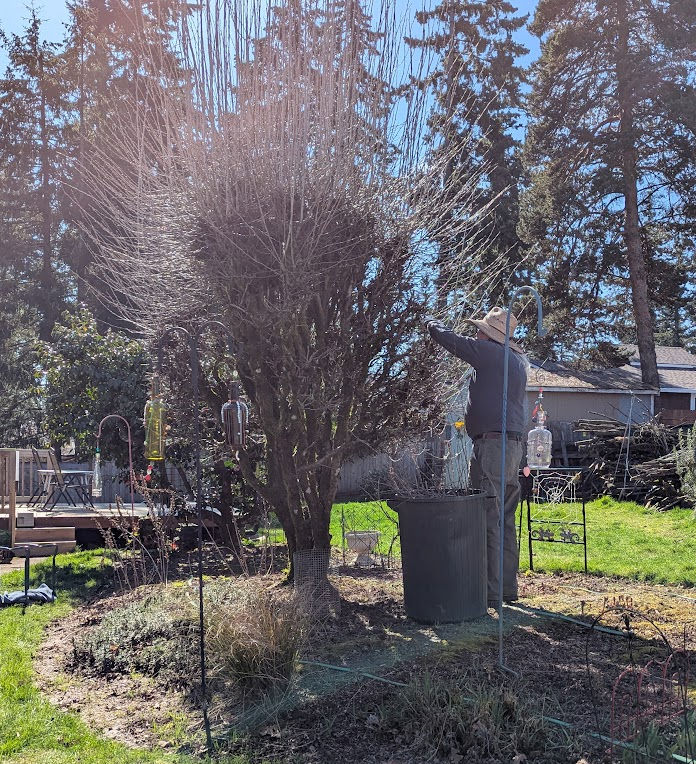
20 years after moving it, it stands over 10’ tall. It hosts birds and insects. We don’t allow it to blossom but if we did, it would host pollinators and produce berries (seeds). Pruning it is a several-day production that includes ladders, avoiding stepping on my peonies, and picking up anything the dog might later step on and puncture his footpad.

The dog has enough problems without thorns between his toes. And when I weed under the tree later in the season, I have enough trouble without a sharp one-inch thorn piercing my gloves.

Also, I don’t do any of this work. I take pictures and sometimes pick up the stray thorny branches my husband misses. My husband is proprietary about the apple trees and I wouldn’t touch pruning that Hawthorne with a ten-foot pruning hook. Nope, nope, nope. Not I.

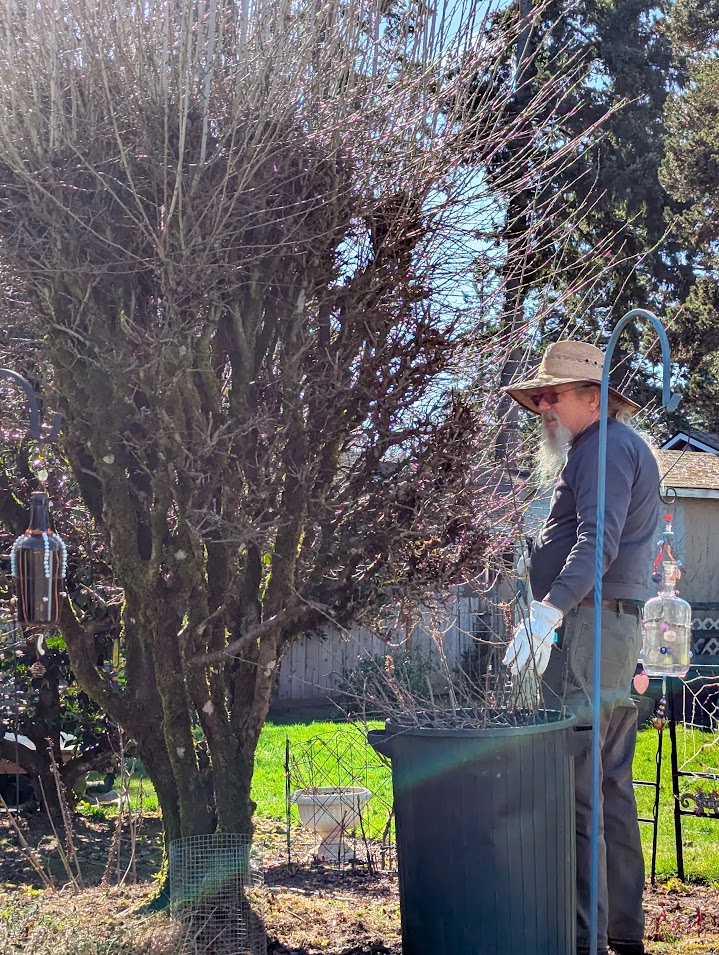
What ensues is a bit of a photo documentary of the pruning on one native Hawthorne tree in our back yard, including some dangerously slanted ladders on the mound of earth where we decided to put said Hawthorne.
Read Full Post »

Time to Prune  

I always prune my roses back on Lincoln’s birthday (or as close to that date as I can get). I grow English hybrid tea roses for the most part and they need to be cut back before their Spring growth.

As an aside, I was once attacked on a birding site because I do not like “introduced” and “invasive” bird species. I stand my ground: wherever you live, invasive species of plants or animals are a problem. And, yes, I already know white people are an invasive species. Spare me the guilt: I did not choose my ancestors; I did not make their choices. But I am here, and I am doing my best to not make the mistakes of past generations. Besides, I am the product of conquests and colonialism: my ancestry reaches deep into the unrest in the Baltic regions and England, Ireland, and Scotland. I do know my ancestors did not promote slavery (but some of them were racist) and they did not participate in the Indian Wars or Manifest Destiny (although I am certain some of them were sympathizers)

This person tried to “guilt” me by declaring, “I bet you grow roses.” Well, yes, I do. There are native roses to the Americas, although I do not have them in my garden. The roses most of us grow are from England or France (the “Old World” as it were) and are anything BUT invasive. They require a lot of work just to keep the one growing and disease-free. They don’t produce seeds or spread by runners or rhizomes or bulbs. They only provide aroma and beauty at the cost of a lot of labor (I need to stress the labor part). Roses are bit of a bright spot.

The time to prune them back is traditionally Lincoln’s Birthday, or the 12th of February (for those younger folk who don’t know the birthdays of the original two presidents who were honored before the date – President’s Day – became all-inclusive). The other birthday was that of George Washington who declined to become king: February 22nd. Now we celebrate all presidents, including Rutherford B. Hayes, Grover A. Cleveland, and even Richard M. Nixon. I suppose they all whined they weren’t given an award for participation at some moment in time and we caved. Not all presidencies are worthy of honor. But that’s getting political and I came here to talk about roses.

I have three at the moment. I had four, but I did a thing last year: I dug up one rose and gave it away to plant another rose which immediately died. I have veteran’s Honor and Rio Samba, both English Tea Roses, and a floribunda called Tuscan Sun. I am not a fan of floribundas, but this one has large, scented blooms and gets to stay. I want to order tow more roses this Spring: a yellow rose and perhaps a white rose.  But that is aside the point. I have the three to deal with right now.

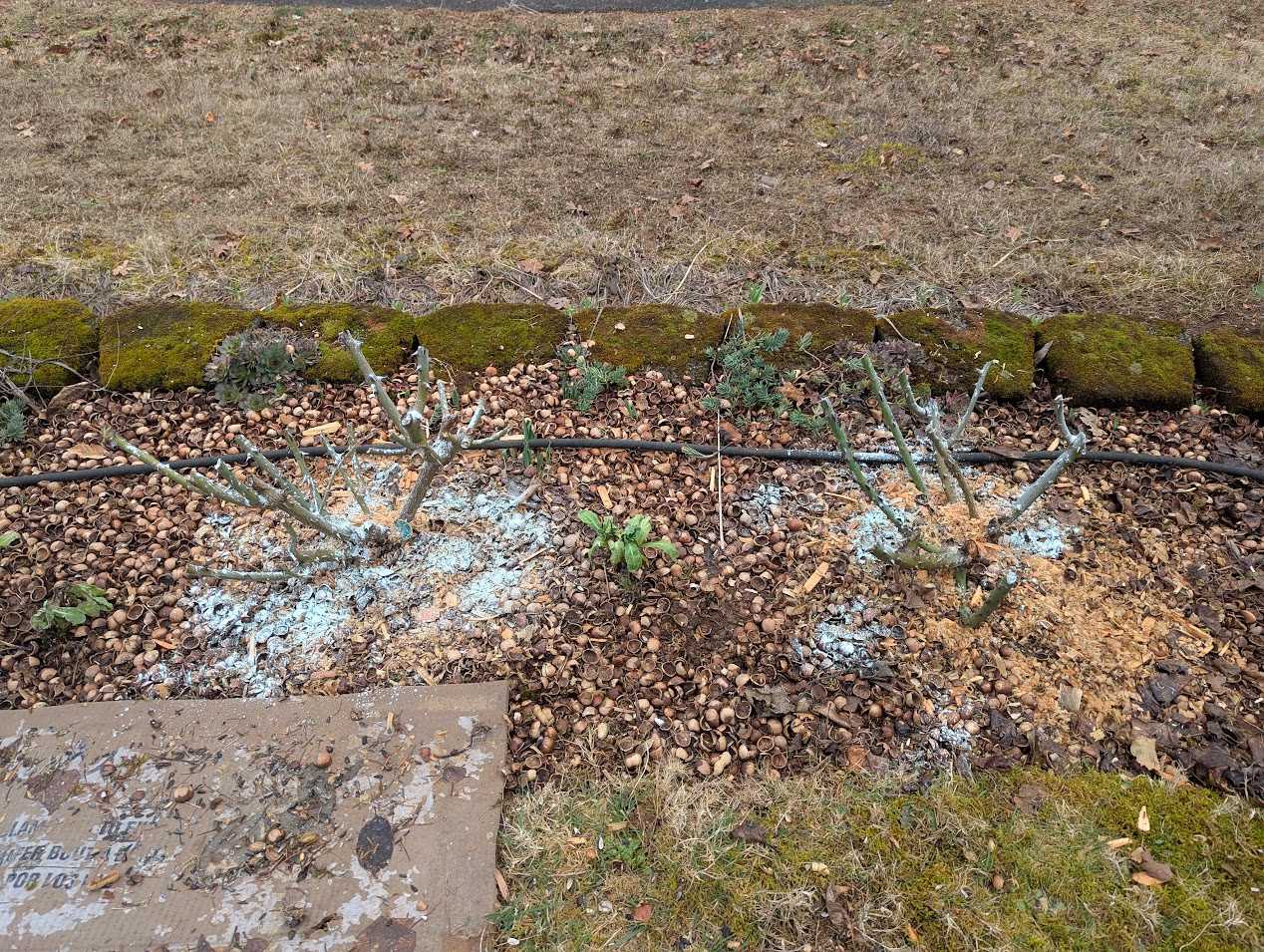
I pruned them back to roughly 8 – 12” (20-30.5CM). Then I sprinkled them with copper fungicide.

My yard promotes the growth of fungus. My peonies and roses are the most susceptible: black or brown spot affects them. I’m at war with something I cannot see.  I have read the pros and cons of using copper fungicide (not good for insects). I know the devastating effects of the two fungi. Since it seems to attack those two plants specifically, I made the decision to apply it to those plants only. Both are cultivars from other parts of the world (there are native peonies to the Americas, but the Western peony does not like our maritime climate in the Willamette Valley – I have tried). Neither are essential to native pollinators. Peonies are resistant to most pests, and roses are subject to aphids and fungus. I think I am safe applying it to just those plants and crossing my fingers to not hurt the native pollinators.

I inherited the peonies: I did not plant them. They came with the property, and I counted over 100 plants last year. I have no idea what cultivars they are as the tags were lost to history after the original owner passed and the property went to the people who flipped it, and then to us. I love peonies. They were one of the deciding factors in purchasing this property. They don’t require a lot of care.

I planted the roses. I accept the amount of work it requires to have beautiful blooms. And who wouldn’t, once ensnared by the rose’s beauty?

It was 25° on Lincoln’s birthday and it was over 50° today. Time to prune. Only time will tell if the copper fungicide works against the black and brown spot fungus that lives in the soil. I have my fingers crossed.

(photos courtesy of Jackson Perkins, Edmund’s Roses, and rosesalesonline. )

Read Full Post »