Feeds:
Posts
Comments

Posts Tagged ‘nature’

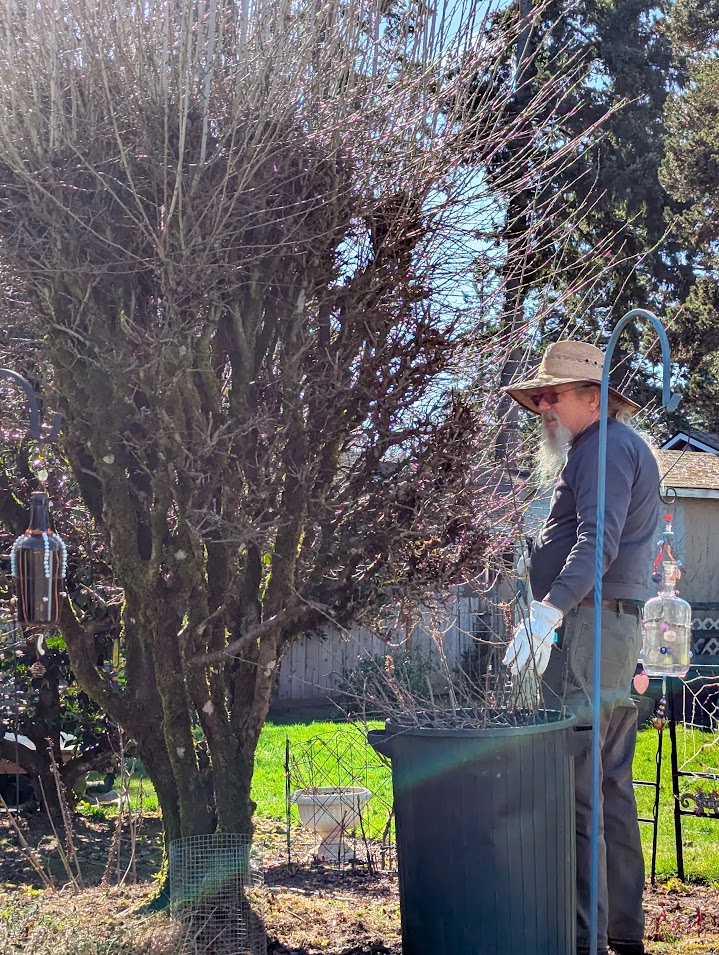
The weather cooperated in time for the annual pruning of the apple trees and the Hawthorne. I forgot to take “before” pictures of the apple trees, but, hey, “after” pictures work.

We purchased espalier apples in 2003 to use as a “fence” around the vegetable garden site. There are six varieties on each tree, some do better than others, and we always have more apples than we can use. I think of investing in a cider press off and on: we could make a lot of vinegar, juice, and cider!

Certain varieties do better than others: the dominant apple (the base to the espalier) does best (yellow trasparent). But we still get a decent crop of Granny Smith and Red Delicious off these trees, and – maybe – someday we will figure out why the other three varieties struggle.  The fence around the apple trees is twofold: the dog can climb under the apple trees and get into the garden and the dog likes to pick apples off the tree (ripe or not ripe). Apples are not good for the dog (apple pips are poisonous). He still manages to get apples off the trees, which he then plays with as a cat would play with a mouse, until we take the apple from him and toss it into the yard debris bin.

Pruning takes place before the leaves unfurl and the blossoms swell. Then we hope there won’t be a late hard frost. It is all you can do.

The Hawthorne is a little more involved. Apples don’t have thorns. The apple trees are not over five feet tall.  That darn Hawthorne…

We didn’t buy the Hawthorne. We dug it out of the horse pasture when we gave my horses away (to a good home) and moved into town. It was all of three feet tall and had been run over by a Caterpillar multiple times and browsed by deer almost as often. It is a Native tree. And it absolutely loves its new location.

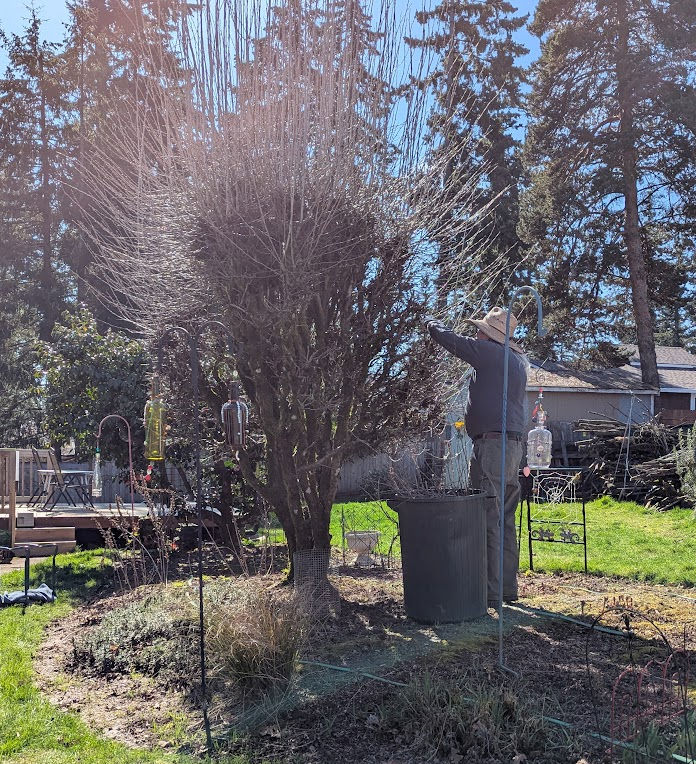
20 years after moving it, it stands over 10’ tall. It hosts birds and insects. We don’t allow it to blossom but if we did, it would host pollinators and produce berries (seeds). Pruning it is a several-day production that includes ladders, avoiding stepping on my peonies, and picking up anything the dog might later step on and puncture his footpad.

The dog has enough problems without thorns between his toes. And when I weed under the tree later in the season, I have enough trouble without a sharp one-inch thorn piercing my gloves.

Also, I don’t do any of this work. I take pictures and sometimes pick up the stray thorny branches my husband misses. My husband is proprietary about the apple trees and I wouldn’t touch pruning that Hawthorne with a ten-foot pruning hook. Nope, nope, nope. Not I.

What ensues is a bit of a photo documentary of the pruning on one native Hawthorne tree in our back yard, including some dangerously slanted ladders on the mound of earth where we decided to put said Hawthorne.
Read Full Post »

 How I love thee, False Spring! I love the sunshine! The warm air! The wee buds poking up out of the ground!

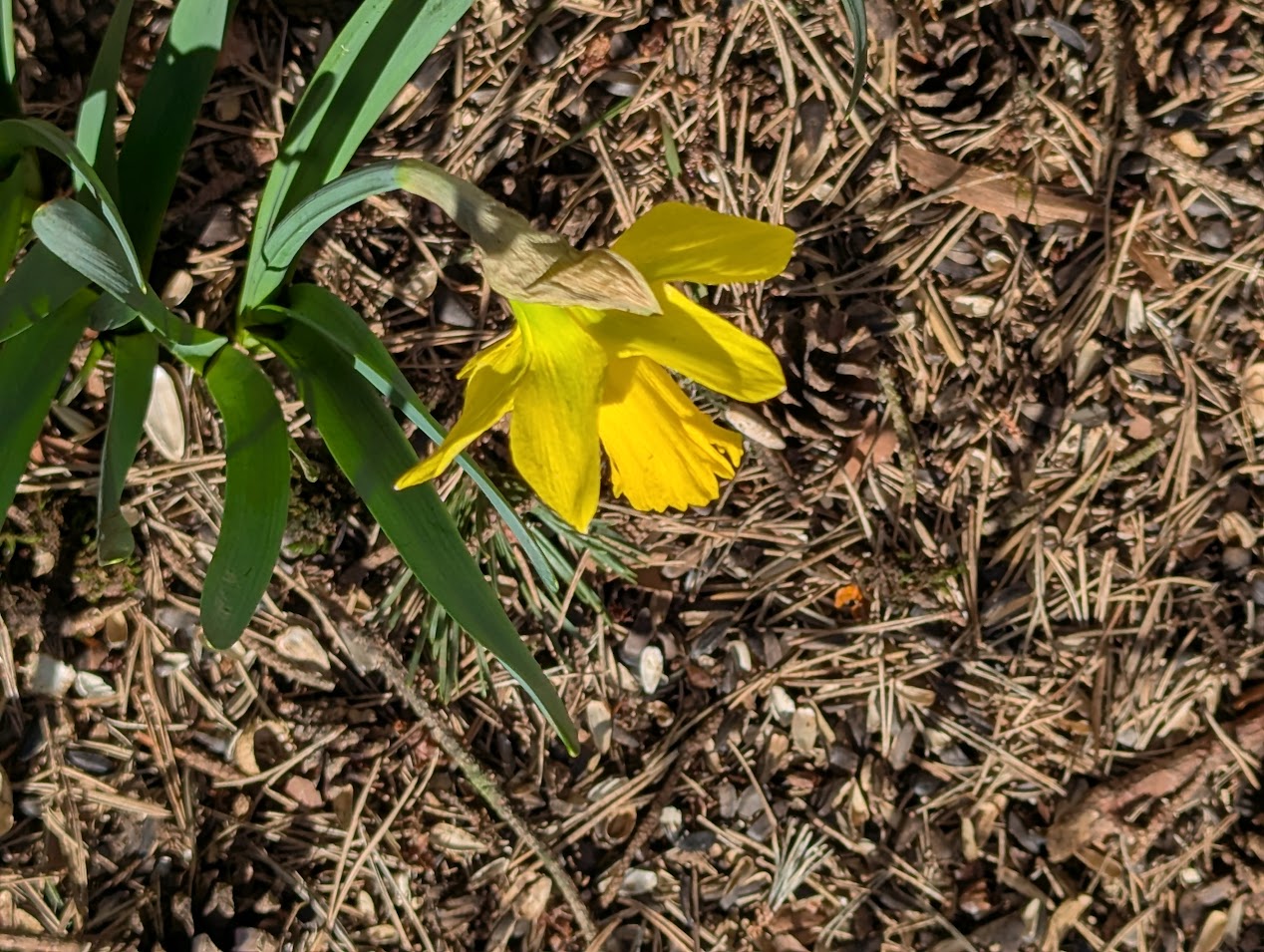
Daffodils! (Except the parts the slugs came and nibbled on!)

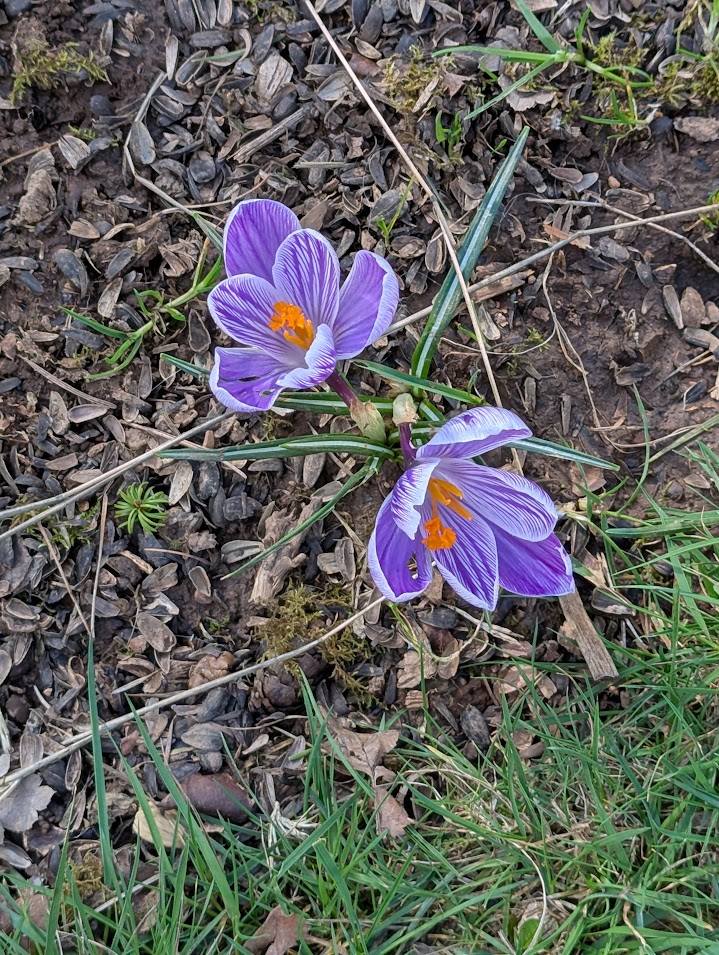
Crocus! (Until the dang squirrel makes off with the flower and eats it all!)

The Camellia! (What buds have escaped both the dog and the squirrel! What the dog tastes in Camellia buds is beyond me but it isn’t harmful to him – surprise! – and he only picks off the blossoms on the lowest branches. Squirrels tend to the upper blossoms where I cannot see, so that leaves the bulk of the bush to me! Me, me, me!)

The Lenten Rose (Hellebore)! (Mine needs some fungicide, I think. The leaves look rather sad.)

The grape hyacinth!

No. Just NO.

Look at them there in my flower bed, crowding out the peonies. All those clumps of impenetrable hyacinth bulbs! I think the last time I purged them was about five years ago. And today they came out in the handfuls, all those little bulbs crowded together just under the surface, clinging to each other like seeds in a pomegranate.

Kill! Pull! Purge!

Except they don’t all come out and there are some with tiny promises of fragrant grape-colored clusters of bell-shaped flowers. I left those.

And I know I will do this again in about five years.

Because grape hyacinths. They merely regroup.

This particular flower bed is my most successful. It is low maintenance, except for the every-five-years purge of invasive and stubborn grape hyacinths.

This garden bed blooms from early spring  starting with the hyacinth, which I promise, will still raise up tiny spikes of purple flowers rimmed with a delicate white border. Not as fragrant as the larger hyacinths that come in a variety of pink, purple, and blue shades, but pretty enough to place in a bud vase and prolific enough to be a nuisance.

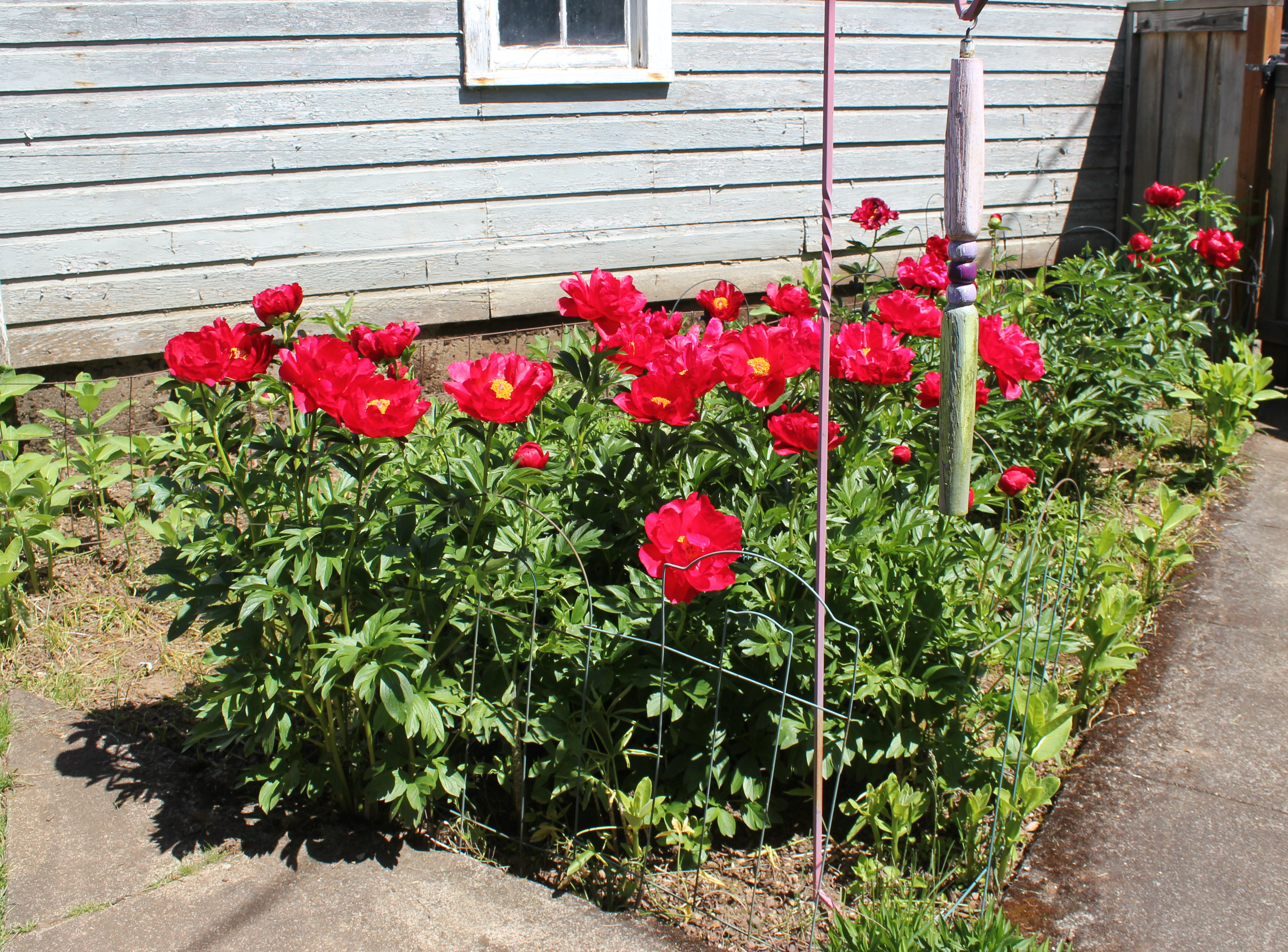
Then come the peonies. Blood red and scarlet. The peonies thrive despite the crowding of tiny bulbs. I throw them some light fertilizer early and a little copper fungicide to ward off brown spot, but otherwise, I ignore them. Well, I pick them and place them in pretty vases that I allow to sit outside overnight until all the ants fall off. Ants love peonies.

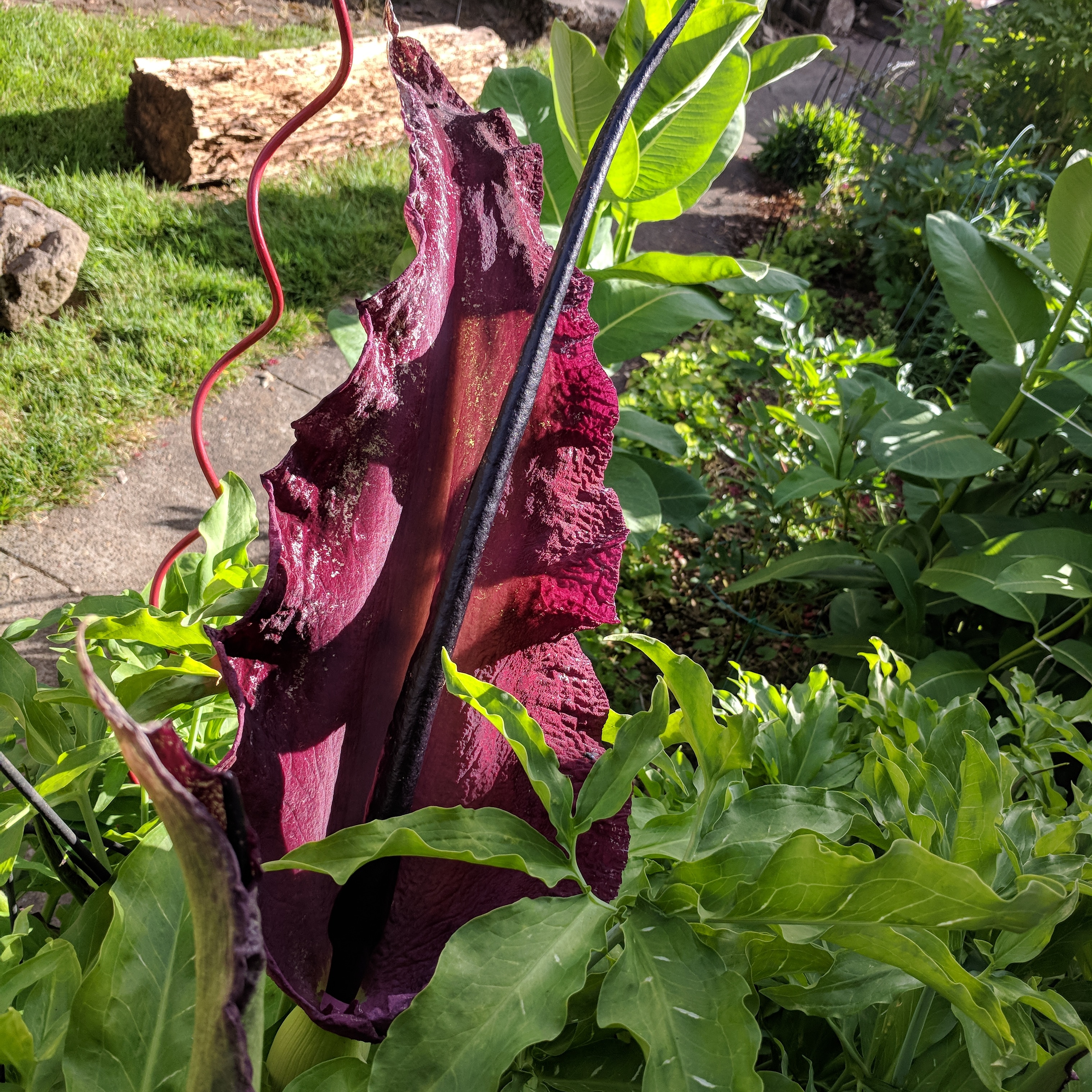
As the peonies fade, the Voodoo Lily comes on. Pungent, odiferous, and so dark a purple as to be almost black. We dug the parent plant up at a rental we lived in some 40 years ago. Didn’t think anyone would care if we took such an obnoxious smelling plant with us, and no doubt they haven’t missed it: surely we missed some of the bulbs.

It smells like rotten hamburger. It attracts beetles and flies (and not a few dogs). It repels neighbors and guests, but it also piques their interest: what is this mysterious plant? Dracunculus Vulgaris. Voodoo Lily. The harbinger of our wedding anniversary (it blooms the first week of June).

And when the lily fades and dies back, the milkweed springs upward. And upward. It blooms with a strong aroma, something far less offensive than the former: milkweed is aromatic and sweet, enticing and hypnotizing. Here come the bees, wasps, flies, butterflies, and beetles. Pink and white clusters of hundreds of flowers. And with it, our hope of seeing a magnificent orange-and-black Monarch butterfly or the yellow-green-and black striped Monarch caterpillar (that feeds exclusively on milkweed).

If you plant it they will come. We hope.

The milkweed, in turn, goes to seed and begins to fade, the seed pods hardening. Summer is at an end. And with a burst of color, the asters open up: tall magenta ones and shorter light purple ones. The bees and wasps that filtered off to other flowers when the milkweed faded are back in force. It is one last feast of nectar, of pollen, of summery intoxication.

Then it all fades away and the grape hyacinth begins to poke its persistent leaves upward, greening the winter brown ground.

**note: the only photo that is not mine is that of the grape hyacinth. Credit goes to NickyPe and Pixabay.

Read Full Post »

Time to Prune  

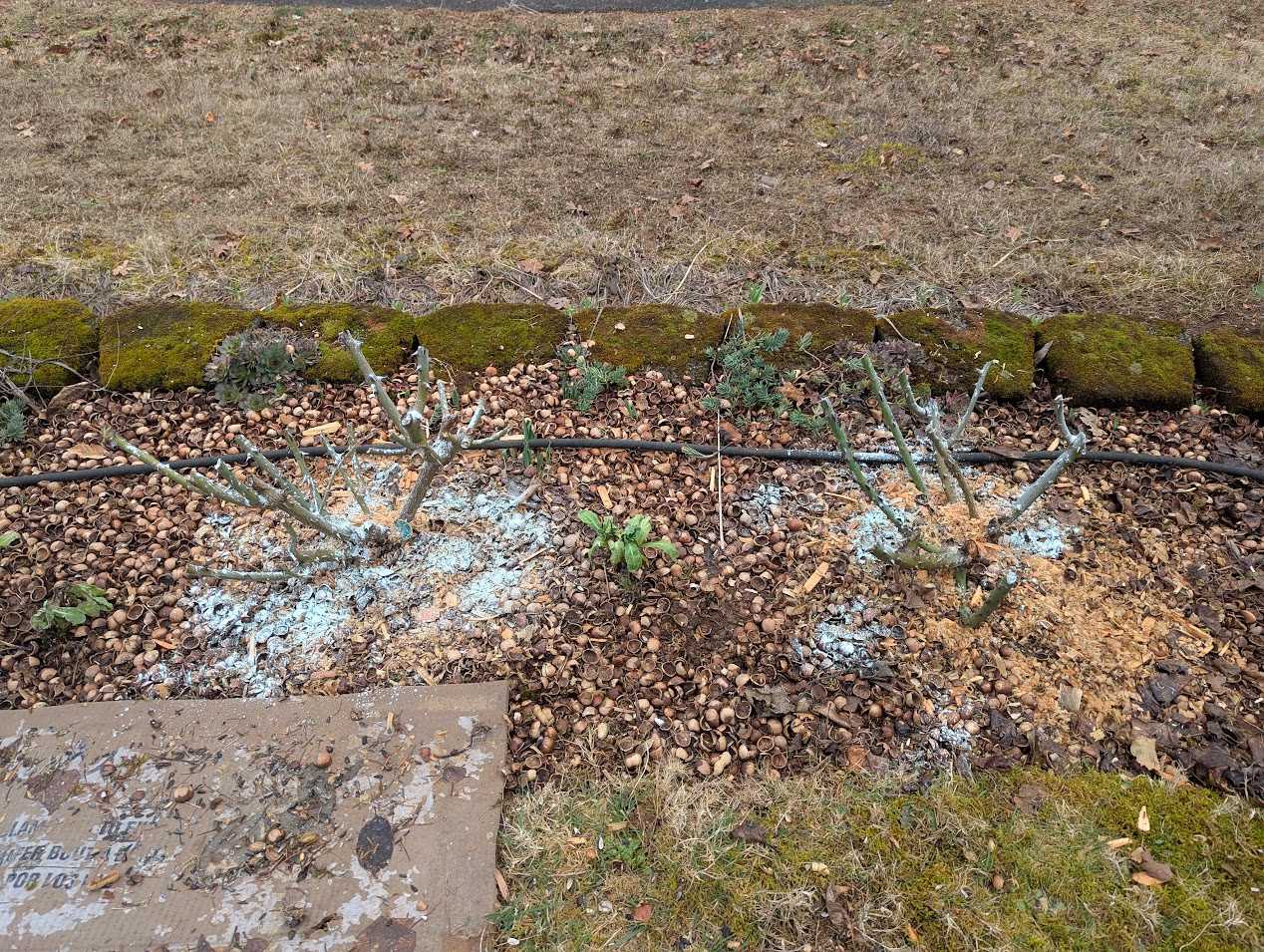
I always prune my roses back on Lincoln’s birthday (or as close to that date as I can get). I grow English hybrid tea roses for the most part and they need to be cut back before their Spring growth.

As an aside, I was once attacked on a birding site because I do not like “introduced” and “invasive” bird species. I stand my ground: wherever you live, invasive species of plants or animals are a problem. And, yes, I already know white people are an invasive species. Spare me the guilt: I did not choose my ancestors; I did not make their choices. But I am here, and I am doing my best to not make the mistakes of past generations. Besides, I am the product of conquests and colonialism: my ancestry reaches deep into the unrest in the Baltic regions and England, Ireland, and Scotland. I do know my ancestors did not promote slavery (but some of them were racist) and they did not participate in the Indian Wars or Manifest Destiny (although I am certain some of them were sympathizers)

This person tried to “guilt” me by declaring, “I bet you grow roses.” Well, yes, I do. There are native roses to the Americas, although I do not have them in my garden. The roses most of us grow are from England or France (the “Old World” as it were) and are anything BUT invasive. They require a lot of work just to keep the one growing and disease-free. They don’t produce seeds or spread by runners or rhizomes or bulbs. They only provide aroma and beauty at the cost of a lot of labor (I need to stress the labor part). Roses are bit of a bright spot.

The time to prune them back is traditionally Lincoln’s Birthday, or the 12th of February (for those younger folk who don’t know the birthdays of the original two presidents who were honored before the date – President’s Day – became all-inclusive). The other birthday was that of George Washington who declined to become king: February 22nd. Now we celebrate all presidents, including Rutherford B. Hayes, Grover A. Cleveland, and even Richard M. Nixon. I suppose they all whined they weren’t given an award for participation at some moment in time and we caved. Not all presidencies are worthy of honor. But that’s getting political and I came here to talk about roses.

I have three at the moment. I had four, but I did a thing last year: I dug up one rose and gave it away to plant another rose which immediately died. I have veteran’s Honor and Rio Samba, both English Tea Roses, and a floribunda called Tuscan Sun. I am not a fan of floribundas, but this one has large, scented blooms and gets to stay. I want to order tow more roses this Spring: a yellow rose and perhaps a white rose.  But that is aside the point. I have the three to deal with right now.

I pruned them back to roughly 8 – 12” (20-30.5CM). Then I sprinkled them with copper fungicide.

My yard promotes the growth of fungus. My peonies and roses are the most susceptible: black or brown spot affects them. I’m at war with something I cannot see.  I have read the pros and cons of using copper fungicide (not good for insects). I know the devastating effects of the two fungi. Since it seems to attack those two plants specifically, I made the decision to apply it to those plants only. Both are cultivars from other parts of the world (there are native peonies to the Americas, but the Western peony does not like our maritime climate in the Willamette Valley – I have tried). Neither are essential to native pollinators. Peonies are resistant to most pests, and roses are subject to aphids and fungus. I think I am safe applying it to just those plants and crossing my fingers to not hurt the native pollinators.

I inherited the peonies: I did not plant them. They came with the property, and I counted over 100 plants last year. I have no idea what cultivars they are as the tags were lost to history after the original owner passed and the property went to the people who flipped it, and then to us. I love peonies. They were one of the deciding factors in purchasing this property. They don’t require a lot of care.

I planted the roses. I accept the amount of work it requires to have beautiful blooms. And who wouldn’t, once ensnared by the rose’s beauty?

It was 25° on Lincoln’s birthday and it was over 50° today. Time to prune. Only time will tell if the copper fungicide works against the black and brown spot fungus that lives in the soil. I have my fingers crossed.
(photos courtesy of Jackson Perkins, Edmund’s Roses, and rosesalesonline. )
Read Full Post »

It froze this morning. It has been freezing for the past week or so. It has also been reaching into the upper forties and lower fifties (Fahrenheit). The fruit flies have not died off and some small mayflies have hatched already. The pine siskins have moved on, but the year-round resident birds have been hitting the feeders with regularity.

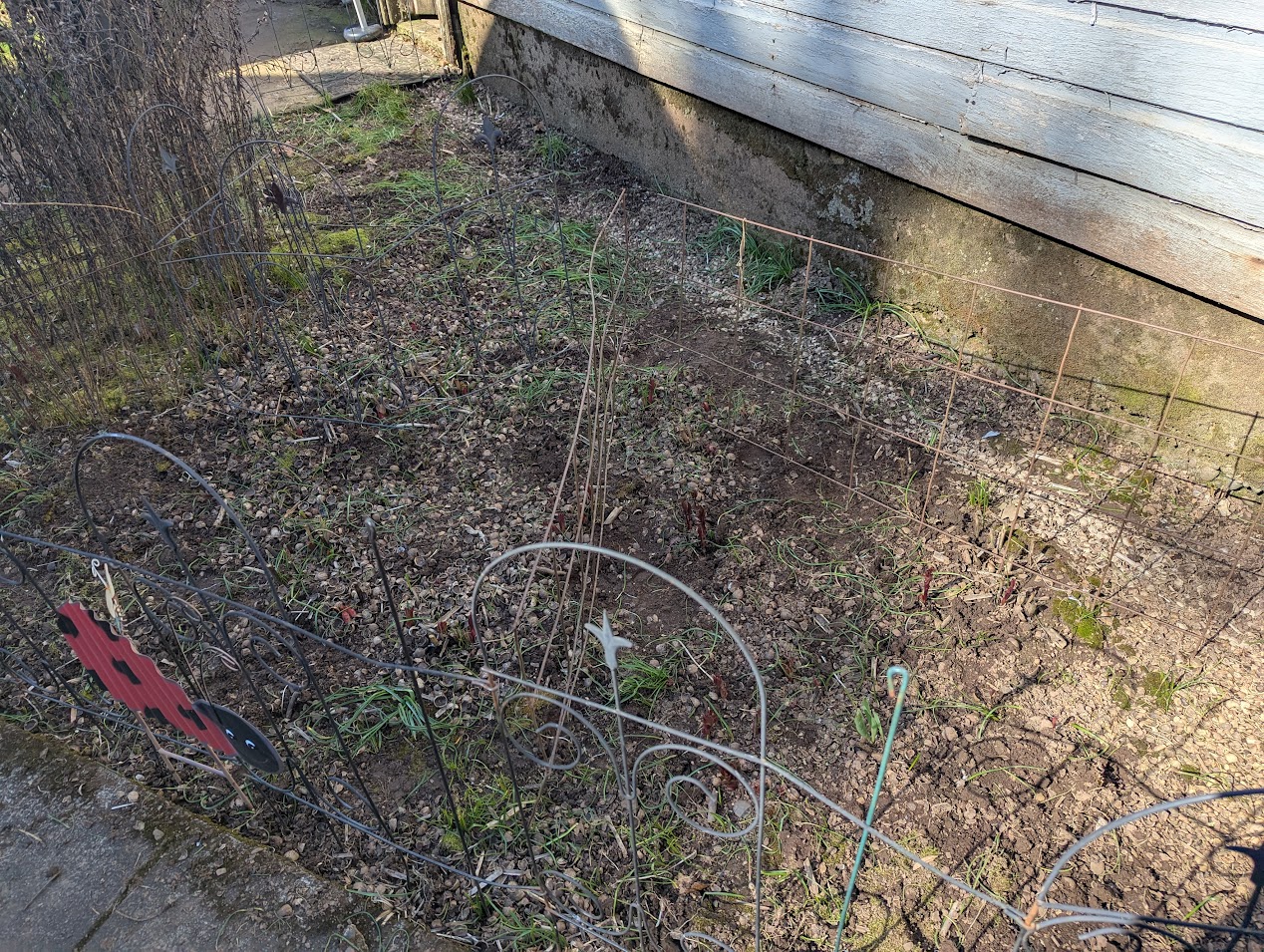
There is not much one can do in the garden right now: too early to prune, too early to plant, still winter. February is often the month we get our “big” storm of the season: snow, ice, melt, floods. January is a month of holding patterns, waiting.

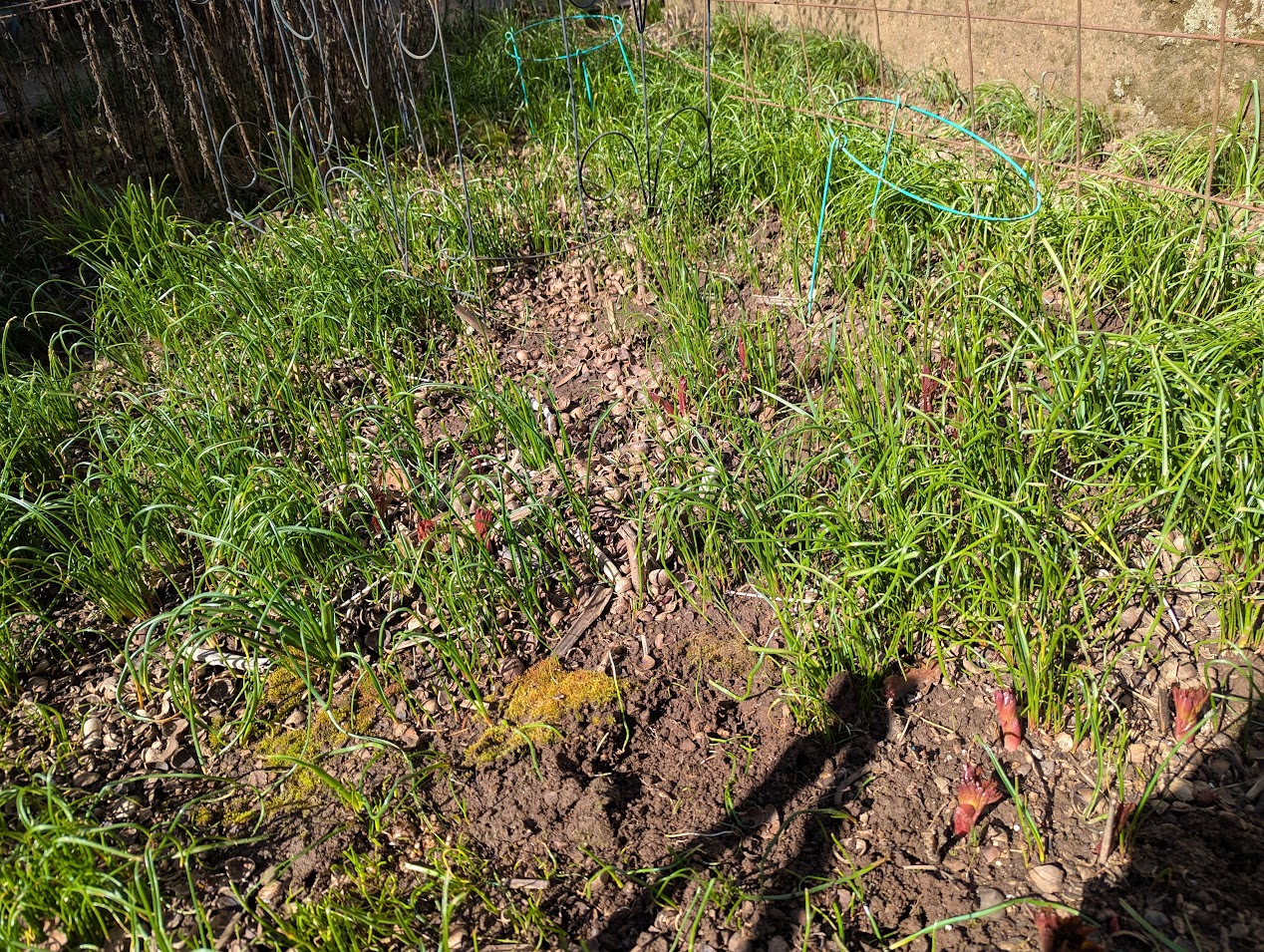
While we wait for the first peeks of green (or red, in the case of peonies), the insect pollinators are snug in their cocoons and hiding places. They are insulated under layers of fallen leaves (assuming you adhere to “leave the leaves” – our neighbors don’t, but they allow my husband to collect the leaves they have gathered, and we use them as mulch to prevent spring weeds and help the pollinators). Our yard is “pollinator friendly”.

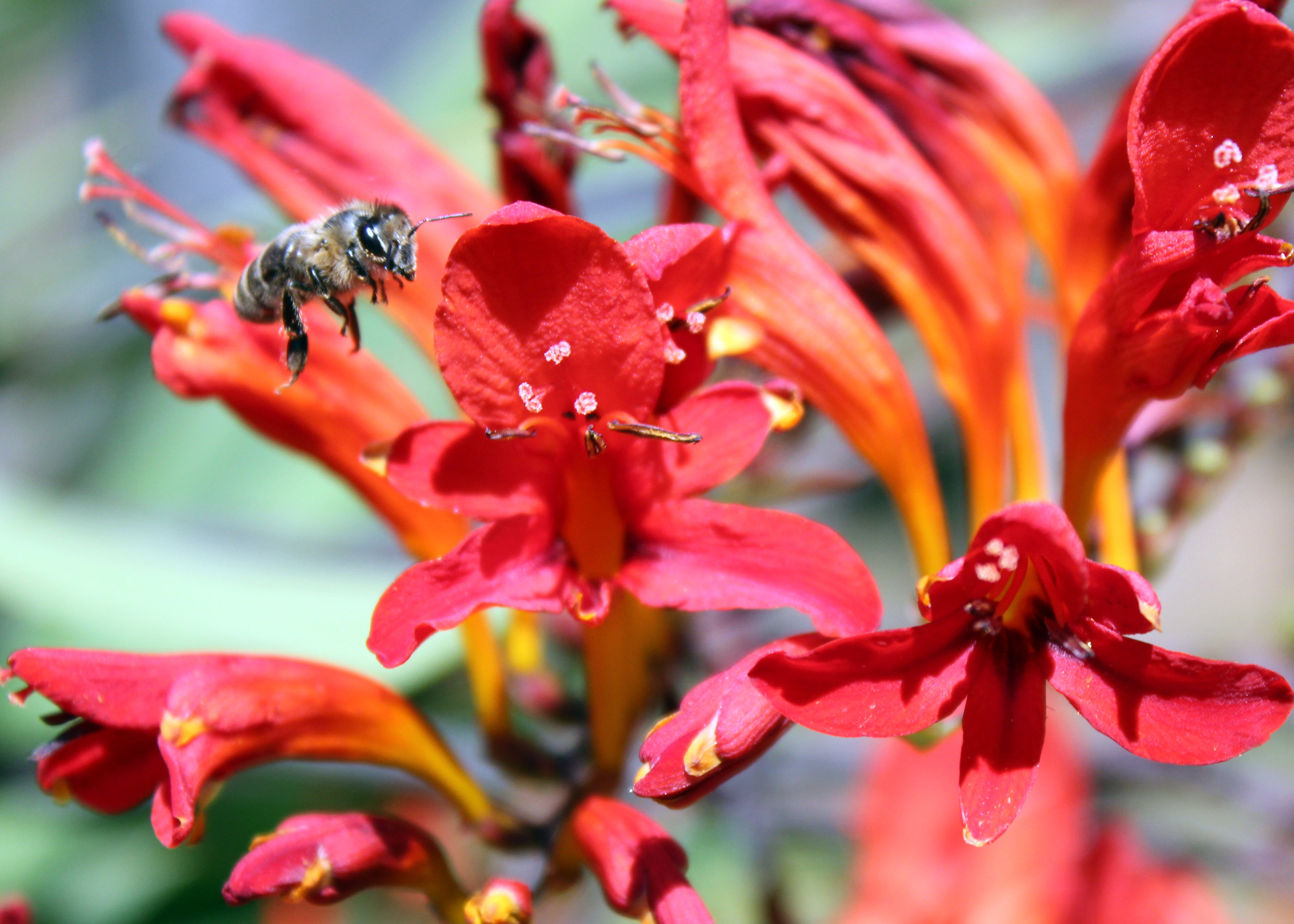
We recently learned what we are doing right to help pollinators and what more we can do. And right now, in the still of January as it tips into February, is the time to think about emerging insects. Bees, specifically, need our help. There are several hundred species of bees in the United States alone, a few hundred in the State of Oregon, and possibly two- to three- hundred in our town alone. Our yard is likely host to over 40 species of native bees. I know we have identified close to thirty different species, not including the non-native (and non-threatened) European honeybee.

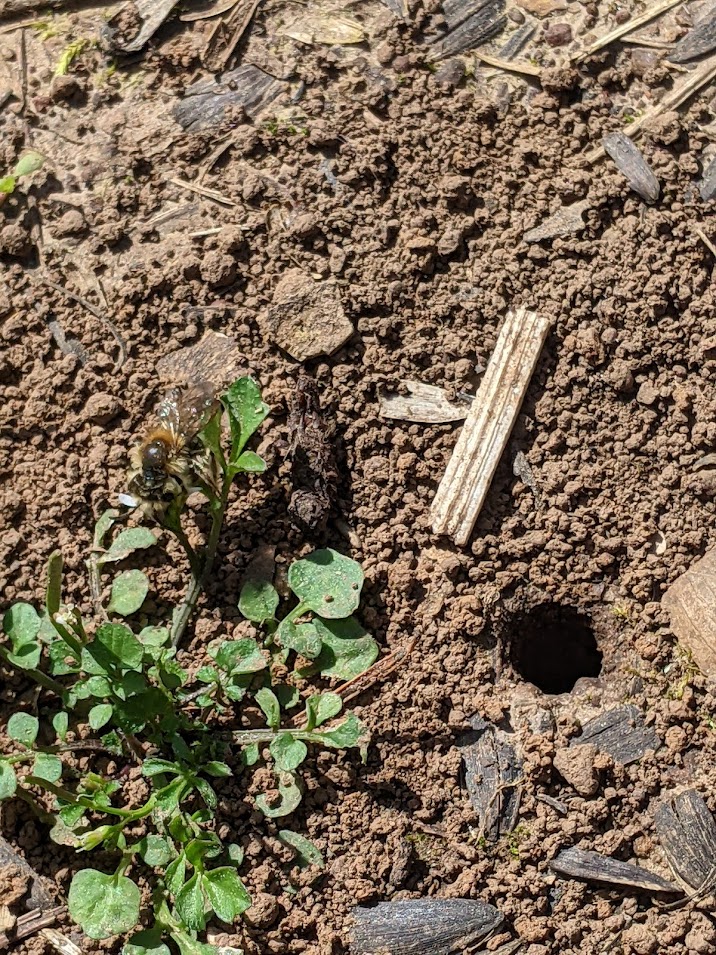
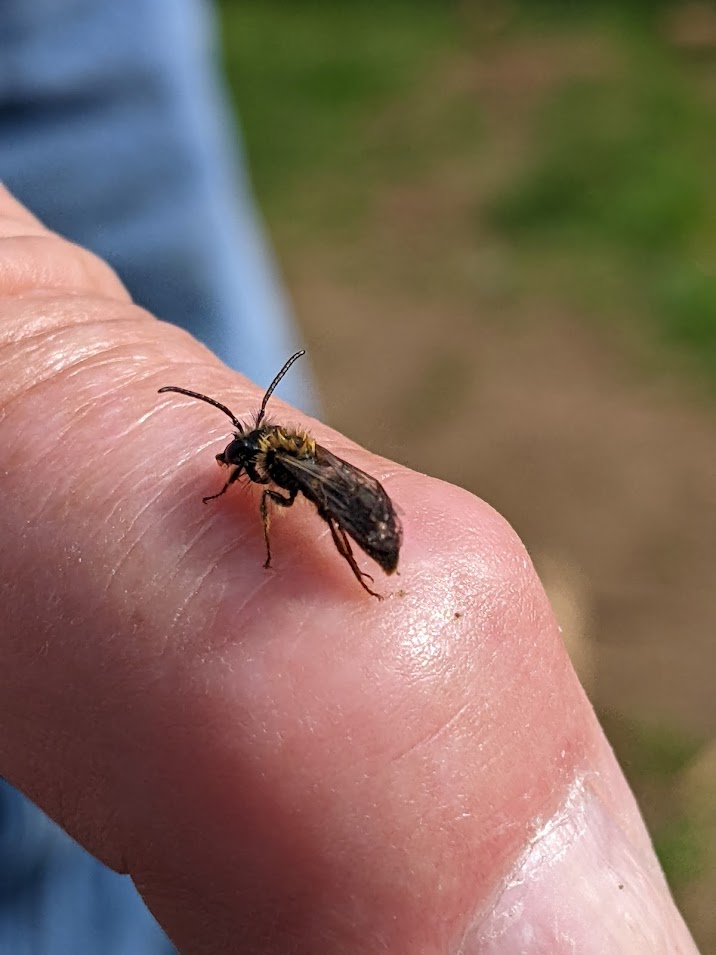
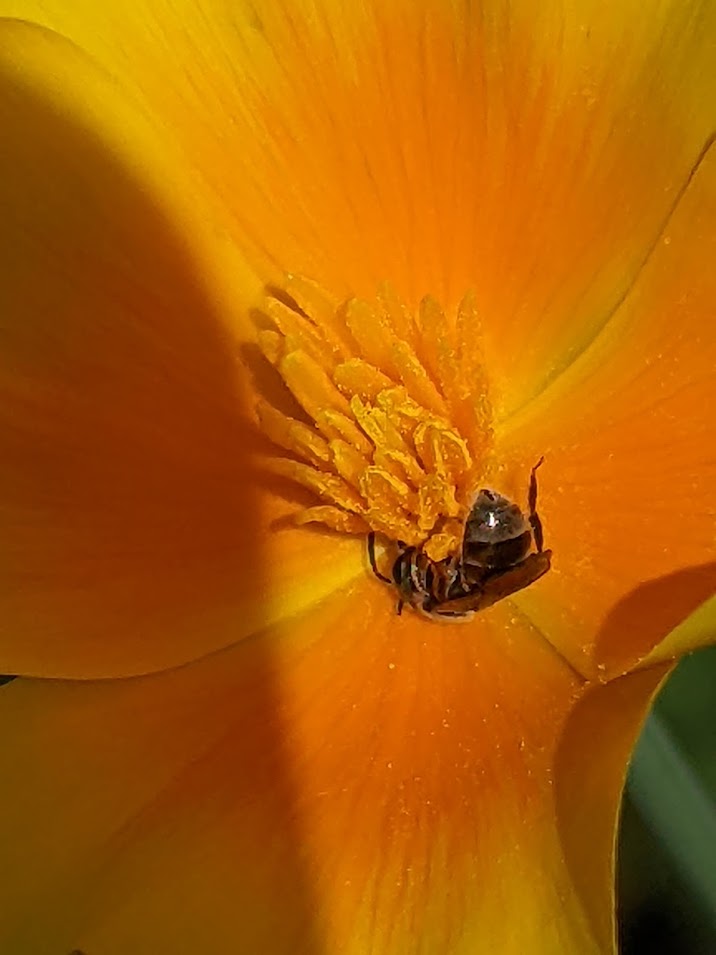
I wish I had photos of all the bees we have found on our little quarter of an acre. We have ground-dwelling bees, bees that love hollow stems, bees that are less than 3/8” of an inch (2CM) all the way up to the big, fat bumblebees that seek out our rhododendron blooms in the early Spring. The bumblebee is especially “of concern” ecologically. Some species of bumblebee are teetering on extinction, like the rusty-patched bumblebee. Bumbles pollinate more plants than honeybees and are native to our continent. (Honeybees are not native bees, are not threatened, and are a thriving industry. They are fine.)

We don’t begin to rake up the leaves and clear out the dead fall around the daylilies until the temperature has been hovering around 50° (F) for a week. This allows the bees, butterflies, moths, and beetles time to warm up, hatch out, stretch their lags and wings, and begin the summer-long process of pollinating flowers, vegetables, and fruits. Certainly, some of these are harmful insects (non-beneficial) but most of them are “good” guys: the beneficials. And beneficials are necessary for the ecosystem.

We learned recently that it helps to not “deadhead” all of the flower stalks, but to cut them down in lengths. Bees and other beneficials hibernate inside the plant stalks, slowly emerging as the air warms and the days get longer. I don’t deadhead a lot of the seed plants: evening primrose, mullein, asters, and goldenrod. The birds dine on the seeds throughout the winter. I never thought about insects.

That messy pile of tree limbs and branches we have yet to get rid of is not only home to our dog’s “beaver hut” (he has quite an excavation under the pile!) but is home to more insects trying to find a good place to overwinter. And here I was, thinking we’d have to finally cut the wood up and recycle it somehow!

That patchy mess we loosely refer to as a “lawn” out front encourages ground dwelling bees and gives us impetus to turn the yard into a meadow of native wildflowers, further encouraging native pollinators to stay and thrive. I am excited to add native plantings to the lawn with more flowers and less mowing! (I will probably have to paint a sign explaining to my neighbors why our yard isn’t as “pristine” as their golf-club perfect lawns or patches of sterile gravel.)

We already grow a lot of native plants, some purchased from nurseries, some collected from the wild, and some that birds introduced by pooping on our yard. The Xerxes Society provided me with a list of more natives, many of which I can purchase seeds for through local nurseries. Yee haw! I’m watching little $$ fly out the window, but it is SO worth it to create a habitat for miniscule creatures like bees.

I’m not going to go into how we depend on native pollinators and how their declining numbers impact our very own survival. You can find that information and more through The Xerxes Society. This non-profit is based here in the Pacific Northwest but reaches out across the continent. It is my favorite non-profit, close to my heart (BUGS!), and is highly rated as a non-profit. You may not think something so Lilliputian might impact our giant lives, but we depend on insects and invertebrates for so much. I’m not a rabid “tree hugger” but when it comes to insects… Well, I’m probably a rabid “bee hugger.”

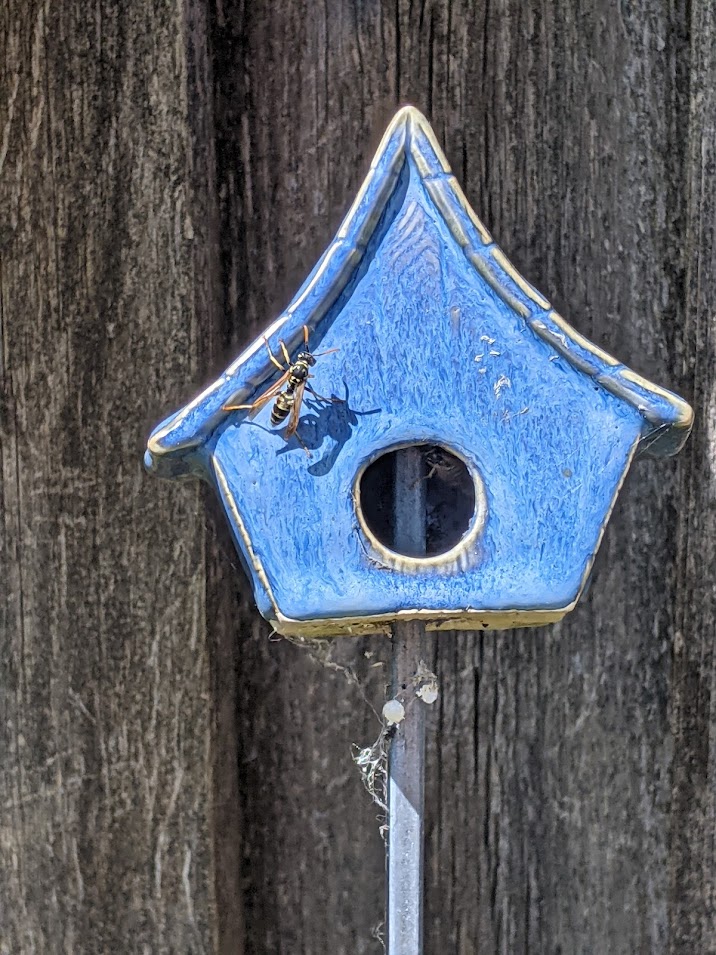
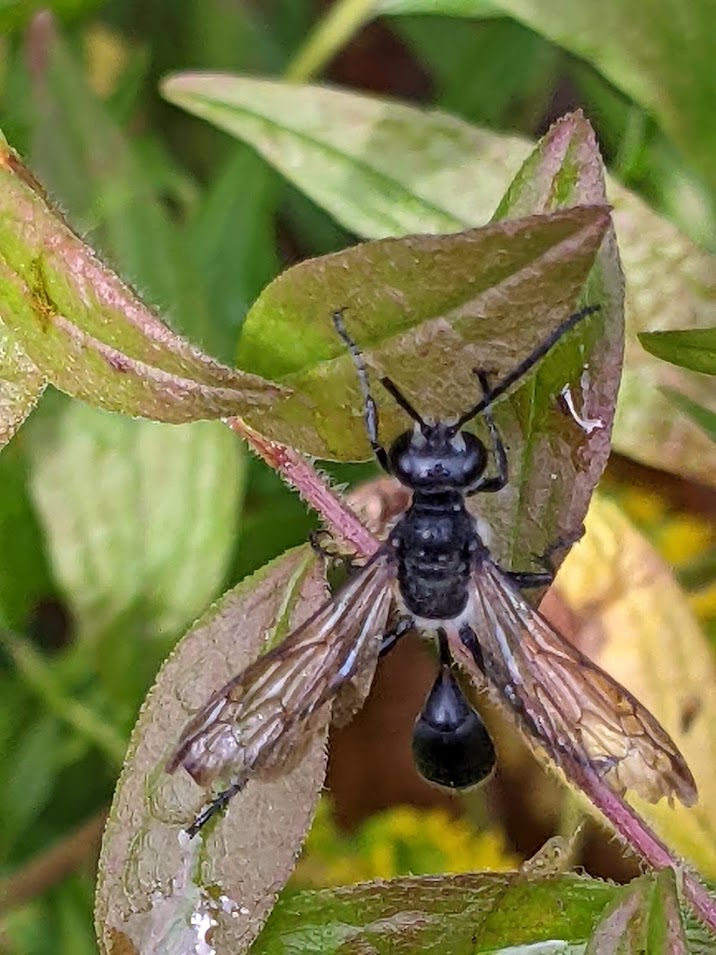
(I also do not know all the bees, wasps, and hover flies I photographed and posted to this article. I apologize for the oversight, but all photos are mine.)

Read Full Post »

I have decided to turn this blog into a Gardening blog. I find myself drawn outdoor more often now that I am retired, and I am even beginning to delve into the murky waters of maintaining houseplants without killing them. I have a lot of gardening how to and how not to ideas, along with my own journey into landscaping the property we currently live on (and, hopefully, any property we move onto in the future, assuming we don’t end up in some Senior Living facility where I will be forced to garden houseplants).

I did get quite a bit done in the garden in 2024. The biggest item on my to-do list was to build a retaining wall inside the vegetable garden area. I bought a pallet of concrete stones a couple years ago (like, three or four years ago). The pallet has been sitting in our driveway taking up valuable parking space for that amount of time. I had a vision of what I wanted to do but the excuses for not doing it were myriad.

I’m not going to kid you: I am 68 years old and things are a little harder to do now.

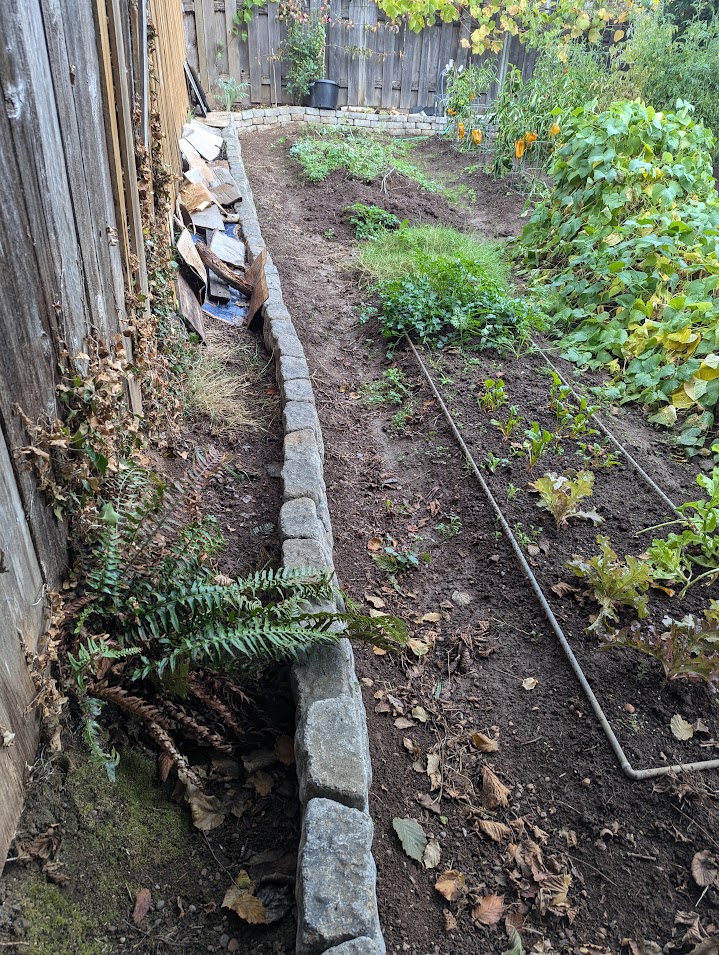
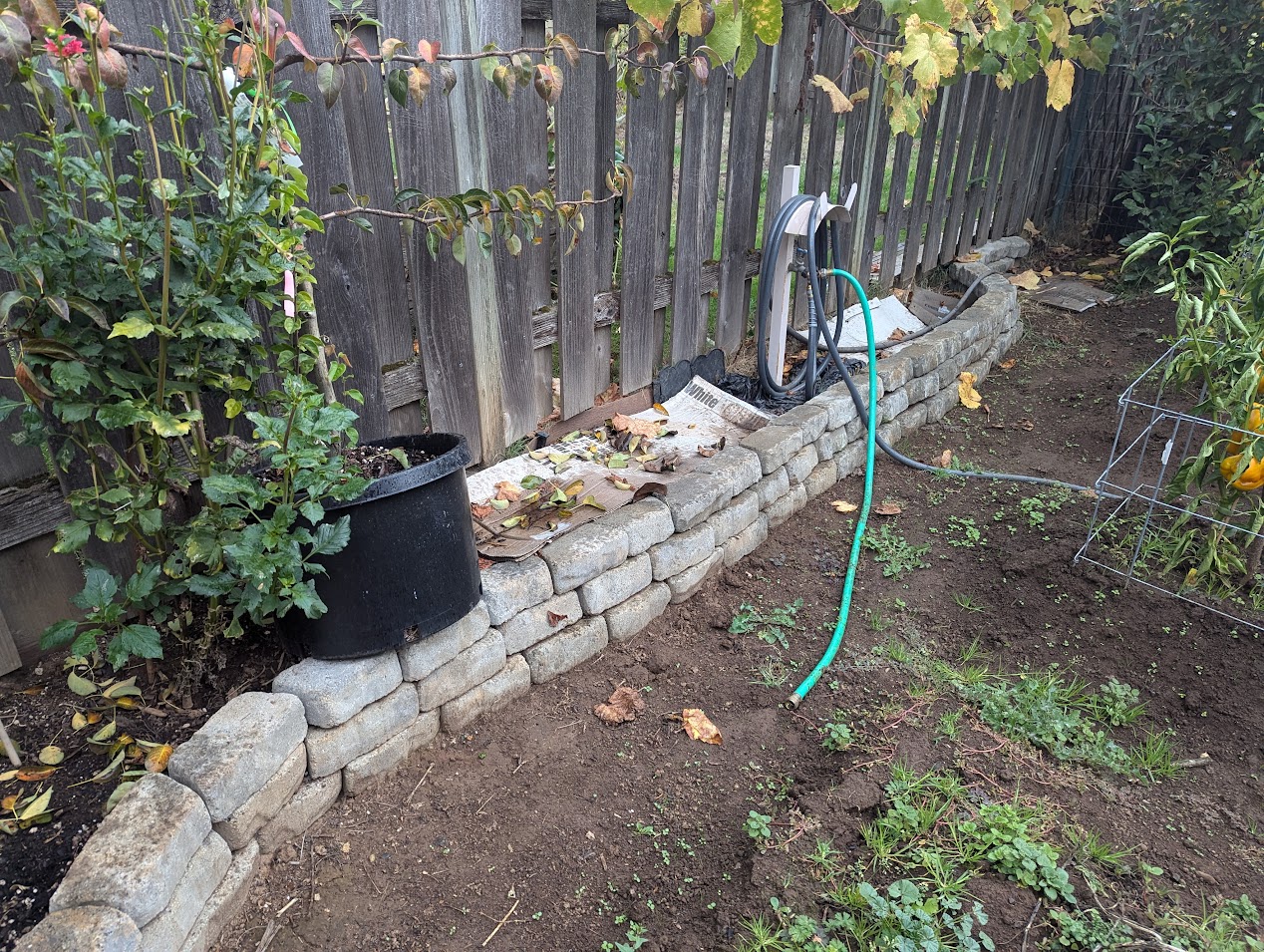
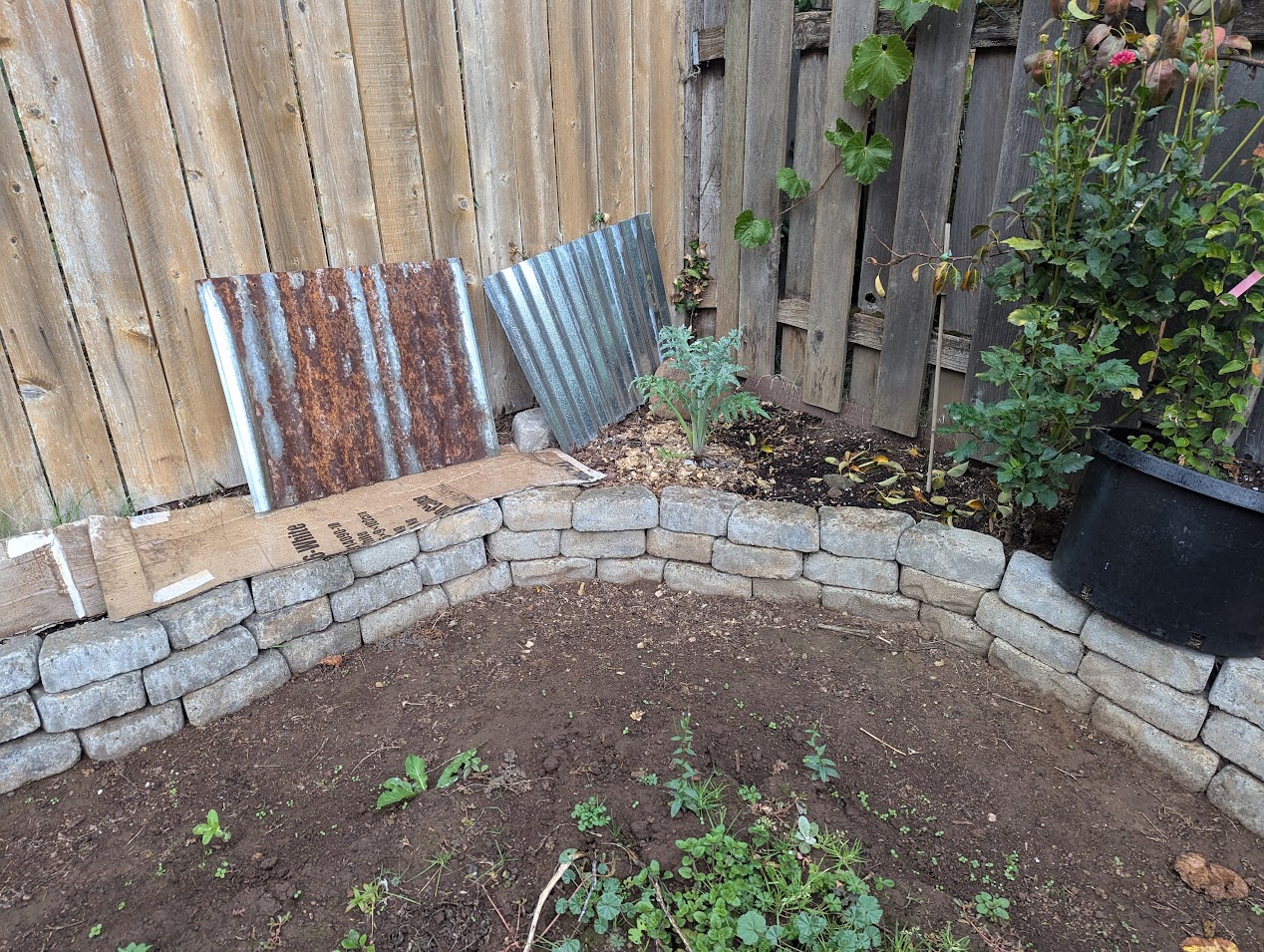
But I sucked it up last summer and started hauling rocks from the driveway into the veggie garden area. The idea is not only to stop the neighbor’s gravel from eroding into our yard, but to create a long planting bed along the edge of the fence.

It’s almost complete: I have enough rocks left over to put one more layer around the fence, enough corrugated tin to use as a weed/gravel barrier, and then we need to put good potting soil into the space created. It’s not as straight as it could be, but I did it entirely myself, from the weed removal to the rock hauling (well, I coerced a certain someone to help a little with the rock hauling, but most of it was my back ache). My husband will be elected to cut the tin into smaller pieces but I will tell him that when the weather improves and I finish the planting beds.

Now, we just have to agree what plants are going to be planted in that border bed. I want a large rhubarb somewhere in there. My husband has already planted an espalier pear tree and an artichoke that hasn’t produced fruit, but also hasn’t died. We haven’t had a killing frost yet this winter so it may still die. Then, again, maybe it won’t and 2025 will be the year that we get at least one artichoke from it.

My favorite project of 2024 was a bird bath that I made out of a discarded pedestal to a sink we pulled out of our bathroom during the remodel. I placed it in the center of the lawn south of our new deck and dug out a flower bed around it. I placed native round rocks all around that and planted some annuals (I rarely garden with annuals, but it was late in the season, and they were all I could find at the local nursery). I will replace them with something perennial in 2025.

I have multiple bird baths of different depths and sizes: this is the one the crows love. The only expense was the bowl I used for the basin: $4.99 at a thrift store. E6000 is the glue I used to attach it to the pedestal.

Read Full Post »

I spent several hours in the garden today. It is mid-October and things are slowing down. I haven’t watered in a few weeks, trusting the rains to come and do the work for me. The rain has been sporadic but comes often enough that even the planters remain green and growing. The rain barrel is full and soon I will have to close it off for the winter. I lost one rain barrel to a late winter’s freeze when I forgot to drain it, I don’t wish to do that again.

I cleaned one birdbath, the one the crows drop pieces of dog excrement in as they search for undigested peanuts. It’s a battle: the dog wants the bird peanuts, but he doesn’t even chew them: he swallows them whole, shell and all. The crows have learned there are nuts to find in shit, and they soften said shit in the water they (and other birds) are supposed to use for drinking and bathing. I console myself that they are no longer leaving me gifts of newly hatched birds in the water. Crows or raccoons: someone has to wash their food.

I try to get a late edging around my flower beds to discourage the spring growth of grasses (plural) which make spring weeding miserable. Grass and wood sorrel, my chief enemies. I cut the peonies to the ground now. I leave the evening primrose stalks of rich seeds along with the Russian sage and black-eyed Susans: the goldfinches, house finches, juncos, and chickadees will feast of them throughout the winter. So, too, the oregano. The rosemary is just beginning to bloom and honeybees swarm it in the waning Autumn sun.

I have finished most of my flower beds already. Mentally, I note where certain plants are that need to be moved in the spring, and which ones will need to be moved later in the Fall, when the stalks have died back, and the rhizomes or bulbs are left. I divided my Dutch irises a few days ago, today I dug up a couple dozen rhizomes of the purple ones and set them on the corner in a box marked “free”. I have more than enough purple Dutch irises, ones my father gifted me many years ago from my mother’s garden. I keep the blue and white ones, my favorites.

Once, someone on an Internet forum tried to school me on how to take care of irises. I was wrong, he said, to state that irises are basically weeds and need little care. I laughed. My irises came from 6500’ elevation in Nevada. My mother had them planted in gravel, on the southwest side of the garage, under the shadow of the motorhome. She died in 1995. My father hated irises and left them to die. Sometime between 2002 and 2003, he dug them up, threw them in a box, and shipped them to me, here, in the fertile Willamette Valley. I have divided them three times since then and given countless ones away. Irises are basically weeds and can survive a lot of abuse, drought, ice, snow, and even slugs, the latter being their greatest enemy in my garden.

I do kill some plants. Sometimes I do it intentionally and sometimes they just don’t like the way I treat them. Houseplants are usually the first to turn brown leaves upward and refuse to put out new roots, but I am getting better at keeping them green. I don’t always know why a certain plant will not take off in my yard, especially when I have had some degree of success with the plant in the past. Flowering currant, a native to the Willamette Valley, is one such failure. I grew it at another house, but it has failed to take root in this yard, and I have tried numerous times. But it took me over three years to rid my garden of comfrey and Japanese anemonies, and I am still battling fireweed (although not too fiercely, as I rather like fireweed).

This past summer I experimented with growing more native herbs. I already had several herbs in the ground but expanded. I planted nettles in a planter and kept them cut back so they could not go to seed and spread in my yard. I harvested leaves, dried them, and have already tried them in tea. I wore long sleeves and gloves when I harvested them: I have memories of crawling into a nest of nettles under the aspens in the Ruby Mountains when I was a girl. It was not pleasant. I don’t blame the nettles, but the little girl who didn’t pay attention.

I harvested yarrow and feverfew. My husband wants me to grow colorful yarrow next year, not the plain white stuff of our childhood. I will no doubt oblige. I have Lady’s Mantle, Holy Basil, Elencampe, sage, lavender, wild sorrel (I didn’t plant that, it has taken over our “lawn”), mallow, thyme, hyssop, elderberry, and more.  Sometimes, I just sit and stare into my garden and the many flower beds and wonder what all I have planted and what I can harvest and what I should get rid of or introduce.

My garden is a canvas. I have plants I dislike and some I even hate: grass is one. There are many kinds of grass, and I despise most of them. I like sedges. There are a couple ornamental grasses I can live with. But grass as a whole, I despise. I am allergic to most grass. If I could have a yard free of grass, I would be in Heaven. And for that reason, I grew flax this past summer. I hope to sow flax seeds into the lawn, mixed with the false dandelions and wild sorrel. I am slowly cutting out more and more of the lawn area for flower and herb beds. I don’t think about the color or composition as much as I think about eliminating the grasses.

I reached a place where I must quit garden work. The largest flower bed has been cleared and most of all the other ones are winter-ready. I still have peonies to cut back, and asters that are just now fading which will need to be dead-headed before the cold sets in. There is one tree peony that I hope to dig up and transplant into a container, separating the grass from its roots and (hopefully) giving it a new start at life. It is probably fifty years old and I wish to be very careful.  I moved one tree peony two years ago and it is happy in its new location. I can do this.

Photo: climbing nasturtium that took all blessed summer to grow and is finally climbing and blooming right before the rains come.

Read Full Post »

Warning: this is strictly a gardening post. It is advice on how to handle Creeping Myrtle when she gets out of control.

Don’t worry: you don’t need a stun gun. A shovel will come in handy, however.

Flash-back: nearly 29 years ago. We lived in a cute bungalow with a wonderful shade garden. We had no money and we were robbing Peter to pay Paul, and we lost the cute little bungalow to our bad debts. In the meantime, I learned to garden in the Willamette Valley, and I first encountered the encroaching powers of Periwinkle.

It grows slowly. It is nowhere as invasive as the dreaded English Ivy (she’s a real bitch in the gardening world, and the City of Portland has banned her from yards) or Kudzu, that invader from the Far East. He’s a nasty invader.

Myrtle, however, is patient. Shallow-rooted. She is also a European invader, but one which can be contained with a little patience and an investment in labor. When I was young – 29 years ago – it didn’t seem like it was all that hard to trim the Periwinkle back. I managed to contain it to one flower bed. It wasn’t “hard” in my mind: I just put a shovel under it and “rolled it up” like a carpet, eventually cutting off all the runners and roots when I rolled up the periwinkle carpet to the point I wanted to contain it. So easy to do when you’re still young… And there are no peonies to save.

Flash forward to a much wiser and much older us. When we moved in, I noted the variegated Vinca Minor that grew in the little triangle flower bed. “I’ll cut it back when it becomes a nuisance,” I thought. I was still in my forties.

It grows slowly, did I mention that? So it took it ten years to cover half the triangle. The triangle is an area about 12’x10’x6′. The problem is this: there are several peonies in that triangle, and they have slowly been choked out by the pretty purple  ground cover.

This weekend, I decided that I really needed to tackle that project. I forgot that I was in the latter half of my fifth decade. The weather was cool and over-cast and I watered heavy: what could go wrong?

Oh, age, time, sunshine, and the fact that the Periwinkle grows so thick that water doesn’t penetrate the foliage enough to moisten the soil adequately for removal of the creeping vine. Nothing else.

Basically, it was the same procedure I used back when I was young: you get a shovel under the Periwinkle and lift it up. Lift and shake the topsoil from the roots, and cut the vines until you pull off an entire section. Repeat. If you do this early enough in the life of the plant, you can contain it to one area and keep it from invading where it should not.

I never maintained it and I had half the triangle to clear out.

Truthfully, I originally thought I’d just hack it back a little. But when I got started, I realize I really didn’t want to do this again. *Ever Again.* It was either clean the Vinca Minor completely out of the bed or repeat this procedure in ten years, when I’d be pushing 70. Um, NO.

It took me two days. I worked hard until the cloud cover burned off and the radiant heat from the garage (the north side of the triangle) forced me to give it up. I retired a pair of jeans and a sweaty t-shirt by 1:00PM on Saturday. I was wobbly-kneed, dehydrated, and sore in every muscle. I sat in the lawn chair and stared at this now-nemesis of mine.

I like Creeping Myrtle. The flowers are pretty and they last in a bud vase. The foliage is evergreen and the variety in our garden is a variegated kind which is striking. But as of yesterday, I hated it in that triangle. I hated it because I knew that if I didn’t get it completely out of there, that it would eventually come back and haunt me – or haunt whoever takes over this home when I die.

I’m pretty certain Barney did not plant it.

Barney Schultz bought this house in 1930. It was partially built then and he finished it. He raised animals, ran a butcher’s shop out of the garage (or somewhere nearby) and he loved peonies. Eventually, he sold off most of the land and gave up making sausage. But he never gave up on growing peonies. Sometime in the 1970’s or early 1980’s, he carried arm fulls of peony blooms across the street for the neighbor’s daughter’s wedding celebration. Everyone who knew Barney remembered his passion for peonies. My 85 year old neighbor to the north tells me that the yard was once a “meadow of peonies”.

Barney would not have liked the Periwinkle. Of course, he would have hated the grass that invades the peony beds, too. And the mole that cruises the yard, but that’s another post.

As I hacked at the last yard of Periwinkle, I felt like Barney was standing on the sidewalk, looking down. “Thank you,” he whispered, “for saving my peonies.”

077

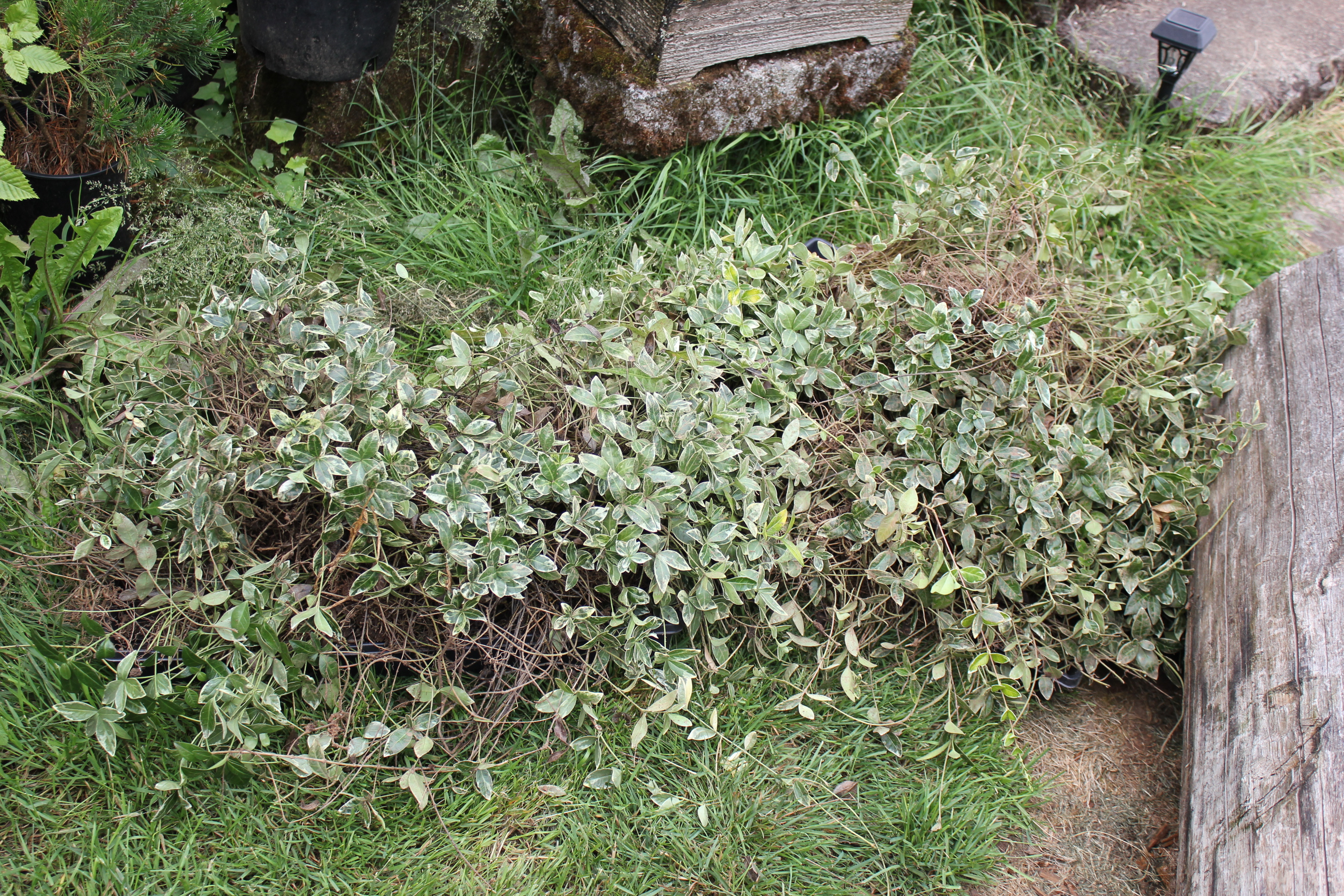
It looks pretty barren now that I am finished. I moved some of the creeping thyme in hopes that some day I will have to “control” that as well (it’s even easier to control)(that’s the green bit of life to the right of the photo). The peonies that have been buried for 10 years breathed a sigh of relief.

078

I saved three flats of Myrtle.

I asked my husband what he thought I should do with it. Put it out on the street with a “free” sign?

He said, “Plant it under the lilacs.” He hates mowing under the lilacs. It grows slowly. I don’t have to give up the Periwinkle entirely. It’s a win-win solution.

I’ll do that next weekend. I’m too tired to think about it now.

Read Full Post »

« Newer Posts