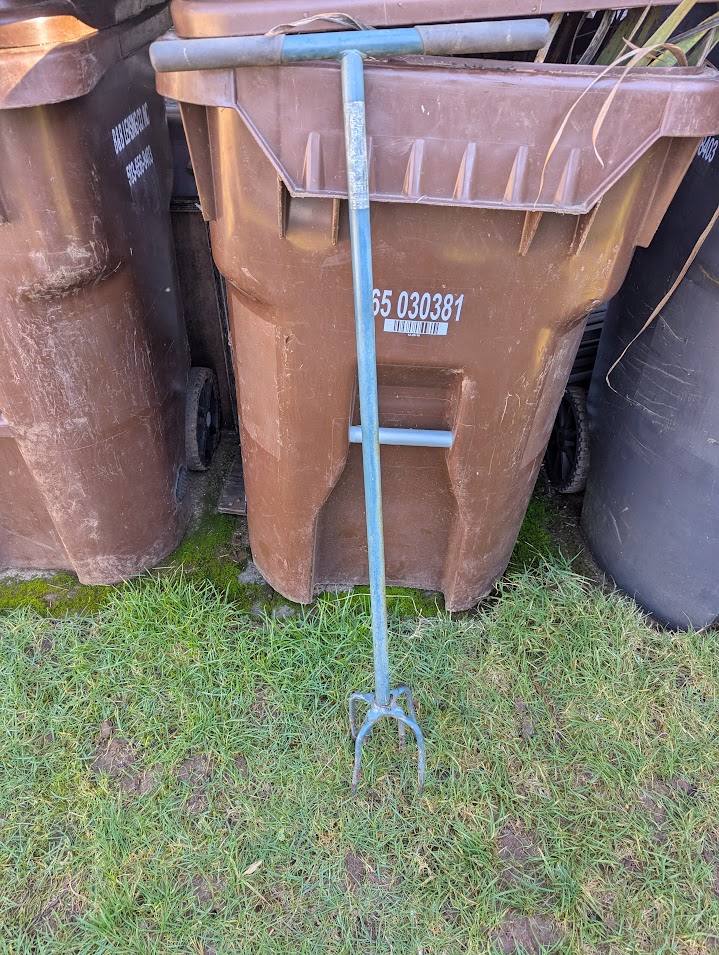
I wrote last week’s garden post without remembering that I own a manual tiller. I don’t use it for tilling which is why it didn’t register on my brain. I use it to help turn the compost. I do have a compost turning tool, but between the pair of them, I can get quite a bit of things turned and mixed inside the compost bin.
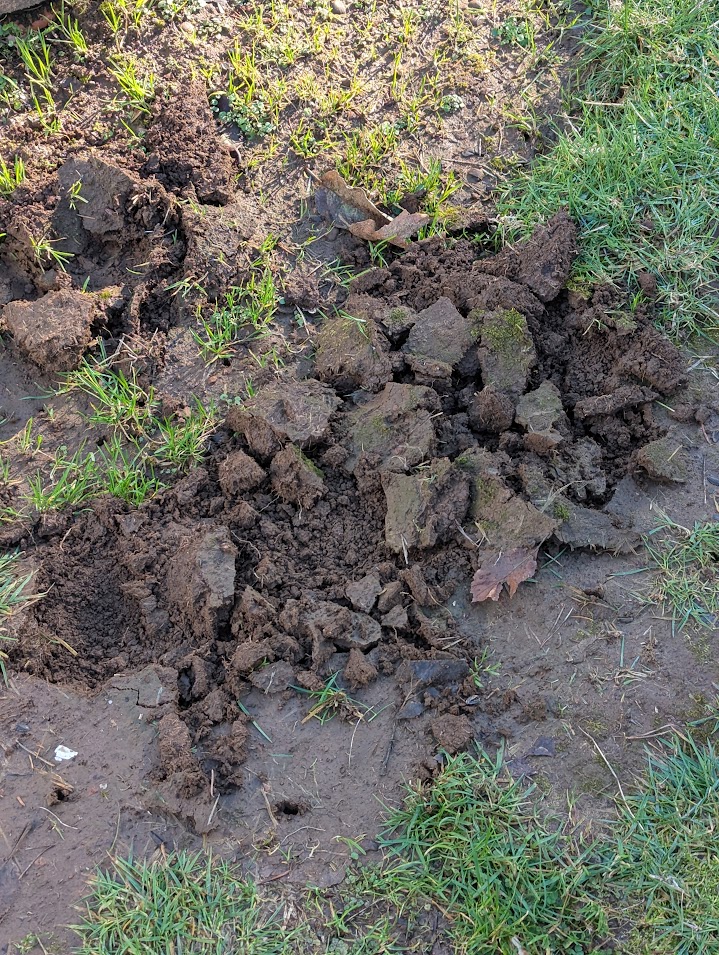
Here’s the tool. You are supposed to press it into the ground and twist, but I never had much luck with that maneuver. The ground needs to be soft, to being with. Compact grasses and sod are too much for it. It does work well in muddy soil.
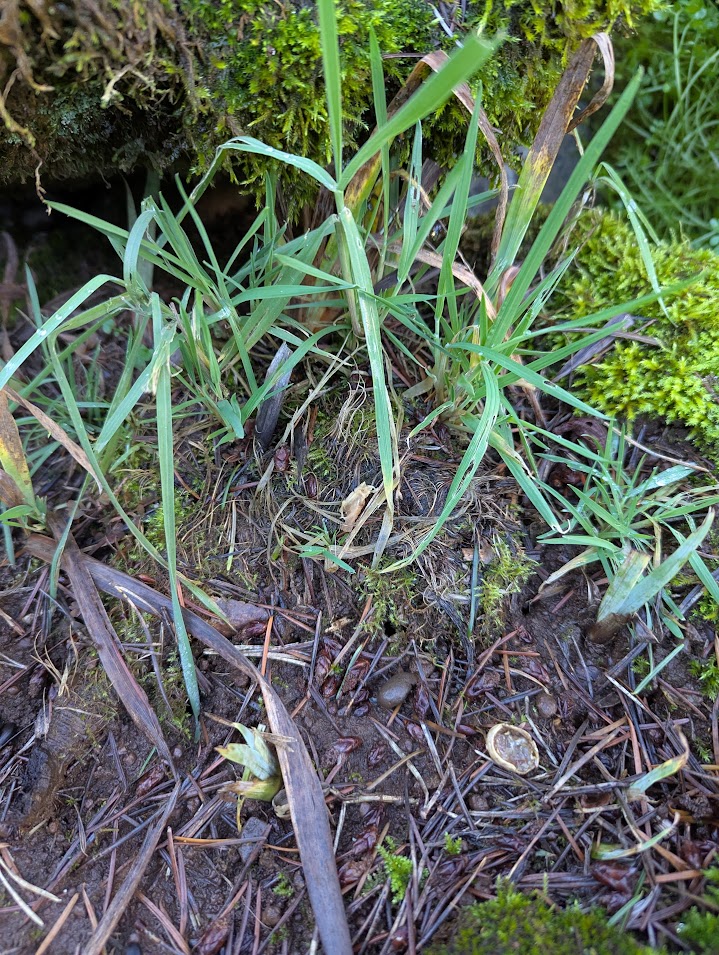
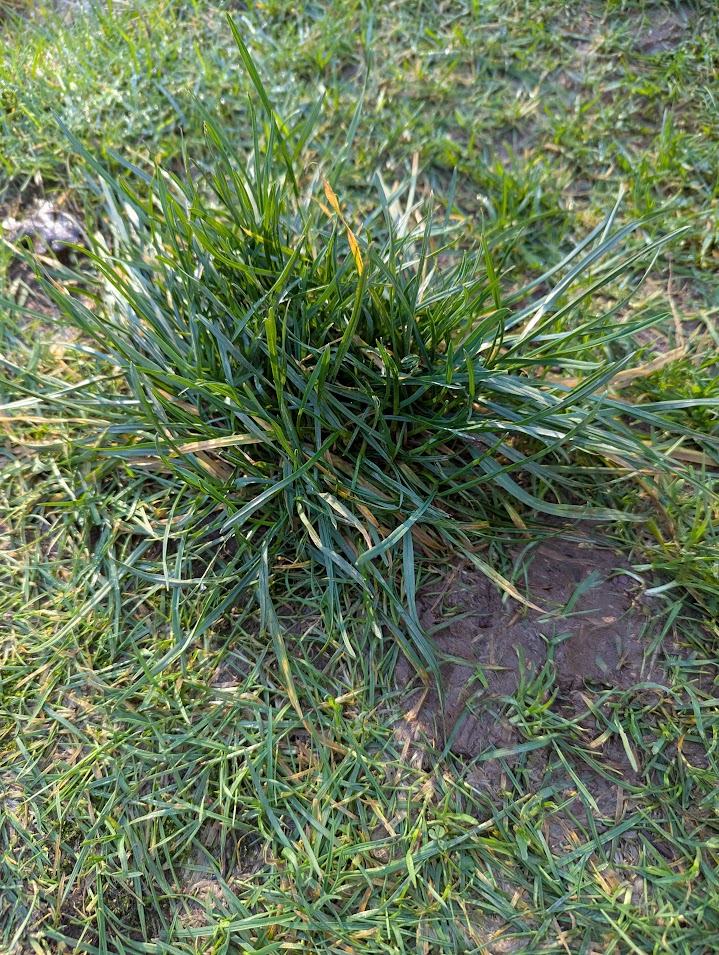
I tried it out today with varying degrees of success. The most important thing to remember is that it still requires a lot of twisting which eventually screws up my old back. I got it to work in mossy grass, in already loose soil, and in muddy soil. Bottom line is: it is only going to work to a moderate degree and I still need to purchase a motorized small tiller of some variety.
While I was at it, I turned the soil inside the compost bin with the official compost bin tool. You push the tool deep into the compost and pull it out. The little blades open and pull up stuff from the bottom of the compost. I pulled up a lot of decomposed matter, soldier fly maggots, and red worms. The latter two creatures are extremely beneficial to compost and a sign that one’s compost bin is working.
I purchased the bin for a small fee from Metro. The tools I bought online. The compost comes from several areas: the kitchen, the lawnmower, and the firepit. We compost eggshells, rotten vegetables, leftovers from vegetables, and whatever we pare from fruits, onions, potatoes, and the like. Grass clippings get added in the early part of the growing season, before the grass goes to seed. Flower discards, but never weed discards. Charcoal and burnt ends from the barbecue and the firepit. It takes a couple of years to heat up enough to create soil or mulch, but that’s just that our yard sits in the shade for six – eight months of the year. The bin gets as much sun as possible.
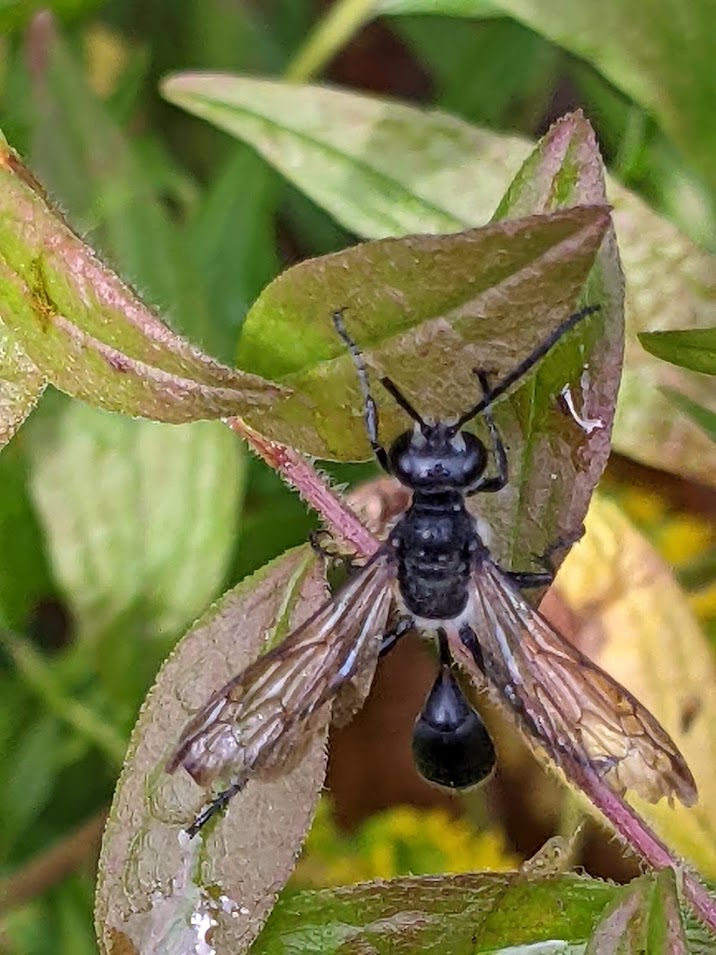
Soldier flies are only one of the major composting insects we harbor, but they are probably the most important. They are large flies, don’t come into the house (except by accident), and live only to mate and lay eggs in the compost. The compost keeps the eggs and maggots warm, then they pupate, and more flies are born. It’s a very cool life cycle. The red worms are great for bait fishing, but they seem to stay inside just the compost bin: we have a yard full of earthworms that aerate the soil and feed the few moles that dig through the yard in search of a meal.
Earthworms and moles are both beneficial to the yard, although moles do occasionally upset some plant roots whilst they search for their favorite protein: earthworms. Moles also prey on crane fly* larva and cut worms, both very destructive insects.
*We used to call crane flies “Mosquito hawks” because they look like giant mosquitoes without the proboscis. They don’t eat in their adult stage: that’s for mating and laying eggs, hovering around outdoor lights, and scaring the bejesus out of people who don’t know what they are. It’s their larvae that damage the roots of grasses and plants, but mostly grasses.
Here’s a garden hint for the do-it-yourself old-timey organic gardener: cardboard.
I have spent too many years with an edger and muscle power digging out sod for new flower beds (or just to preserve flower beds already invaded by grass). I would cut out little squares, then slice the edger underneath and lift up the square of sod. In the right conditions, you can shake out most of the soil caught up in the roots, but that doesn’t happen most of the time. What you have just lifted out of the ground is now something you can’t put into your personal compost (grass, roots, seeds of weeds are all a huge no-no in a small compost.) or into the public yard debris bin (if your community does yard debris pickup, even).
The “lawn” consists of at least six different types of grass in our yard. From what I can discern there’s two kinds of pasture grass (a fescue and one “Yorkshire Fog”), two bluegrass, one rye grass, and one native bent grass. Several of those spread by rhizomes and “root runners” – those are the worst!
Your personal small compost pile probably does not get “hot” enough to kill the grass roots or weed seeds. They will break down (albeit VERY slowly) into something resembling soil, but when you use it, the grass and weed seeds will gaily sprout upward and you have more weeding to do.
Where we live, we have a yard debris service that is “free” (included in your monthly garbage bill, extra for extra bins which we always need). This yard debris is hauled to a commercial composter where the compost gets hot enough to destroy all those seeds and grass starts, but here’s the caveat: they don’t accept sod with soil clinging heavily to the roots. And sod *is* heavy.
I developed a system whereby I hauled the sod to the hazelnut tree and tossed it underneath, root side up, to die. Nothing grows under it except for the stray Himalayan blackberry and a bit of escaped English ivy (both are a pestilence). I have tried. Everything ends up dying like the sod I toss under it, and the sod takes years to break down into soil under the hazelnut (but doesn’t resprout, because nothing grows under hazelnuts except the aforementioned invasive plants. I’m working on getting rid of those).
I was young and had energy and muscle tone in those days. I also knew I was losing a lot of precious topsoil with that approach. My new flower beds were lower than the ground around them.
The cardboard idea has been around for a long time. I simply hadn’t tried it. Who wants large, open boxes of brown cardboard melting in your yard in the rain over the winter. (Love all those prepositional phrases in one sentence!) The winter of 2023/24 changed my mind. I’m getting older and slower and the edger is losing its sharpness (I know: a trip to a tool sharpener would fix that issue in a jiffy and for a sum). I decided to give the appearance factor a good “who cares?” and I placed cardboard in the front yard where I wanted a new flower bed.
The result was wonderful. Awesome. The grass (such as it is in our yard – more on that later) and the sorrel, the false dandelions, dandelions, and even the thistles all died. I approached it the same way I had been doing, but now that the sod was dead, the soil just fell off the roots leaving me with just a handful of dead grass and roots. I tossed those items into the yard debris bin and shook out the soil (and consequent insects and arthropods and worms necessary for good soil) back into the bed. Sifted a few rocks out (OK, a LOT of rocks out – we live on top of a bluff formed by ancient lava flows and some sedimentary rocks, plus there was gravel dumped in the front yard by previous owners). The result was a fluffy bed ready for planting, rich in nutrients, and poor in repeat unwanted plant growth. My herbs thrived and I had little weeding to do through the growing season.
This Autumn, I added a lot more cardboard cover to the yard, estimating the amount of energy I hope to have in the Spring/Summer and where I want new flower beds.
This Spring, I hope to add a small rototiller to my repertoire, replacing the edger. I don’t know why I never got a small rototiller in the past. I enjoy the manual labor, I was only working with small yards, and I was too cheap to spend the money. My husband has a rototiller for the vegetable garden, but it is too large for the small spaces I work in and is never available when I want to work. That search and the result will be another blog post in the future.
I have decided to turn this blog into a Gardening blog. I find myself drawn outdoor more often now that I am retired, and I am even beginning to delve into the murky waters of maintaining houseplants without killing them. I have a lot of gardening how to and how not to ideas, along with my own journey into landscaping the property we currently live on (and, hopefully, any property we move onto in the future, assuming we don’t end up in some Senior Living facility where I will be forced to garden houseplants).
I did get quite a bit done in the garden in 2024. The biggest item on my to-do list was to build a retaining wall inside the vegetable garden area. I bought a pallet of concrete stones a couple years ago (like, three or four years ago). The pallet has been sitting in our driveway taking up valuable parking space for that amount of time. I had a vision of what I wanted to do but the excuses for not doing it were myriad.
I’m not going to kid you: I am 68 years old and things are a little harder to do now.
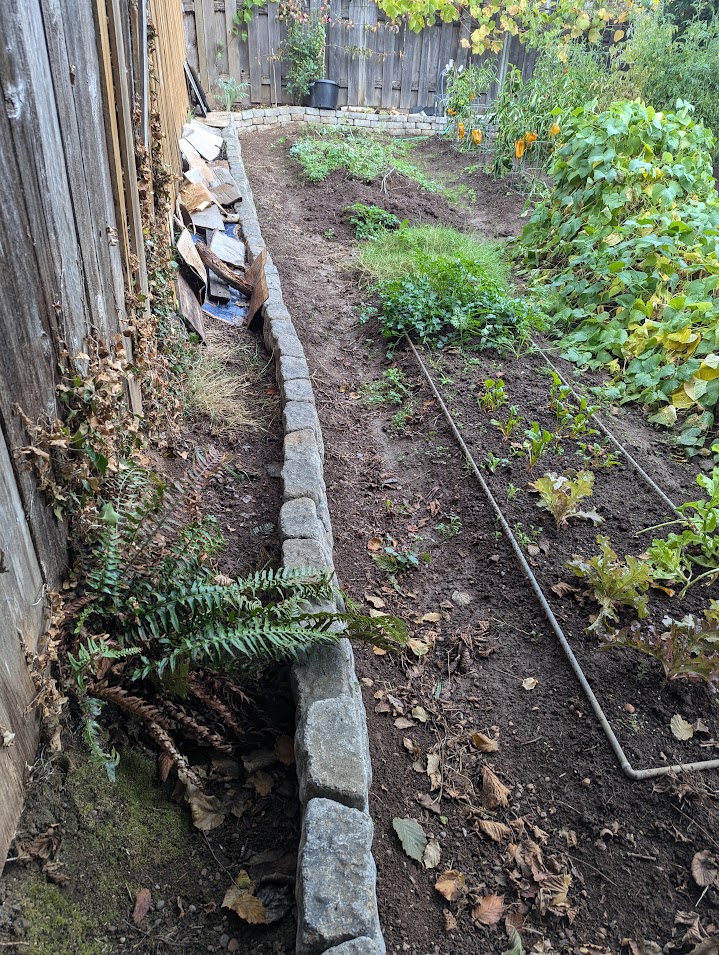
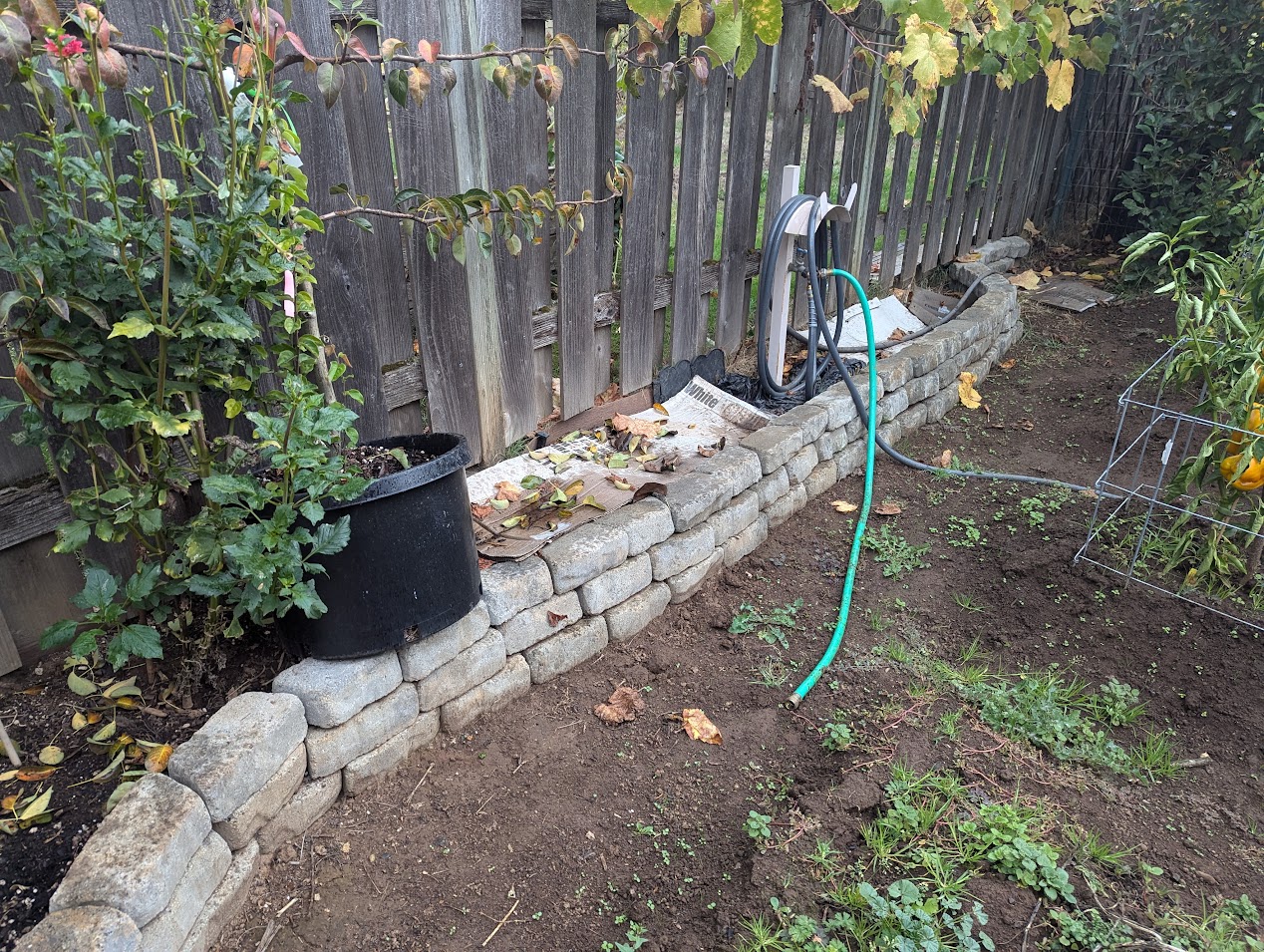
But I sucked it up last summer and started hauling rocks from the driveway into the veggie garden area. The idea is not only to stop the neighbor’s gravel from eroding into our yard, but to create a long planting bed along the edge of the fence.
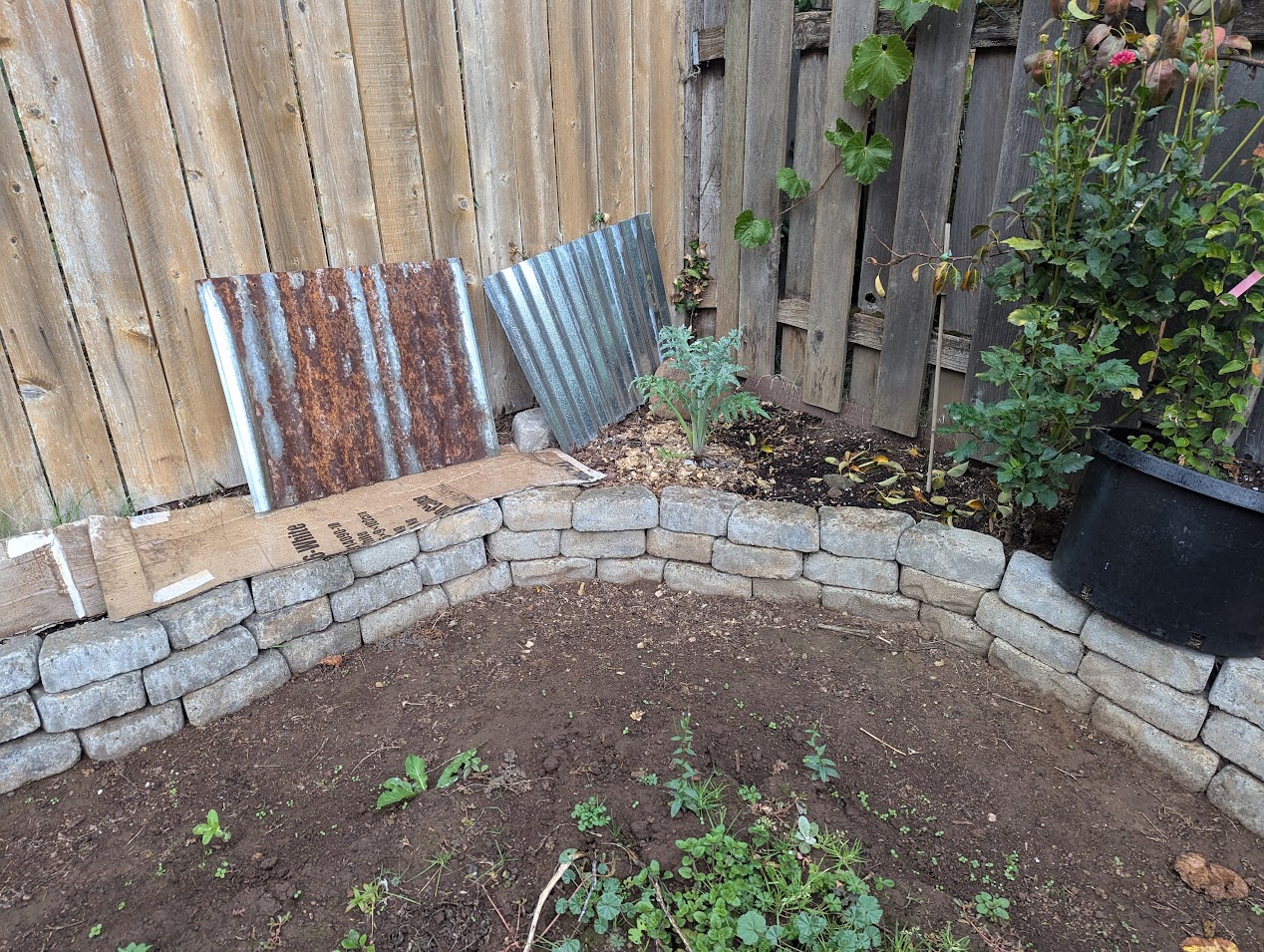
It’s almost complete: I have enough rocks left over to put one more layer around the fence, enough corrugated tin to use as a weed/gravel barrier, and then we need to put good potting soil into the space created. It’s not as straight as it could be, but I did it entirely myself, from the weed removal to the rock hauling (well, I coerced a certain someone to help a little with the rock hauling, but most of it was my back ache). My husband will be elected to cut the tin into smaller pieces but I will tell him that when the weather improves and I finish the planting beds.
Now, we just have to agree what plants are going to be planted in that border bed. I want a large rhubarb somewhere in there. My husband has already planted an espalier pear tree and an artichoke that hasn’t produced fruit, but also hasn’t died. We haven’t had a killing frost yet this winter so it may still die. Then, again, maybe it won’t and 2025 will be the year that we get at least one artichoke from it.
My favorite project of 2024 was a bird bath that I made out of a discarded pedestal to a sink we pulled out of our bathroom during the remodel. I placed it in the center of the lawn south of our new deck and dug out a flower bed around it. I placed native round rocks all around that and planted some annuals (I rarely garden with annuals, but it was late in the season, and they were all I could find at the local nursery). I will replace them with something perennial in 2025.
I have multiple bird baths of different depths and sizes: this is the one the crows love. The only expense was the bowl I used for the basin: $4.99 at a thrift store. E6000 is the glue I used to attach it to the pedestal.
I spent several hours in the garden today. It is mid-October and things are slowing down. I haven’t watered in a few weeks, trusting the rains to come and do the work for me. The rain has been sporadic but comes often enough that even the planters remain green and growing. The rain barrel is full and soon I will have to close it off for the winter. I lost one rain barrel to a late winter’s freeze when I forgot to drain it, I don’t wish to do that again.
I cleaned one birdbath, the one the crows drop pieces of dog excrement in as they search for undigested peanuts. It’s a battle: the dog wants the bird peanuts, but he doesn’t even chew them: he swallows them whole, shell and all. The crows have learned there are nuts to find in shit, and they soften said shit in the water they (and other birds) are supposed to use for drinking and bathing. I console myself that they are no longer leaving me gifts of newly hatched birds in the water. Crows or raccoons: someone has to wash their food.
I try to get a late edging around my flower beds to discourage the spring growth of grasses (plural) which make spring weeding miserable. Grass and wood sorrel, my chief enemies. I cut the peonies to the ground now. I leave the evening primrose stalks of rich seeds along with the Russian sage and black-eyed Susans: the goldfinches, house finches, juncos, and chickadees will feast of them throughout the winter. So, too, the oregano. The rosemary is just beginning to bloom and honeybees swarm it in the waning Autumn sun.
I have finished most of my flower beds already. Mentally, I note where certain plants are that need to be moved in the spring, and which ones will need to be moved later in the Fall, when the stalks have died back, and the rhizomes or bulbs are left. I divided my Dutch irises a few days ago, today I dug up a couple dozen rhizomes of the purple ones and set them on the corner in a box marked “free”. I have more than enough purple Dutch irises, ones my father gifted me many years ago from my mother’s garden. I keep the blue and white ones, my favorites.
Once, someone on an Internet forum tried to school me on how to take care of irises. I was wrong, he said, to state that irises are basically weeds and need little care. I laughed. My irises came from 6500’ elevation in Nevada. My mother had them planted in gravel, on the southwest side of the garage, under the shadow of the motorhome. She died in 1995. My father hated irises and left them to die. Sometime between 2002 and 2003, he dug them up, threw them in a box, and shipped them to me, here, in the fertile Willamette Valley. I have divided them three times since then and given countless ones away. Irises are basically weeds and can survive a lot of abuse, drought, ice, snow, and even slugs, the latter being their greatest enemy in my garden.
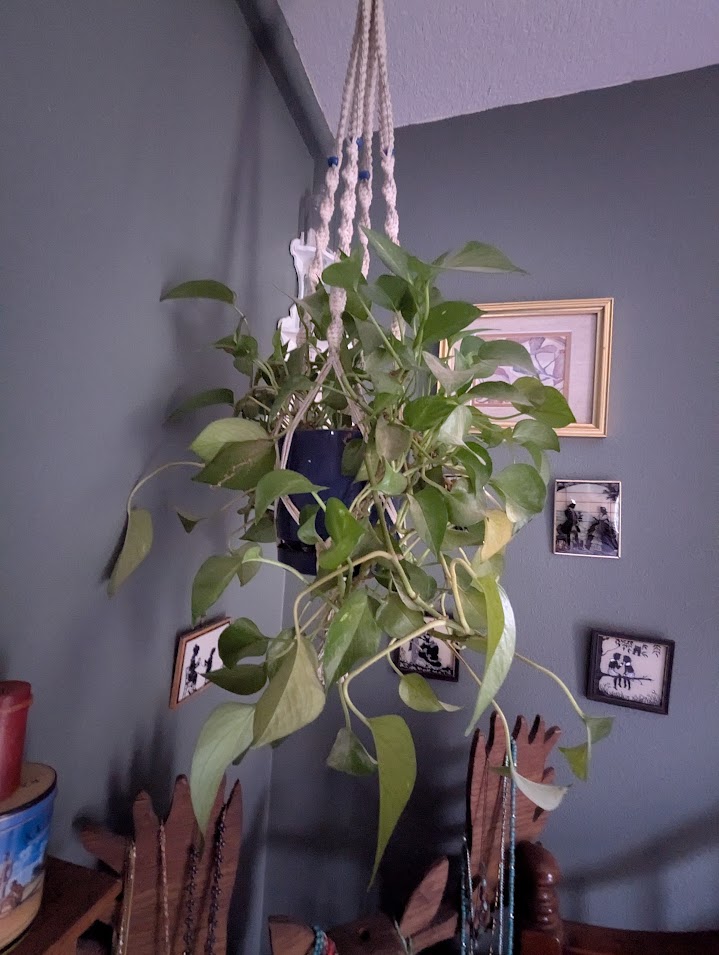
I do kill some plants. Sometimes I do it intentionally and sometimes they just don’t like the way I treat them. Houseplants are usually the first to turn brown leaves upward and refuse to put out new roots, but I am getting better at keeping them green. I don’t always know why a certain plant will not take off in my yard, especially when I have had some degree of success with the plant in the past. Flowering currant, a native to the Willamette Valley, is one such failure. I grew it at another house, but it has failed to take root in this yard, and I have tried numerous times. But it took me over three years to rid my garden of comfrey and Japanese anemonies, and I am still battling fireweed (although not too fiercely, as I rather like fireweed).
This past summer I experimented with growing more native herbs. I already had several herbs in the ground but expanded. I planted nettles in a planter and kept them cut back so they could not go to seed and spread in my yard. I harvested leaves, dried them, and have already tried them in tea. I wore long sleeves and gloves when I harvested them: I have memories of crawling into a nest of nettles under the aspens in the Ruby Mountains when I was a girl. It was not pleasant. I don’t blame the nettles, but the little girl who didn’t pay attention.
I harvested yarrow and feverfew. My husband wants me to grow colorful yarrow next year, not the plain white stuff of our childhood. I will no doubt oblige. I have Lady’s Mantle, Holy Basil, Elencampe, sage, lavender, wild sorrel (I didn’t plant that, it has taken over our “lawn”), mallow, thyme, hyssop, elderberry, and more. Sometimes, I just sit and stare into my garden and the many flower beds and wonder what all I have planted and what I can harvest and what I should get rid of or introduce.
My garden is a canvas. I have plants I dislike and some I even hate: grass is one. There are many kinds of grass, and I despise most of them. I like sedges. There are a couple ornamental grasses I can live with. But grass as a whole, I despise. I am allergic to most grass. If I could have a yard free of grass, I would be in Heaven. And for that reason, I grew flax this past summer. I hope to sow flax seeds into the lawn, mixed with the false dandelions and wild sorrel. I am slowly cutting out more and more of the lawn area for flower and herb beds. I don’t think about the color or composition as much as I think about eliminating the grasses.
I reached a place where I must quit garden work. The largest flower bed has been cleared and most of all the other ones are winter-ready. I still have peonies to cut back, and asters that are just now fading which will need to be dead-headed before the cold sets in. There is one tree peony that I hope to dig up and transplant into a container, separating the grass from its roots and (hopefully) giving it a new start at life. It is probably fifty years old and I wish to be very careful. I moved one tree peony two years ago and it is happy in its new location. I can do this.
Photo: climbing nasturtium that took all blessed summer to grow and is finally climbing and blooming right before the rains come.
Today was a wonderful day to get lost in the garden. My soul needs to get lost. The day-to-day pressure of this life wears on me. Dirt under the fingernails is healing.
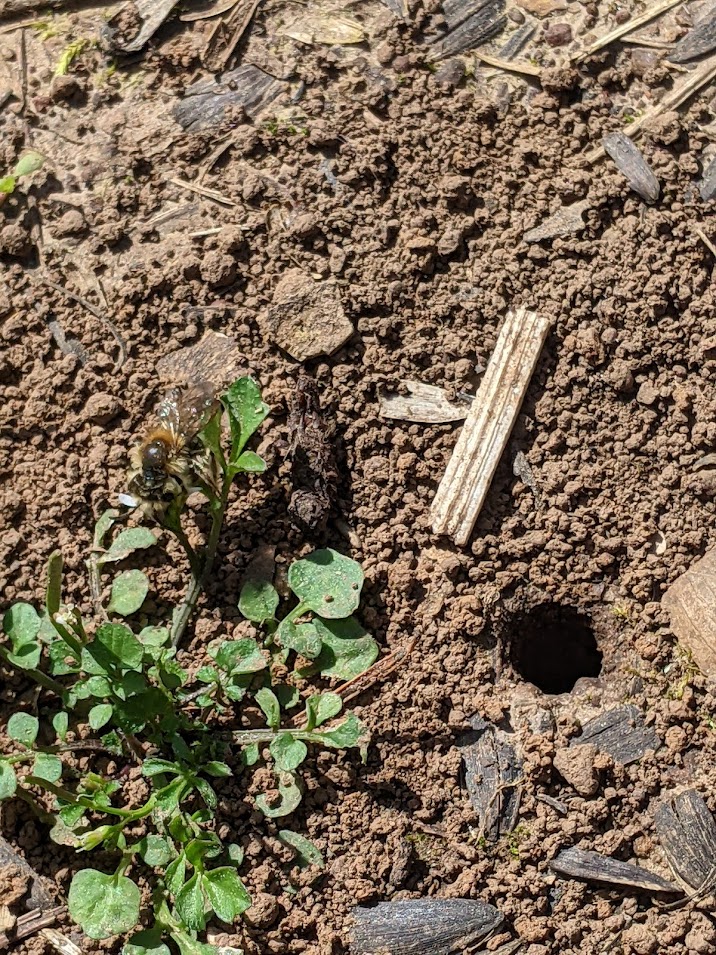
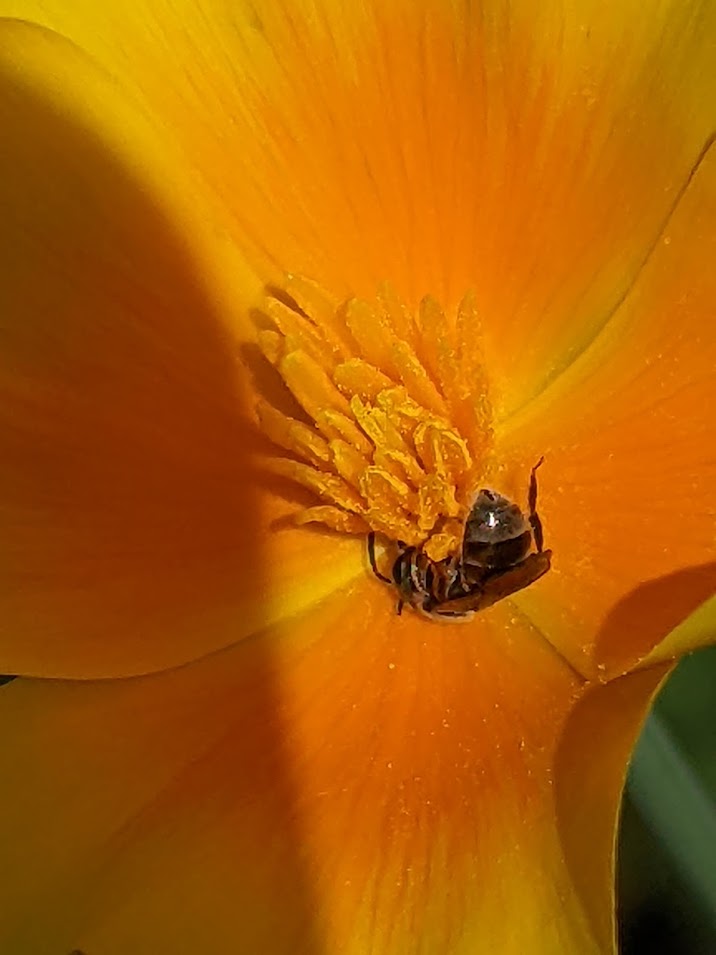
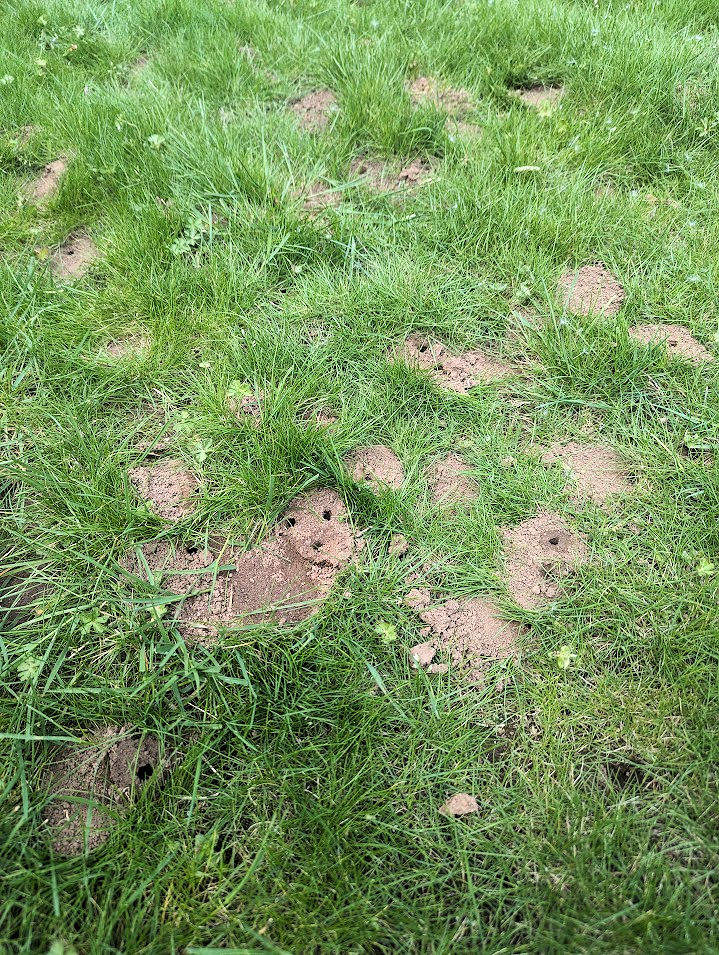
We discovered the neighbors have a small field of mining bees nesting in the bit of yard just north of our fence. There must be over a hundred little holes in the ground where the bees are laying eggs! Fortunately, this is the one neighbor that is an organic gardener and is interested in preserving native pollinators (especially as this species of bee is stinger-less and very laid-back).
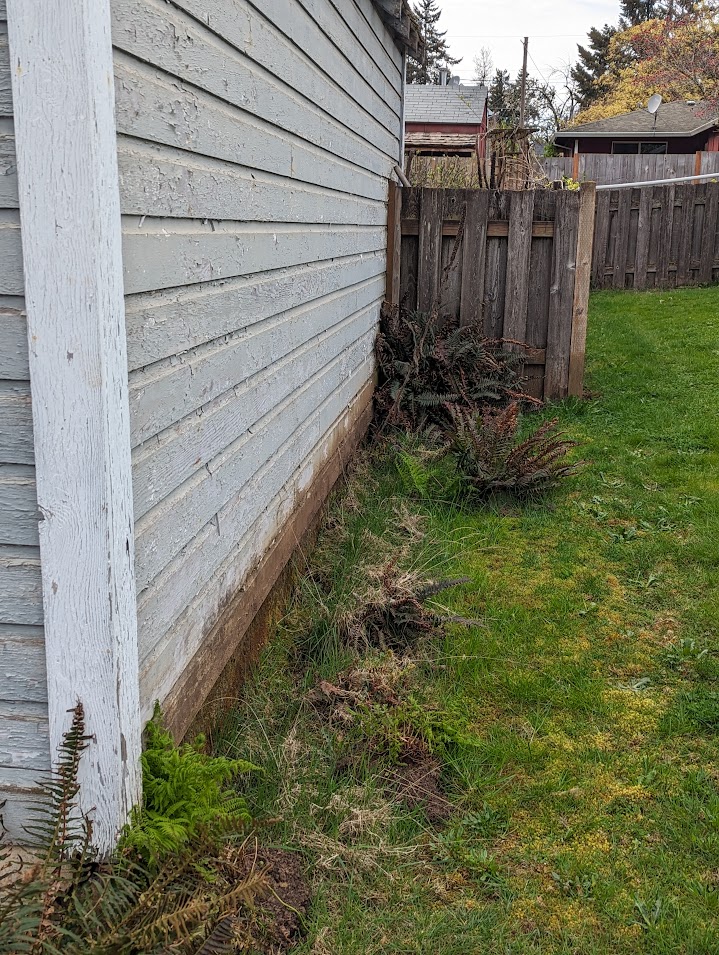
I planted four sword ferns on the north side of the garage, in that little strip of land that is ours but is a set back from the property line. The idea is to fill it in with ferns so neither the neighbor nor us will have to mow the lawn/weeds that grow there. We forget about it, and it isn’t their responsibility. Ferns the size of VW Beetles is the logical answer.
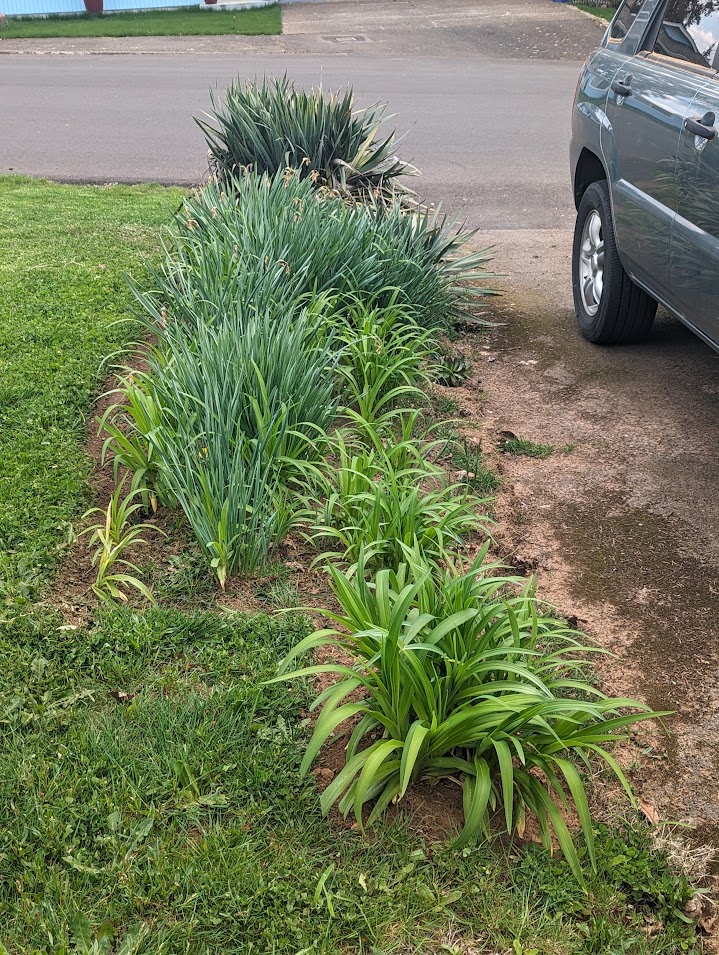
I filled in the part north of our driveway with orange daylilies and daffodils last Autumn. The yucca has been there 20 years (I planted it). There is still a section of about 4×3’ that needs to be filled in, but I’ll get there, eventually.
I fulfilled a promise today, too. I made this promise ten or fifteen years ago: that I would obtain a blackcap raspberry from the wild for a friend in North Portland. My husband brought me two blackcaps last Fall and I was able to gift her one. Her husband picked it up today.
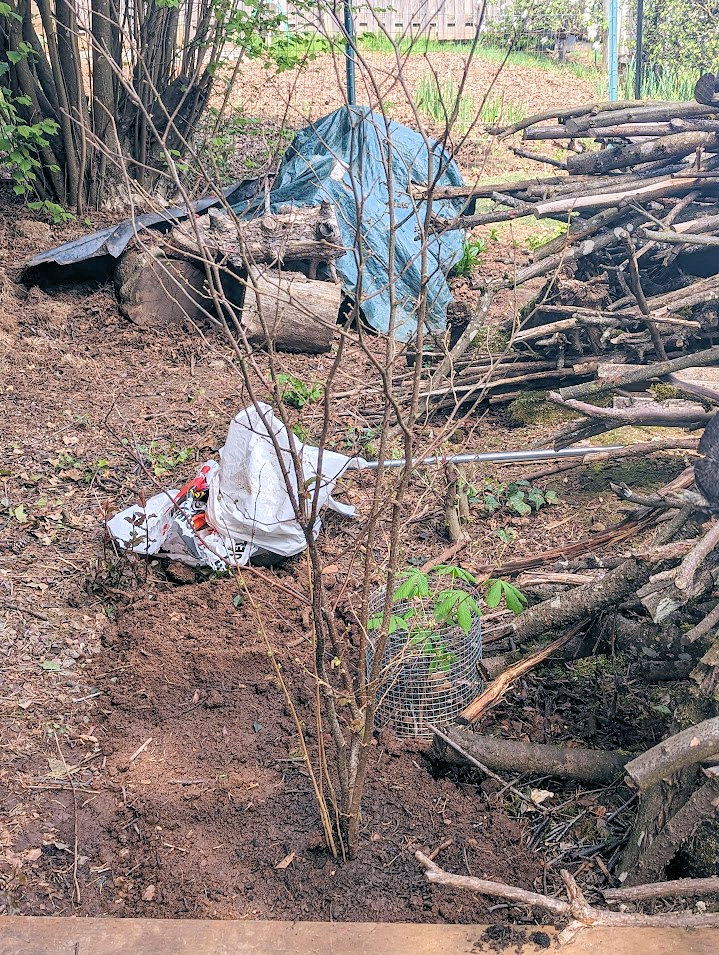
My husband put two filbert saplings into the ground. Our lone filbert produces hollow hazelnuts, Guess you need more than one filbert in order to have meat in the hazelnuts. It only took us 18 or 19 years to figure that out and another few years to find a source of free filbert saplings.
He buried my hardy fuchsia when he planted one of the filberts. In his defense, he did not see anything growing right there: the fuchsia doesn’t begin to put up stems until late May. I saw it right away and carefully scraped all the soil off my precious flower. I’ve had it for 20 years!
Warm weather came on so quickly this year that I have fallen behind in the weeding department, especially with the chickweed. It is already gone to seed. At least this year I am not battling a ton of grass that migrated into flower beds, and even if the chickweed spits seeds everywhere when I pull it, I will still be able to get ahead of it in the coming months. That is, if one ever does defeat chickweed! It pulls up easily even as it spits hundreds of seeds into the air.
I did more, but mostly I just didn’t think. I didn’t think about our losses. I didn’t think about the day-to-day worries. I didn’t worry. I just smelled loam and leaf, apple blossoms. I watched blue orchard mason bees collecting mud from under the stone wall out front. I reveled in the city of mining bees next door. I let earthworms crawl away. I talked to the crow that came to watch me. I stayed in the moment. And that made today a wonderful day to garden.
Dirt under the fingernails. Better than a manicure.
It is that time of year when an organic gardener’s thoughts turn to soil amendments, natural slug repellent, and turning compost so that the soil at the bottom of the heap can be used. We also turn our heads and slam on the brakes at every plant sale we see, especially if there might be native plants to be had. We know if our garden spots are shade, wet, well-drained, full sun, part sun, clay, or well worked topsoil. My flower beds are all of those listed.
I have a list of plants I want. I always have a list of what I want to do in my flower beds. The vegetable garden belongs to my husband. He always has a list of the vegetables he wants to grow. Have list, will shop.
This year one of my goals is to completely fill the useless spot just north of our garage with sword ferns. It’s a three-foot mandated distance between our garage and the adjacent property line. No one wants to mow it. Full shade. No available water. The only true solution is to plant sword ferns and allow them to fill in the spot, kill the grass, and end the need for mowing. I have been adding small ferns to the spot over the years but this year I have four large sword ferns donated by a friend from his pasture. If I plant them now in the cool weather they will be established by summer and there will no longer be a need to mow north of the garage. Minimal maintenance, win-win for both parties.
Last fall I filled in the sunny portion of that piece of property with orange day lilies. I also have a magnificent yucca plant growing there. I picked the yucca up out of a FREE pile in front of a house one day. The orange day lilies were given to me by someone. There are daffodils growing there as well, a gift from the previous owner of this house. No more mowing a section of our lot that is difficult to get to and maintain. Ta da!
Minimal maintenance.
I took my list to a plant sale last weekend. It was a fund raiser for a State Park nestled in Lake Oswego. The prices of the (mostly) natives was more than I cared to pay, so I walked out empty-handed and right into the arms of a group giving away bare root saplings of “native” trees and shrubs. I turned down the witch-hazel (and later learned it is not a native to Oregon, although it is indigenous to parts of North America). I already had a mock orange that is two years old and establishing itself. There were a couple others that I questioned as to whether or not they were truly natives. I settled on three bare root plants: black gooseberry, a dogwood, and Indian Plum.
The dogwood is not the native Pacific dogwood, but a Florida import. Say, what??! Oh well, it was free, and I picked out saplings small enough that my husband can work his Bonsai magic on them. I was the only person standing around that had any idea what I was getting with the gooseberry. I’m more familiar with the yellow kind from the more arid side of the State, but this is a native from the Oregon coast – and a gooseberry promises tart berries perfect for a pie. I may have to make a gooseberry/huckleberry pie: I have an evergreen huckleberry (also native to the coast) that produces tiny berries in the late fall.
The Indian Plum is not a plum but produces tart berries that look similar to plums. It was a subsistence plant to the tribes of the Pacific Northwest and is one of the earliest flowering bushes which is a boon to the native pollinators. I’ll figure that out if and when it bears fruit. It can just be an ornamental for now: a native ornamental and attractant to pollinators.
My list incudes two lavenders: a Spanish lavender and a French lavender. I had both in my garden and they both died. My Spanish lavender was over 15 years old. I think I simply had the French lavender in the wrong part of the yard. I also want to get a second campanula, toad lily, phlox sublate (McDaniel’s Cushion), curry plant, and Chinook hop. I need a new rhubarb: the one I have doesn’t grow tall now produce long juicy stems. I’d like to add oxalis and bunch berries to the shade flowers. I also have some annuals on my list: petunias and climbing nastrutiums.
I purchased 19 packets of herb seeds from Mountain Rose Herbs. Those are waiting to be sown. Not for today. I bought the nasturtium seeds from Reneé’s Garden. The Chinook hop from Thyme Garden. The rhubarb is coming from Gurney’s. And the rose I bought from Jackson Perkins is showing some signs of life… (All of my English tea roses are from J&P, this one was a replacement for a floribunda I didn’t like. The floribunda went to a good home. This rose is also on probation until it starts growing…)
Today was the first day of Garden Palooza, a large plant sale south of here, almost to Salem. It is held at Bauman’s Farm & Garden in Gervais. I set aside a certain dollar amount and hope we don’t go over budget, but this year we were way under budget and came away with more plants!
I found both lavenders. My husband found the tomato starts he wants. He also found a pretty campanula for me. The one I currently have is a blue color: Serbian bellflower (campanula poscharsky). The new one is Birch’s Campanula and it will be a pretty purple color. Bauman’s also had so many pretty petunias! I found a full sun ground cover called Creeping Baby’s Breath (gypsophila cerastiodes). Drought tolerant. I need so many ground covers, they do a much better job than bark mulch at keeping the soil moist and weed free. Also, as perennials, the ones I pick out will last longer than bark or hazelnut shell mulch.
Oh, but the best buy of the day? Don found a tree peony for $24. Not $240 or $140, but $24. Tree peonies are not inexpensive even in a year without inflation. There are three old ones in the yard presently along with at least 80 other peony plants. I’m told the yard had more peonies but that was when Barney Schultz lived here, and he died over 30 years ago. The house sat empty, was purchased and flipped, and the grass killed so many peonies during the years of neglect. Then we bought it and I have single-handedly cleared all those peony flower beds, carefully divided tubers, and coaxed those beauties to new life. In short, I don’t need another peony or tree peony.
But $24. Gallon pot. Paeonia lutea var. Ludlowii (Tibetan Tree Peony). It’s young and I may have to wait a few years to see the large yellow blooms it promises. My other tree peonies are white, cream, and pale yellow fringed with red. Of course I bought it.
Our friend gifted us with two filbert trees as well as the ferns. We already have one filbert but the hazelnuts have never produced nuts. You learned you need more than one filbert. (Side note: the trees are filbert trees, the fruit is referred to as a hazelnut.)
So much planting in the near future. And making of larger flower beds to accommodate the 19 varieties of plants I purchased in seed form from Mtn. Rose Herbs.
I am coming up on my 50th high school reunion, which, of course, has made me a tad bit nostalgic. Not that high school was all that wonderful, but it was a far cry from the misery of elementary and middle school – and it was in a small town where folks tend to be more sentimental about those things. Not all folks, but… And I am not even sure why I care.
I only survived high school because of Jay.
We were a month into my freshman year when my father’s employment uprooted our comfortable life in the town where I had suffered through elementary and middle school. My brother was a senior. My sister was in the 6th grade. I had this one disadvantage to my siblings: I was – and remain – a very shy individual. An introvert. My experience in my younger years made me gun shy of making new friendships. I didn’t trust people. And, of course, I was only focused on what the move was doing to MY life, not my brother’s senior year plans or my sister’s tender age as she entered the world of middle school and all of the baggage of pre-teen pressures. They were on their own.
I was a late developer. At the age of 13, I stood 4’11” and weighed possibly 85#. I looked like a 6th grader and felt like one in the halls of a strange school with giants all around me.
The kids surrounding me had grown up together like the kids I had just left behind. Cliques (and “pecking orders”) were established. In my old school, I was on the lower echelon of the strata, but I had friends who could protect me. I was now in unfamiliar territory, with no friends to circle the wagons for me. I had to develop a strategy of porcupine quills and I had to fake being an extrovert. I just wanted to curl up in a ball and cry.
Enter Jay. I may remember it wrongly, but it seemed like it was the first day of being in a school that overwhelmed all of my senses, and going into a lunchroom with my sack lunch and no idea where I would sit – or with whom. My brother, ever the extrovert, had already established himself and couldn’t be relied on (he spent his senior year following me down the halls, making fun of the way I walk: “Quack! Quack! I’m a duck!” – loudly).
I stood there, confused and dazed when Jay came over and told me I could sit with her.
We never had any classes together, but for the next three years we met every lunch hour. We never did an overnight thing except once when I stayed at her house on Hallowe’en before her family moved to a homestead out of town and she had to ride the bus. She was never involved in any of the civic or class things I was in. She came to school and went home, period. But she was there for every single lunch period.
We had so much in common: a miserable first 9 years in public school. Bottom rung of the social strata. Same size shoes (we traded shoes every morning in 10th – 12th grade, switching them back out when we had to go home). Sense of humor. Sense of loyalty. Introverts. November birthdays. Names that began with the letter “J”.
Most of those years there were three of us: the cowgirl, Tina, Jay, and me. Whenever a new kid showed up at school, we took them in to have lunch with us and ease their introduction into our high school. Most of those moved onto other social engagements, but Jay, Tina, and I… The three musketeers.
Tina talked me into joining the Rodeo Club even though I did not have a horse or any hope in h*** of getting one. We sponsored school dances, the food cart at football games, and the annual junior rodeo. We did fund raisers together. Tina and Jay always were jealous of my friendship and never hesitated to gossip about each other. I stayed as neutral in the middle as I could: Jay was my first, and best, friend. I was not about to turn on that kind of friendship.
I remember one girl we took in when she was new at our high school. She pulled me aside to tell me I could “do so much better than her”, meaning Jay. I could just quit being friends with Jay and be her friend, and we’d be popular. I was truly shocked. WHY would I do that? Whatever I told that girl… she never talked to me again. And I didn’t care: my friendship with Jay was more important.
Why not four years? Well, Jay fell in love. Near the end of our Junior year in high school, she started spending most of her time with a boy. I was invited at lunch, of course, but who wants to be a third wheel? We still switched shoes every day, but we didn’t go to lunch together. I had developed other friendships and had other people I could go to lunch with besides Jay or Tina. I still spent time with Tina because she could go to after-school events and, well, Rodeo Club.
Jay got married a few weeks before we graduated. She went on to be a mother and a wife, and she went where he went. I tried college out and failed at that. I wandered, always falling back on my high school strategy of pretending I was not a true-to-form introvert. I made friends. I moved to Oregon, met a man, got married, became a mom and wife. We lost touch.
There’s a twist to the story, of course: Jay’s husband (and our classmate), Dee. I hadn’t been in favor of the marriage: we were too young. Dee “stole” my best friend from me. I had lots of excuses. I was against anything that led a young girl down the traditional role of wife and mother (I repented when I fell in love). My porcupine quills were out when it came to the love between Jay and Dee. But it was Dee who tracked me down in an age before social media, computers, and cell phones. It was Dee who called me out of the blue and gave me their phone number and address.
We lost touch again. And it was Dee who found me on social media. It was Dee who always found me and tried to get us back together as best friends, and I think I owe Dee as much as I owe Jay for her friendship during the years when I was full of angst and teenage drama.
I know where Jay is these days. She raised sons. We still have a lot in common, but we aren’t very close on social media. I keep in touch with Dee more than Jay, but we never forget each other’s birthdays. I know, for instance, that Jay will not come to our 50th class reunion (but I messaged them and asked anyway). High school memories are not as sweet for Jay and Dee as they are for me. They grew up in the same small town and endured the same social status for the 12 years they were in school with the same people. I would probably feel that way if I had attended twelve years of school with my elementary and middle school friends.
Tina died last year. I lost touch with her as well. I only learned of her passing when an email was sent out listing everyone we have lost over the past 50 years and there was her name. My cowgirl friend who liked peanuts in her cokes and twisted my hippie arm into being in the Rodeo Club with her.
I don’t know why I am excited for this class reunion. Maybe to make amends with people I offended when I was still a porcupine. Maybe to see how my other friendships panned out. I did have other friendships. It won’t be the same without the girl whose shoes I wore for three years. Hers were always worn out in just the right places. My feet felt right in her shoes. I have never traded shoes with another living soul. It’s not hygienic.
I went to visit an old friend today. She lives at a senior “assisted living” place on the west side of the Portland Metro area. My oncologist’s office is less than five miles from where my friend now resides, so when I make a trip to see one of the doctors there, I try to drop in on my friend.
Our visits never last an hour. She gets tired. I can’t stand nursing homes. Today, we didn’t make it past twenty minutes because she was falling asleep on me. She doesn’t look good. Do any old people resigned to living in such a space look good?
I’ve been to a number of these places over the years, and they always leave me depressed. Seeing a dear friend in the early winter of her life… That’s more depressing.
This friend was once my superior at my job. She was brilliant. Dedicated. A mathematical wizard and an innovator. Faithful to the company and the men who ran that company. She worked for a little over minimum wage, lived in a single-wide trailer, and raised three children on very little income. There was no pension plan for us at the company, only what we earned over the years that was socked away into Social Security.
She mentored me over several years. I discovered I had a small gift at mathematics under her tutelage. She had a sense of humor, a lot of dreams, and a keen mind. We went from paper files, paper storage, to digital files and even a program that could do the math for us. My friend stayed current with all those changes in her senior years. She was a legacy.
But change is inevitable, and the company sold out to a corporation that didn’t value the small people. One by one, friends and coworkers faced the axe, not the least of which was my friend. My entire department went under the axe, except for me. I left voluntarily before they could figure out a replacement for my job.
For a while there, all of us got together and had lunch or dinner together. Even that got old as we moved on to new jobs or our retirement plans.
I think it was about five years ago that my friend lost her youngest child to brain cancer. That was the beginning of the end: it is difficult to recover from the loss of a child. My friend was already faltering physically: a broken hip that set her back several weeks, an income that didn’t support her anymore, a mind that no longer fired on all eight cylinders (if my friend had been a car, she would have been a V-8: luxury, speed, and staying power. I’d be a V-6).
We talked on the phone. We called on our birthdays. We no longer had restaurant dates together. My child died. My friend found herself in a walker and in a nursing home. Pardon, an “assisted living” home. The first time I visited her there was in 2020. I have been sporadic ever since, but more regular since the cancer scare of last year. After all, my oncologist’s office is nearby.
My friend was frail and tiny in 2020. She looked much older than her 80+ years. Much tinier than I had ever known her. Her mind was still sharp, however. She was angry that she had “lost everything” in the move from her trailer to assisted living. All her collectibles. The comfort of her own home. Most of her wardrobe. Her car. Her independence. But not her memory.
Her birthday is next week. I took her a birthday card today. She no longer walks, even with a walker. Today was the first time in three years that there was no sign about Covid being “in the building” somewhere, but I masked up anyway. She hates it when I wear a mask because I don’t look like me. She doesn’t look like herself.
We talked about our coworkers and who still visits her in the home: three of us coworkers and the one son who lives nearby. Her great grands haven’t been by in a while. She’s angry. She’s resigned. She’s not ready to die. But we both know Death is hovering on the horizon, closer than she wants to admit. She struggled to stay awake during my visit.
I will be back over there in March. I’m not certain that my friend will still be there. I do know that her son will remember to notify me when she goes. I hope she will be there.
I hate going there. I hate the idea of ending up like my friend: unable to walk, tied to a bed, only a TV to entertain me with old reruns, and a small handful of people who remember to call or visit. I know she isn’t ready to die, but I also know if I was in her position, I’d be thinking of ways to end my life already. I’m too selfish to want to waste away by millimeters in a building with other dying people, and in a room with some stranger.
I understand why my mother-in-law fought so hard to get out of assisted living and back in her home with a nurse coming by daily. I understand even more why my father quit taking his medications three months before the effects caught up with him and he died in his own home, still independent. I understand why my mother, at the age of 63, chose to stop breathing rather than be tied to an oxygen machine for the rest of her life. There is nothing gratifying about lingering death. There is nothing enticing about waiting while the Grim Reaper bides its time.
Death either comes in like a freight train or it slimes in as slow as a slug. So – tonight – lift a glass of whatever it is you drink and toast my Lola. I said good-bye today and kissed her forehead. I don’t know if I will get another chance. And for those of you who have a loved one in a nursing home, assisted living space, or hospital: go visit. I don’t care how uncomfortable it makes you feel. Hold their hand. Feel the papery skin. Remember for them. Remember them.
Sometimes I think my life is just a cautionary tale. I do some very dumb things. Point in case is my most recent sewing “adventure”.
I am in the midst of Spring Cleaning (there’s nothing else to do other than work on some artwork or writing and January is always a good time to give the house a yearly purge). I’m not a great housekeeper to begin with, but the yearly purge cleaning makes me feel like there is hope for me. So far, it is going well: I’ve done the bathroom, the hall, the bedroom, and the kitchen. The kitchen always presents the greatest challenge because there is no hood over the gas range. No exhaust fan. A lot of grease, dust, and food fumes go into the house atmosphere and settle on top of things: the cupboards, the refrigerator top, the things I have on top of those items for display or storage, and the uncovered appliances.
Over the years I have developed a strategy of putting waxed paper on top of the cupboards and refrigerator and this helps immensely when I am finally moved to clean in places I can’t see. I roll up the filthy wax paper and dispose of it. I still have to do a fair bit of wall washing and cleaning of the items that have been stored on top of those places. I try to get to this task quarterly, but it more often falls biannually. The top of the fridge can sometimes go an entire year. I’m short; the fridge is tall. What I don’t see doesn’t affect me.
Well, it does. But summer comes and I am outside playing in dirt and I don’t pay much attention to the top of the refrigerator.
This year, it dawned on me that there was probably a more sustainable way to do this. I’m only 67 and have been married for almost 44 years. I’m a little slow on the uptake, OK?
Instead of using disposable wax paper, I could use picnic tablecloth fabric which can be tossed into a washer while I clean the tops of things. Oh, and I could sew covers for all the appliances that are currently covered with plastic garbage can bags or kitchen towels to reduce the dust accumulated between uses and/or cleaning sprees. I am so brilliant that I can’t see my own reflection!
I thought the garbage bags and kitchen towels were a pretty neat idea when I thought of those. I didn’t factor in how ugly that looks and how easily garbage bags tear.
I should mention that I live with a dog. Sometimes more than one dog, but always a dog. And dogs track in dust and mud and they shed. We’ve never owned a dog that didn’t shed although I know they exist. My husband’s birddogs do not fit into that niche of neat dogs to own. Birddogs are more like perpetual toddlers with very large feet that collect substantial amounts of mud between the toes. One birddog we owned had hair like a porcupine’s quills: she didn’t have long hair but what hair she did have went into the fabric of chairs and rugs, never to be pulled out again. She’s been gone for 16 years and we still have furniture with short white hairs stuck into the fabric. The longer haired dogs just shed copious amounts of fluff. (photo: the dog. Ruger.)
I digress. I decided I would not only cover the top of the fridge with a fabric I could wash, but that I would sew covers for the appliance like my pressure canner, the crockpot, and various Dutch ovens. My stand alone mixer already has a cover over it, hence the brilliant idea.
I don’t sew. Not much. I can sew, that has never been the issue. I’m just not in love with sewing. My mother was the woman who sewed all of our school clothes, our Christmas pajamas, and a million other little things including Barbie outfits. If she didn’t have a pattern, she made a pattern. One of my best friends is an accomplished seamstress who tutored one of my daughters. That friend creates beautiful costumes for cosplay and Renaissance faires. Both of my daughters went to someone else to learn how to sew.
I’m not a terrible seamstress. It is simply not a passion. And for decades the only sewing machine I had was my mother’s Singer Featherweight. A few years ago I splurged and bought a newer model Singer with fancier stitches and I have used that since (when I have had the notion to sew). I even made a cover for it. I was on my game when I made the cover: dimensions, seams, hem: perfect. (photo: the sewing machine under cover)
I was not on my game this time around. I made all the proper measurements. The blue canner has a diameter of 15”. If I made the cover plus a skirt, the skirt length would need to be 8”. Of course, you need to add an inch for seams and hems, so the canner lid would be 16” and the skirt would need to be 9”. Circumference is easy, too, if you remember your formula from school. That’s (r+d)2 + c. You can skip the math, however: I found some pretty cool apps on the Interwebs that do the calculating for you.
I had some calico fabric laying around, but not enough to do the skirts – only enough to do the tops of all the appliances. So I figured out how much more calico I would need and what color. I knew at the outset of the project that I would be piecing fabric together rather than sewing perfect little matching covers. I also calculated about how much picnic tablecloth fabric I would need (not factoring in the width of the cloth on the bolt which is an unknown until you actually go to the fabric store. Can’t hurt to have too much.
I wrote out my list, took a photo of the calico I was using for the tops, and went to the local fabric store with coupons. 20% off the entire purchase plus 40% off one regular priced item (the picnic tablecloth fabric). Everything was on sale except for that. Thread, calico, hemming tape. I had it all figured out in my head. (I never needed the hemming tape and I already had green thread on a spool on my sewing machine – oops.)
The tablecloth fabric was wide enough that I not only got the refrigerator covered, but I have enough left over for a couple of the hanging cabinet tops. No sewing required, but it will easily wash clean in a gentle cycle. One item off my list!
I prewashed everything, then set about making the measurements (measure twice) before making the cuts (cut once). THEN I realized I had used my initial measurements, not the measurements plus seam allowances. I cut the blue canner top at 15”, not 16”. Oh.For.Crying.Out.Loud. And we’re in the middle of an ice storm so running back to the fabric store is out of the question, plus I didn’t want to waste the money. (Bangs head on desk and posts woes on Facebook.)
Not to worry: I had enough fabric to recut the circles, plus I could trim some of the larger ones down to fit the smaller items (e.g. the blue canner could be cut down to fit one of the Dutch ovens with an 11” diameter). Whew.
I carefully measured the skirts according to my circumference calculations. I was short fabric for the crock pot. Dang. I would address that last, I decided. Now was the time for the ironing and the sewing to begin and all would be well. I could do this.
I calculated the circumference from the original figures. Remember the blue canner? (7.5+15)2=45” Only I NEEDED (8+16)2=48”. OY VEY.
But not to fear: I could still use the skirts, add a ribbon at the bottom to create a tie (fresh out of elastic, but that would have worked as well). I just had to sew seams all around plus remember to sew the ribbons on. And it worked! (Photo: before – under the garbage bag, then with the tie at the back, and turned so you can’t see the tie)
I still didn’t have the crock pot figured out. It’s oblong, for one thing. The calculations are going to be different. And I was out of enough calico to make that happen, anyway. But I do have a number of old tablecloths I have picked up at yard and estate sales and… Yes, I cut up a (stained) vintage tablecloth to make it work. I do not regret that decision. (Photos: before with the kitchen towel, after with the tablecloth skirt)
I am not unhappy with the results; it just took more effort than I expected. And it showed just how (ahem) cautionary a tale I can be. And, yes, I had to use the seam ripper a couple times when I forgot to make certain I was sewing fabric face-to-face. That’s my least favorite sewing tool.