I want to tell you (if you follow me) that I *think* I solved the mystery of the Land Deed to Hiram Walker. Now, I could be wrong, but here goes: instead of a “title search” as we know it today, the way to prove the property being sold actually belonged to the seller was to provide the proper documentation. My ancestors purchased quite a bit of land in Wisconsin and Illinois. I found more than one example of an original deed belonging to some unrelated person(s) followed by a deed of the same plot to my ancestor. It’s a theory and I don’t have any further documents showing the land in Illinois belonging to Mr. Walker was ever deeded over to a Melrose, I am hanging onto my theory as “entirely plausible”. At least, until it is proven otherwise.
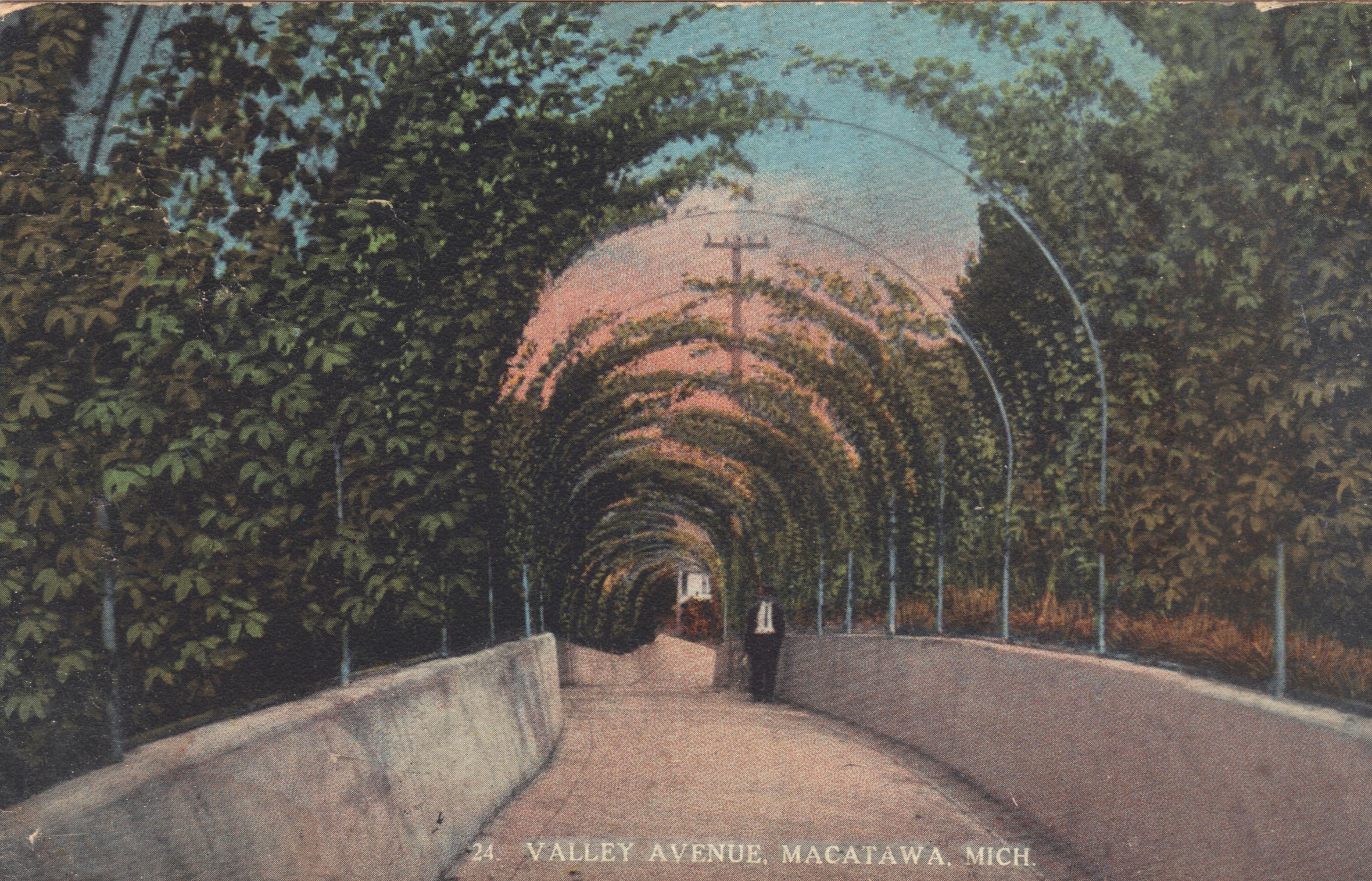
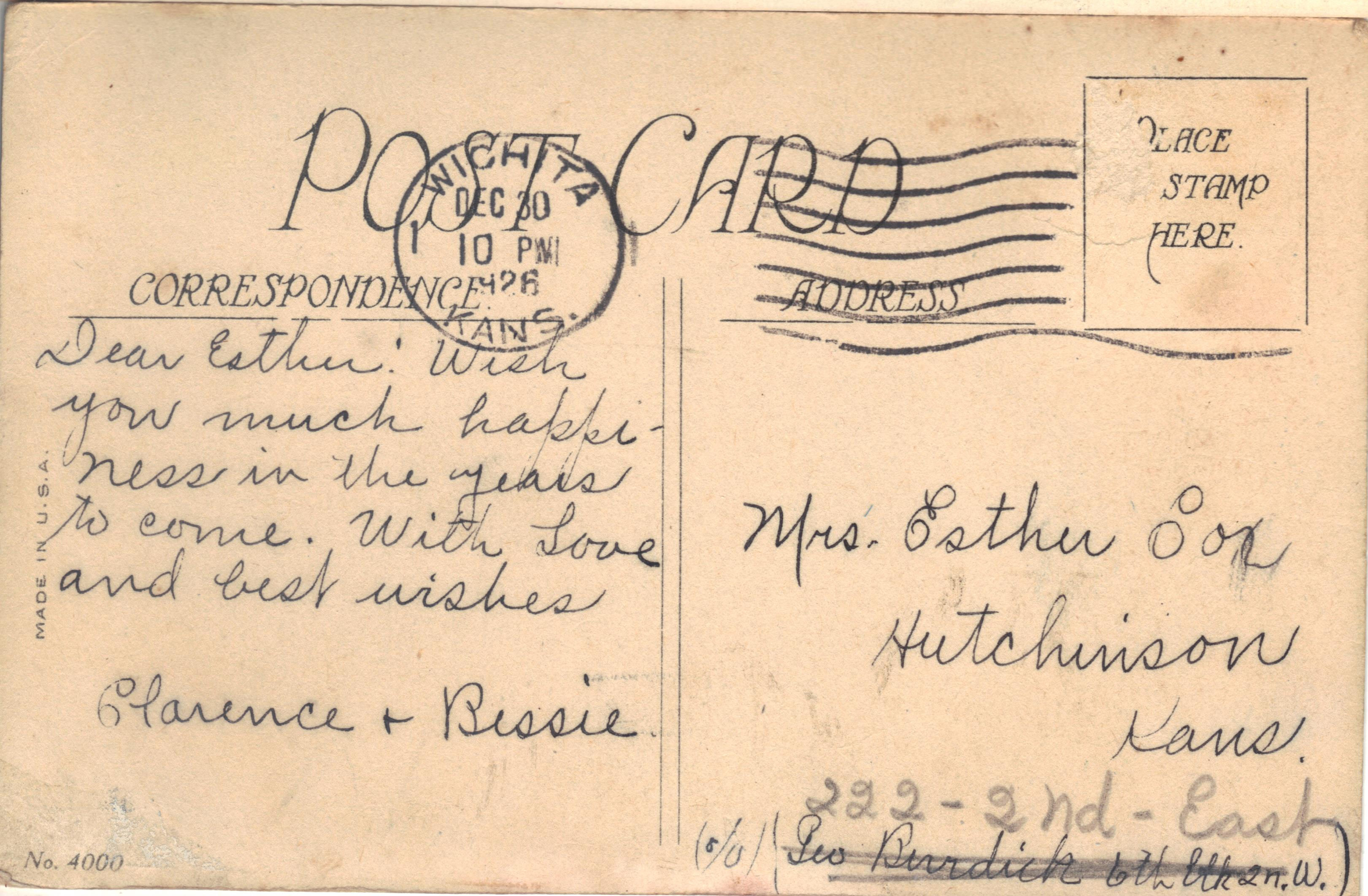
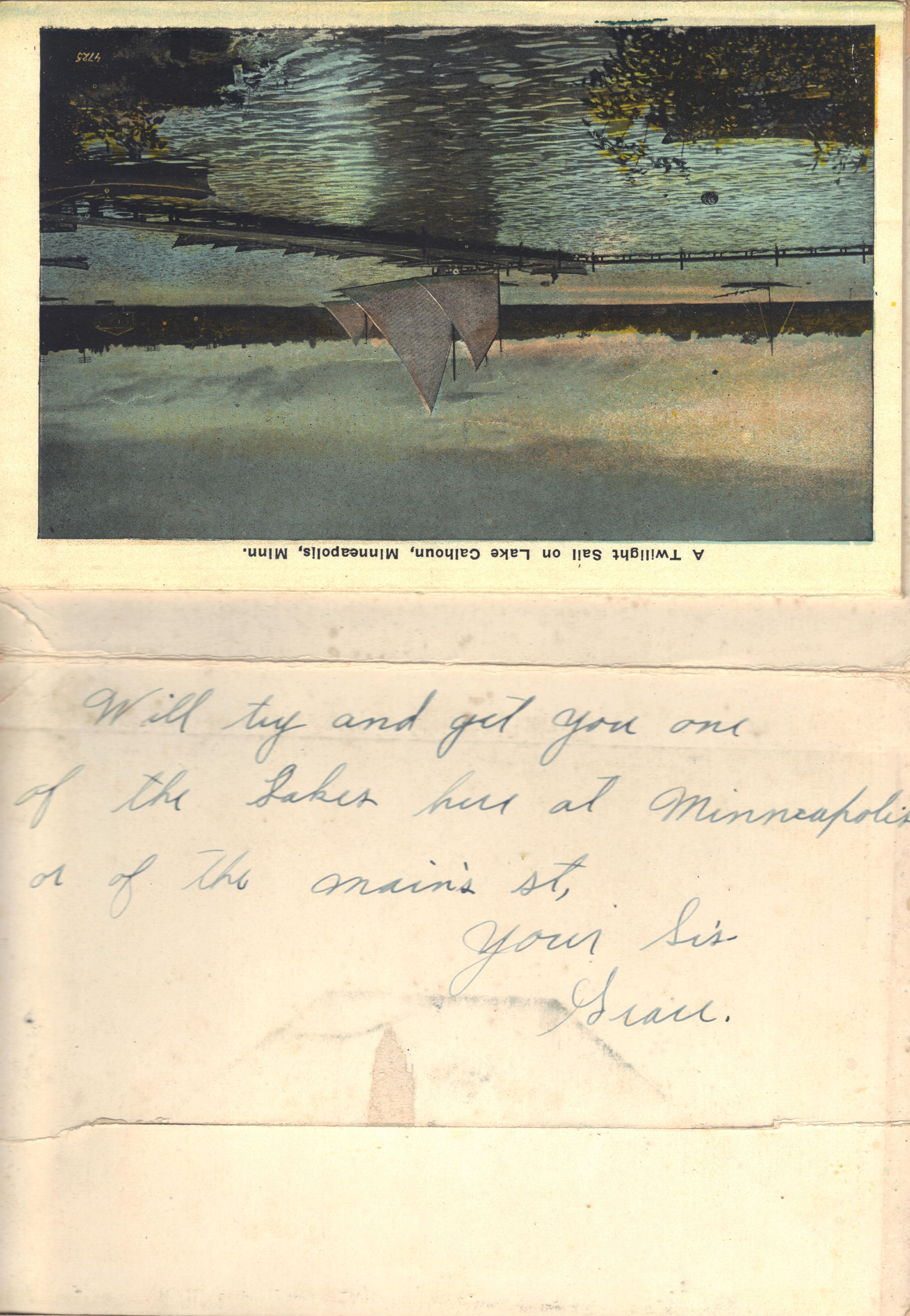
Tonight, I scanned old postcards and discovered another mystery. Who was Mrs. Roy (Esther) Cox? For that matter, who was Dora and Mary Keenan? And why do I have old postcards addressed to them?
191419261928Undated
The last one is actually a booklet of tourist photos from the Twin Cities. I did not scan all the postcard photos included inside.
This last one is between the Keenans, sisters-in-laws, I think. Undated. The Oregon locations make me wonder if this is not a postcard on my husband’s side of the family, but it could be someone my Great-Uncle Dale knew in his travels around the Pacific Northwest.
I think I may have some of those years wrong upon closer inspection of the originals, but the dates do help give me some parameters to search with.
I am gearing up for the last “pop-up“ market of the season while other people are gearing up for the big food event. My studio is littered with papers, feathers (yes, feathers), binders, acrylics, markers, and a few Christmas gifts that need to be wrapped and shipped. I have parsley hanging to dry, the last of the garden harvest I will hang this year. I am using this “down” time to catch up on genealogy.
My genealogy has waited for decades to be digitized. I’m not getting younger, and my memory is starting to fade. I have a pretty decent family tree started but I want to get done with the scanning and converting all my files to digital. Photos, old letters, old land deeds, and typewritten memories from my ancestors who also dabbled in family history. Get done with that, then convert my husband’s paperwork to digital.
Whew – I have a lifetime of work ahead of me. At least enough to fill the winter months for the foreseeable future.
I have already scanned all the deeds my mother collected whenever she happened to visit Wisconsin where her people were from. Mom did a lot of leg work, and I am reaping the benefits. She concentrated on the “newest” Americans: the Melrose clan. She never got into the Scotland roots, but I can understand why: every other son was named Phillip or John.
Phillip Melrose begat John Melrose who immigrated to the Americans before the American Civil War. John moved to Wisconsin and sired Phillip George Melrose. Phillip George sired two sons: Dale and John Vaughn Phillip Melrose. Phillip – John – Phillip – John. Dale died when he was young (see Letters From Dale in my archives). John VP Melrose fathered three girls, no sons: Phyllis, Donna, and Mary Lou (my mother). Phyllis was the closest he came to naming another child Phillip.
Mary Lou Melrose 1952
That original immigrant bought and sold quite a bit of land in Wisconsin and Illinois.
I came across some deeds that seemed to have nothing to do with my family line: A patent deed to Mary Eliza Drury (1878), Ormal Walker to Harvey Hakes (1889), and Preston King to Hiram Walker ((1860). That latter one is truly a puzzle, but I will get to it in a moment. It was the deed from Hakes to Walker that finally helped me figure it out (I think) because I have a second deed from Harvey Hakes to Phillip Melrose. Same property.
My hypothesis is this: instead of a “Title Search” as we know it in modern real estate transactions, the original deed was presented to the buyer as proof that the seller had the right to sell. I couldn’t find a deed from Drury to Melrose or Walker to Melrose, but those could simply be missing. Things got lost when Mom passed in 1995 or maybe she never acquired those deeds. Makes sense to me.
It doesn’t explain the original land deed from Preston King to Hiram Walker, signed by the 84th President of the United States. On parchment, hand signed, with a seal. Preston King was deeded the land after the Black Hawk War (a nasty piece of history). He was a private who served under Captain Campbell’s Illinois Militia.
I framed it. It has been folded and stored incorrectly for decades. I think it deserves wall space and maybe one day I will solve the mystery surrounding why I own it.
I have done all I can do in the garden for 2025. The roses are mulched, the peonies have been dead-headed, and the rains have begun the relentless parade of clouds, downpours, wind, and occasional sunbreaks whereby we build a fire in the fire pit and sit outside with our hands in fingerless mittens, hovering close to the warmth.
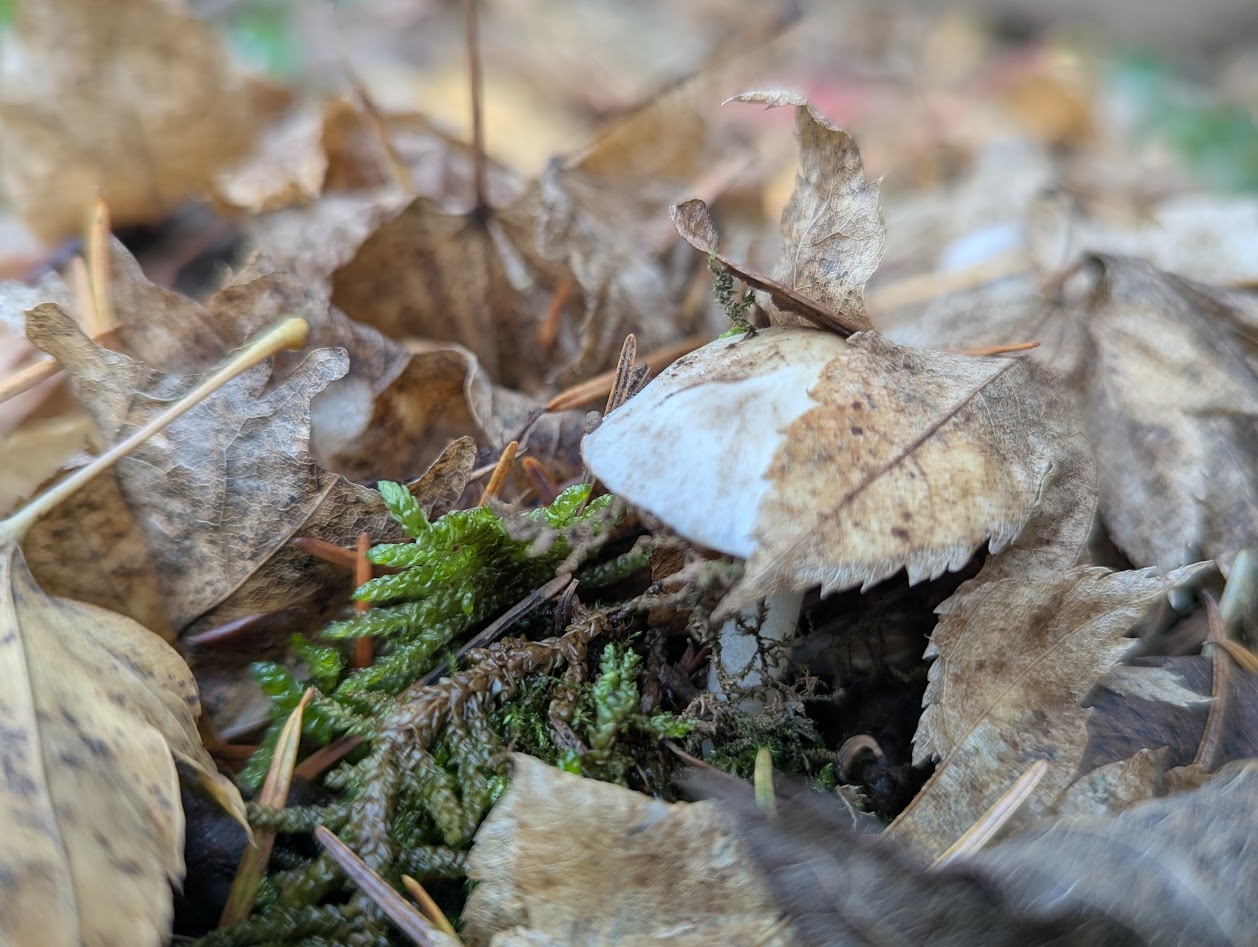
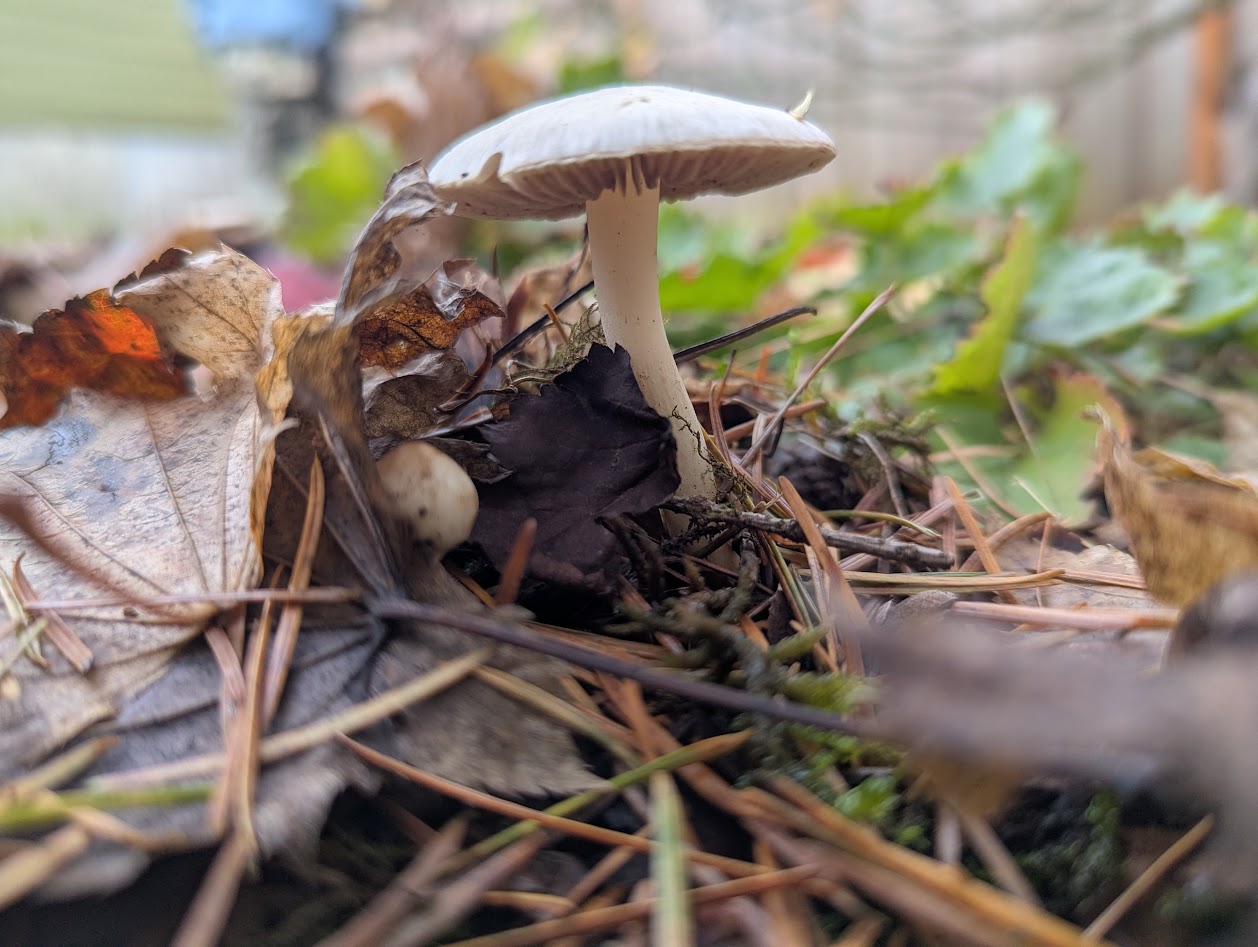
It is time to think about a different tack on the blog. But before I switch gears, here are the newest residents of my garden: the fungis. I don’t know my mushrooms well enough to identify them (beyond the panaeolus).
Welp, the rains are here for the duration. I’ll still get in some gardening on the few days of sunshine and dry that intersperse the gray, depressing, and very, very, wet days. The rain isn’t what is depressing: the cloud cover and long, gray, days is. I tried those blue anti-depression lights, once. Blah. I’d rather coerce my husband into building a fire in the fire pit and bundle up in layers on those days that are dry (the clouds can still be there, but a fire, the outdoors, and wood smoke alleviate depression better than a lamp that pretends to be the sun).
Microsoft Word doesn’t like that I refer to our winter weather as “the rains” (plural) but it is an accurate description: it isn’t one single rain but many such storms and sprinkles that come overhead throughout October to June. Rains. Multiple rain storms. With lots of thick, gray, clouds. If we’re lucky, we’ll get a snow storm tossed in there. If we’re unlucky, it will be an ice storm that comes down in the guise of rain: freezing rain. Fun times.
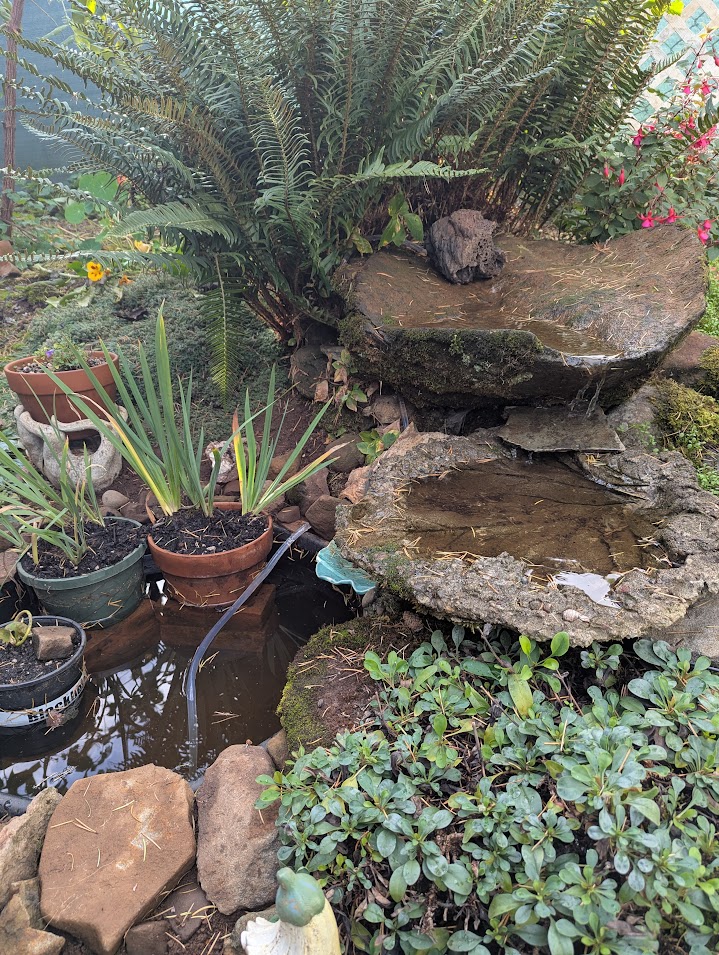
Before the weather turned and the cloud pattern changed, I finished up my second water feature. It needs a little fine tuning that won’t get done until the weather begins to warm back up, but I’m still pretty proud of what I created.
The rock that is the centerpiece came with the house. We live on top of a rocky bluff where tons (literally) of these sedimentary rocks formed when volcanoes were young and glaciers were receding. Boulders atop layers of lava rock, bluffs upon bluffs above the Willamette River, Our yard was cleared and farmed in the early 1900’s and most of the very large rocks were removed or sit buried under several feet of topsoil and clay. The corner of yard where my newest water feature is happens to be an area least developed and used as a rock and concrete dump for at least thirty years. I still find fat pieces of asphalt and broken concrete in the ground when I dig.
The native rocks are red, like the clay that makes up most of the earth around here. We just happen to be blessed with at least a foot of good topsoil atop that clay due to the farm that was established here in the 1930’s. At least everywhere except in this particular corner where everything was dumped before we moved in.
We removed most of the large chunks of concrete and asphalt and I started turning the area into a small garden. Don moved this big concave rock in the hopes of “someday” building a water feature in the corner. Twenty some years later, I built that water feature. I could say I got tired of waiting for him but the truth is more nuanced than that: he has his projects, the vegetable garden, a new shed, and more. I love to garden flowers, dig in the dirt, build walls, and rearranged things. It is only natural that I should take on the task of building a water feature after waiting for him to find time to do it.
I have the time and the will; he has neither.
I bought the round rubber animal trough at the local feed store. I ordered the solar pump. I dug the hole in the ground.
I didn’t find a lot of rocks in the way: I found the roots from the neighbor’s tall pine tree running through the ground, none of them larger than 1.5” diameter. I cut them out knowing they wouldn’t impact the life of the tree (which is dying anyway, but slowly, and due to a beetle infestation). I leveled the ground and installed the trough, planted the yellow flag irises in tubs, and filled the crater with water.
Oh, and sometime along the road, I made the semi-solid concrete feature that forms the second rock in the waterfall: concrete and a rhubarb leaf.
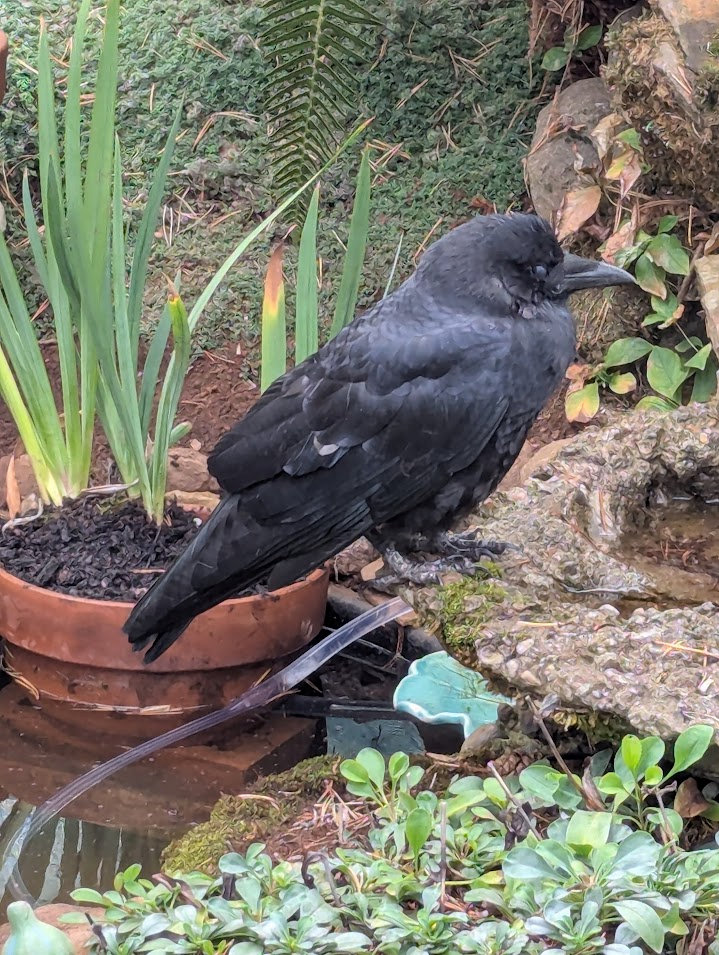
Me, me, me. And I’m only bragging about it because I will be 69 years old in a week and I’m still playing in the dirt and digging holes. Also, the birds already love it.
And, yes, I took a couple days off to recover after all that work.
Here we are, less than 24 hours from a massive rain storm and I am writing about sprinklers. It’s not like we’ll need them for the next eight to ten months as all the water will be coming from the skies. Well, tomorrow they say it might be coming in sideways with gusts up to 60MPH (that’s 96+ KPH for my friends who use the metric system, or 52+ knots per hour if you speak nautical). It’s going to be gusty and very, very, very wet.
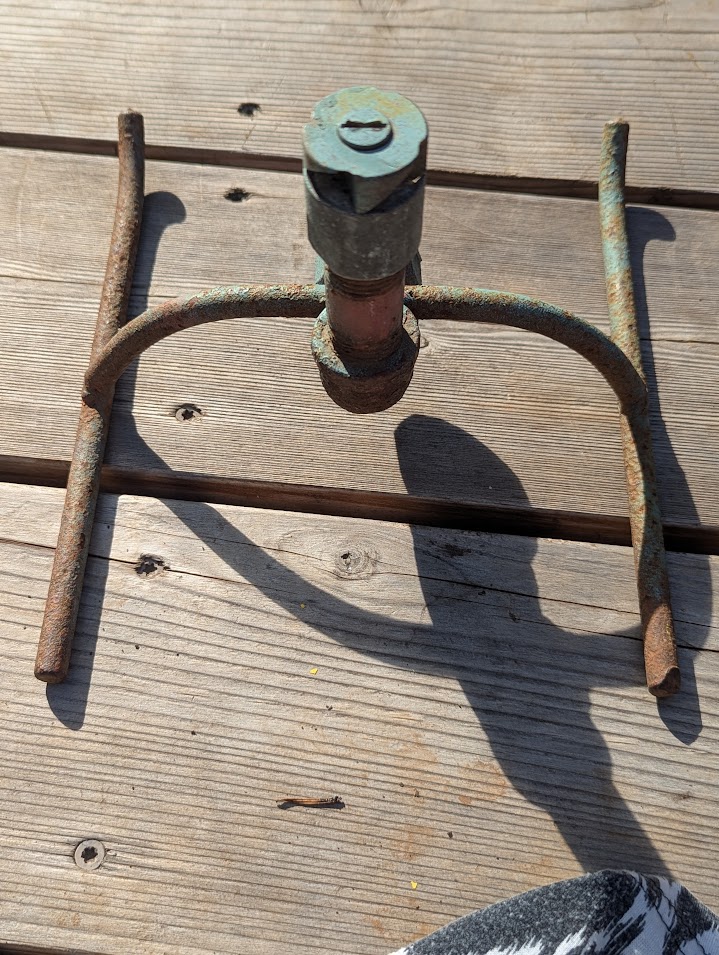
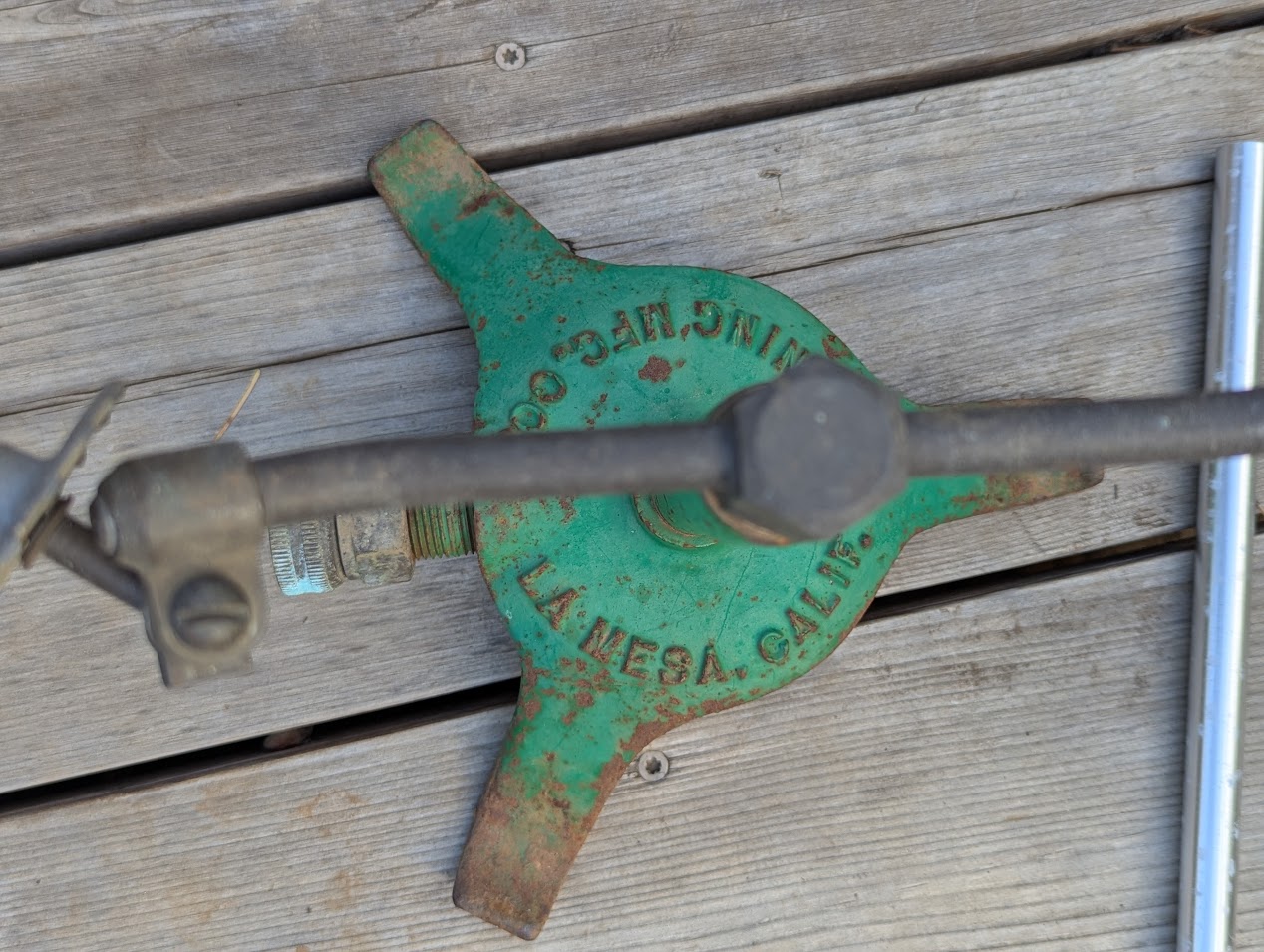
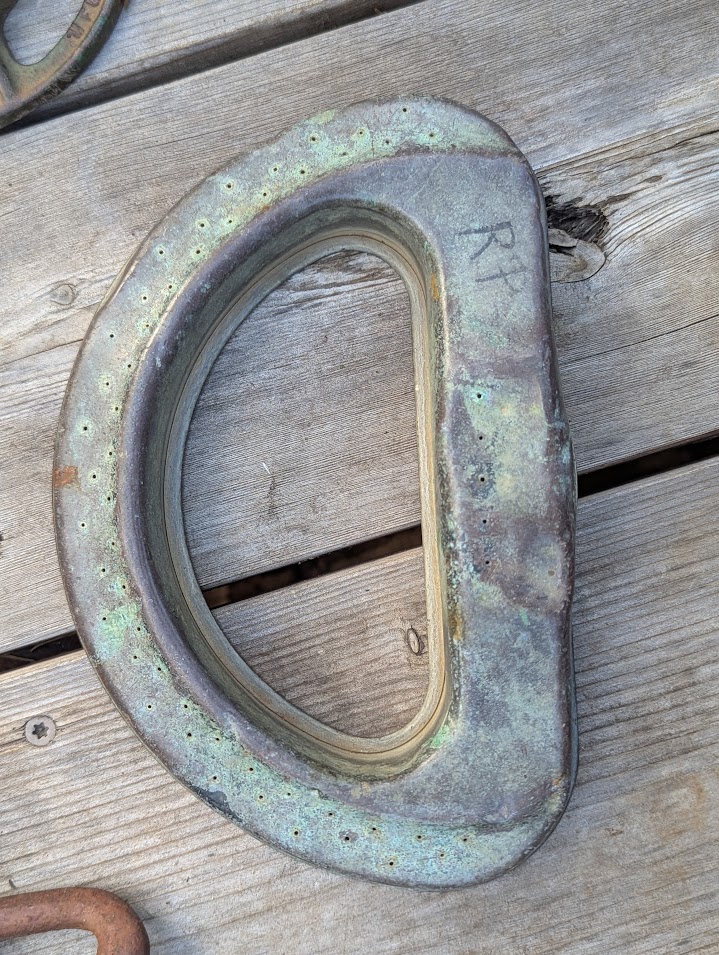
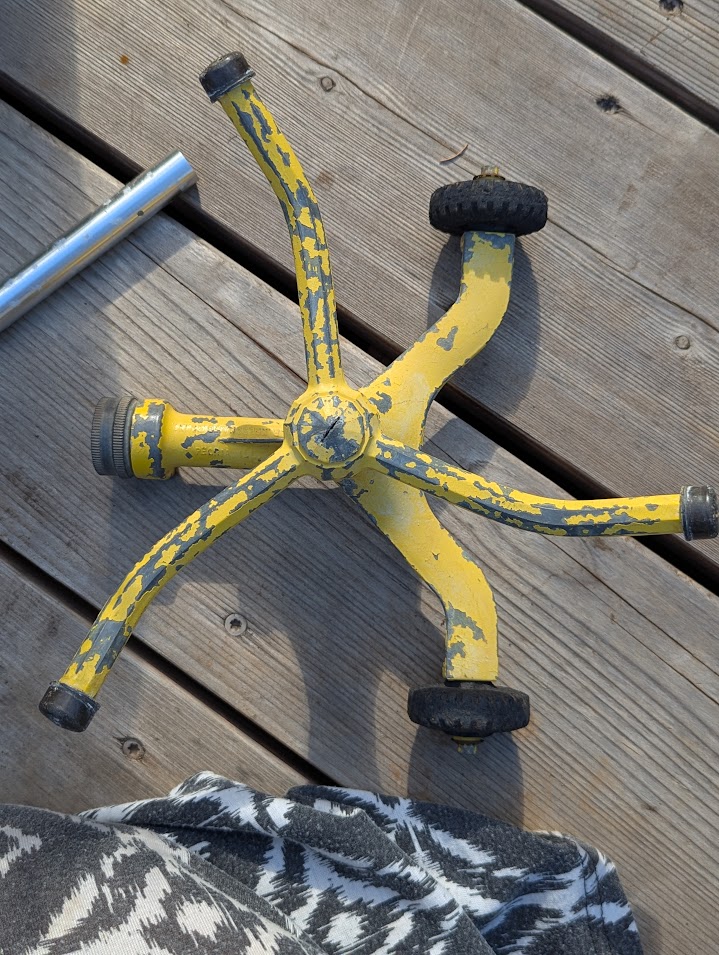
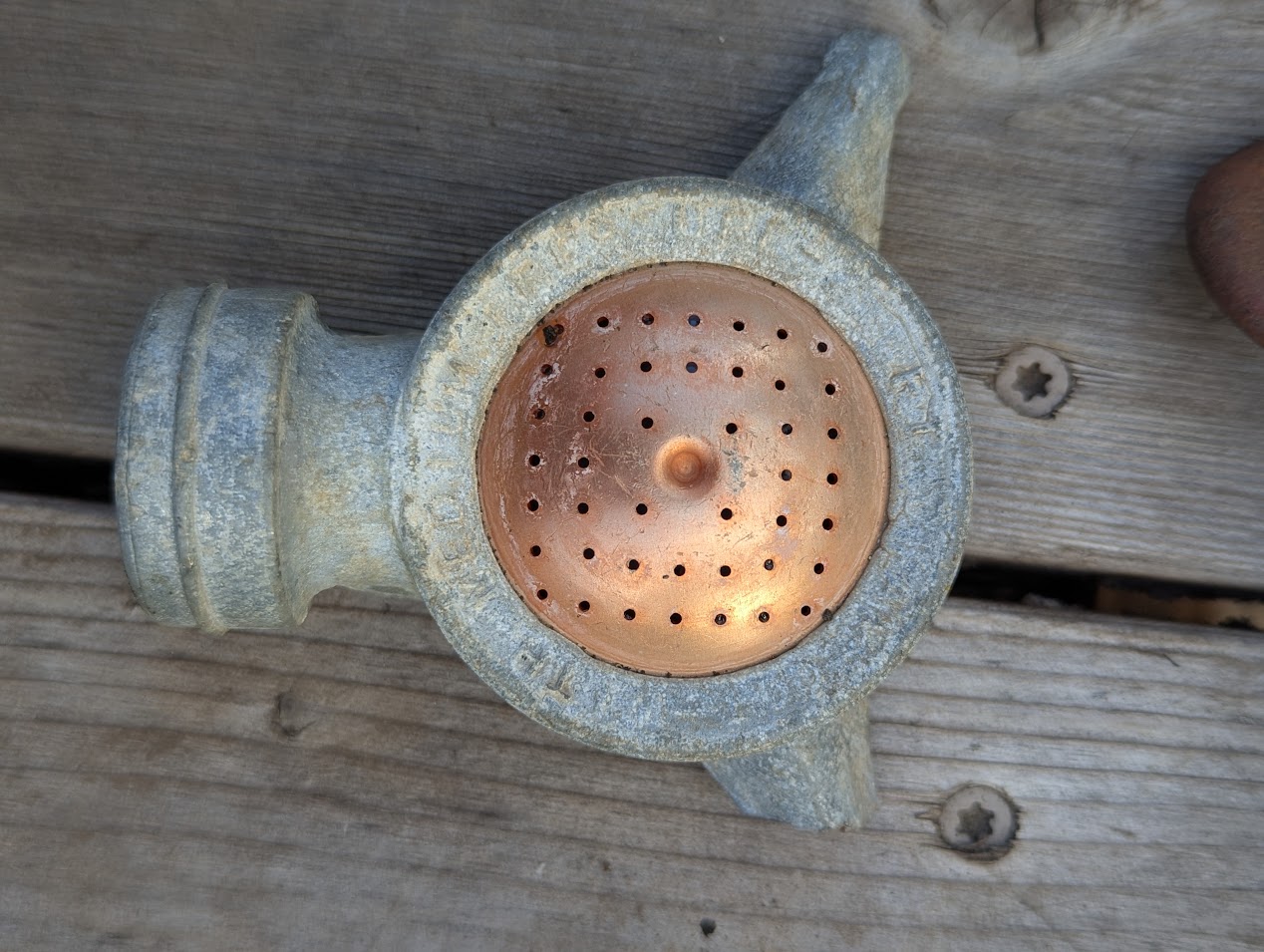
We collect vintage sprinklers. One of those is homemade – can you identify it?
They aren’t worth a lot according to Google Lens, but some of them (and they aren’t all shown here) are worth a little bit of money. I doubt we paid more than $5 for any one of these and some were outright freebies. As to whether or not they work… Well, some better than others.
Those are the ones that don’t work well. Bad design, just old, or they don’t work in the space I have. The one on the top row that is heart shaped can be found on eBay or Etsy selling for around $65.
Nope, doesn’t work. Homemade, just didn’t make the cut.
These are some of the best sprinklers we have. The green one (top left) sells for around $30, center top row for about $20, the older yellow (top right) for around $10 (and it work so-so). The yellow one on the bottom row is one of my favorites and I found it selling for $20. The owl-eye sprinkler works in small spaces and I found it for around $30. The pot metal with brass center works quite well but it pretty much worthless as a resale item, plus I broke one of the points.
These are the last three. I never use them. Modern technology has given us better hand sprinklers although modern technology has given us spray wands that break easily and dies after a couple years of use. The two on the outside of this trio still work and will work for years to come. The red one might be worth $10 – $15.
The middle item is the most interesting to me. You may have already noticed it is not a sprinkler, but is a siphon. A heavy duty brass siphon that sells for around $30. I think I paid $0.50.
There you have it: our sprinkler collection (sans the all metal yellow oscillating sprinkler which was probably in use when I was busy taking these photos).
I’m ashamed: I have not kept up on the blog. Well, I’m not really ashamed, but I am a tad bit regretful that I haven’t kept up. I think of things to write during the day when I am elbows deep in something, but evening comes, and all that inspiration has evaporated. Poof! Gone! Dissipated into the Nether.
We put in a new shed, replacing the homemade one that came with the house when we moved in here over 20 years ago.
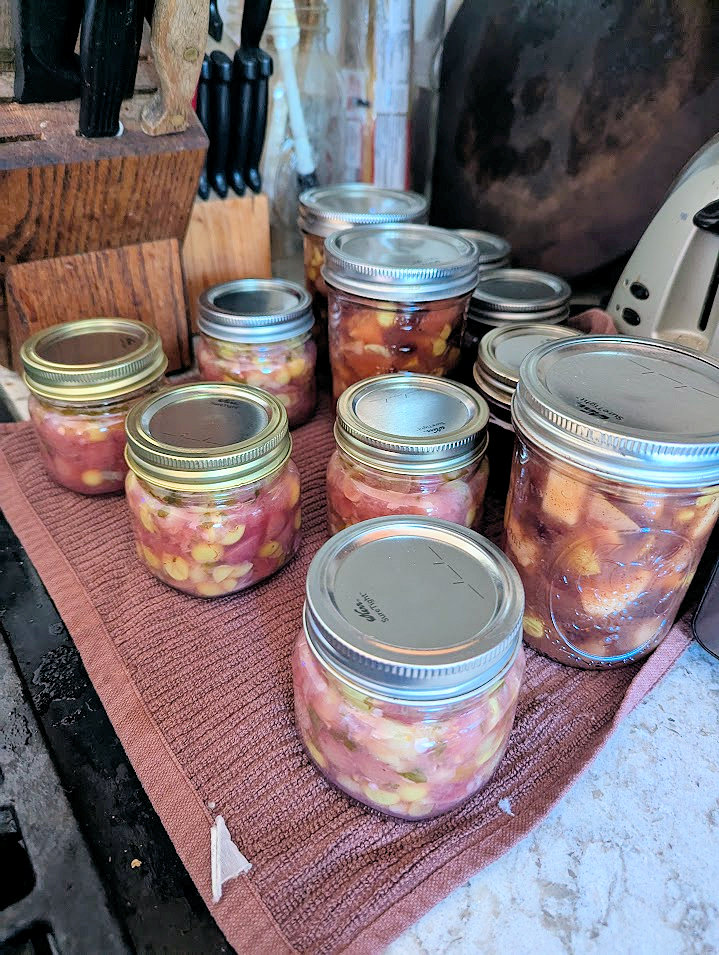
I have been busy canning enough for the two of us: salsa, compote, conserve, chutney. Herbs have been dried or are drying for herbal teas. We foraged huckleberries and elderberries from the National Forest (those are in the freezer, awaiting a moment of inspiration).
We also foraged some more native plants for the yard, some of which have already been planted in the ground and some which are waiting for me. They won’t have to wait long: I have been busy moving plants around and tilling new sites for more plants. I’m waiting for the next round of rain to pass through and will use the ensuing dry days to my advantage.
I have filled the hummingbird feeders and hung them out: I took them down during the hot days of late August when honeybees get lazy and swarm the nectar. I melted and mixed up a new batch of bird suet. That came down when the weather warmed up and the starlings started coming around. The starlings are gone now, moved to parking lots. The weather is cooler and the suet won’t melt or mold now. We’ve started feeding the corvids and small songbirds again. (Corvids: California scrub jays, Steller’s jay, and crows.)
I have cleaned up the space between our shed and the neighbor’s lawn. That’s a bit of a sore point: our garage is set back three feet as per the law, but the yard maintenance person insists on mowing our portion, including over my ferns and day lilies. ARGH. I have tried little fences, cardboard, and now I am merely tilling up the strip to plant more flowers. When we first moved in, the elderly woman who lived in that house asked me to do that so her lawn person wouldn’t have to mow that (because we aren’t the best at keeping up the lawn mowing, preferring to let our yard go “natural”). I wasn’t in a place to do it then, but I am in a place to do it now.
Too bad that Selma died several years ago and we have had renters living next door since. Renters who did not mess with our three feet until the landlord hired this current lawn guy. I have even posted a sign on the side of the garage: DO NOT MOW OVER THE FERNS, PLEASE. He still hits them. So I am in a passive-aggressive war with him (and by extension, the landlady to the property). Yes, I could make a phone call, but it is infinitely more fun doing it this way. Don’t judge me.
(If you’re thinking I’m afraid of confrontation, you’d be very, very wrong. Most people are afraid of confrontation with me. When I come into a confrontation, I come with both barrels loaded and a back-up cannon. The world is much safer when I resort to passive-aggressive flower planting.)
I hacked my poor hydrangea back by at least two feet. It used to be planted under the pine tree (Nature rest its branches and rotting roots). The pine tree fell over some seven or eight years ago. The hydrangea is now in full sun, and summers have heated up the past five or six years. I have covered it with umbrellas, sheets, and tablecloths, but it still gets sunburned. The flowers fade too quickly. It has grown spindly. I could either kill it outright or prune it way back and see if it survives.
A woman walking her dog by the house commented on it. I told her I hopes I hadn’t killed it by my merciless hacking. She said she’d watch it and if it lives, she’s hacking back her overgrown hydrangea next fall. That’s me: inspiring neighbors to bush cruelty.
I also cut the Rose of Sharon back quite a bit, the forsythia, and the mock orange. They aren’t as noticeable a hack job as the hydrangea that was five feet tall one day and less than three feet tall the next. Turn me loose with pruners and a saw…
I meant to do a blog on sprinklers, highlighting our eclectic collection, most of which we don’t actually use. I may still do that. It sounds like a wintertime post. Meanwhile, I am considering this post finished.
My oldest grandchild is coming for a week-long visit in just a little over a week from today. He wants to visit before he gets too busy with his Senior year of high school and basketball, and, I think, he wants to check out his mother’s alma mater. It’s hard to believe we will be driving to Newberg to tour the campus of George Fox University again: wasn’t it just yesterday that we made the trip with our daughter? I secretly hope our almost-18 year grandson will decide to attend college there instead of Anchorage. Sure, the latter is closer to his parents, but the former is closer to us.
Z’s arrival means I have to create space for him in our little house. The “spare bedroom” is now my studio and cluttered with what my husband refers to as “the detritus” of my later life career as an eccentric. I have sculptures, paintings, canvases, paints, sewing, and more stacked up waiting for cooler weather and my attention.
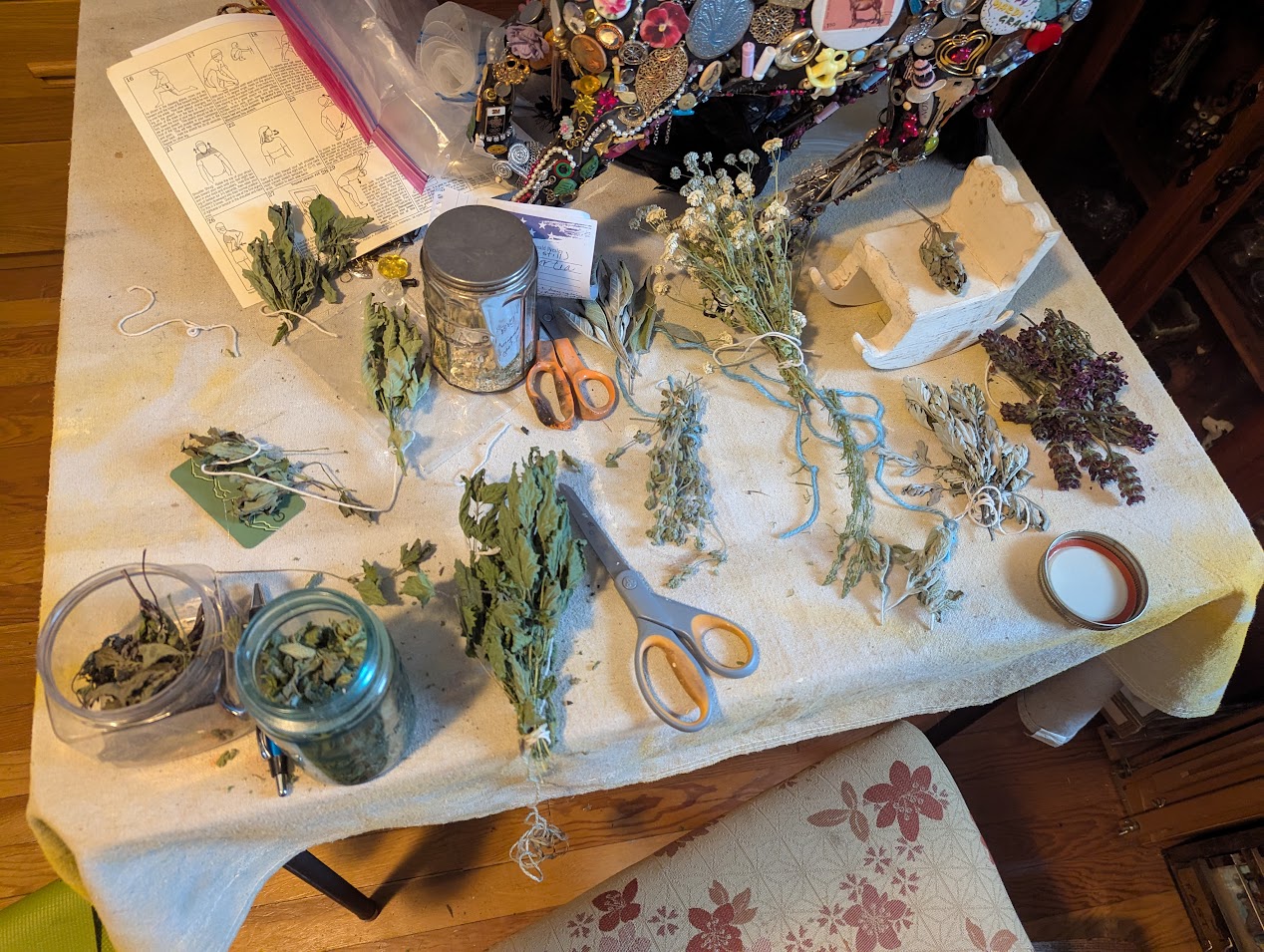
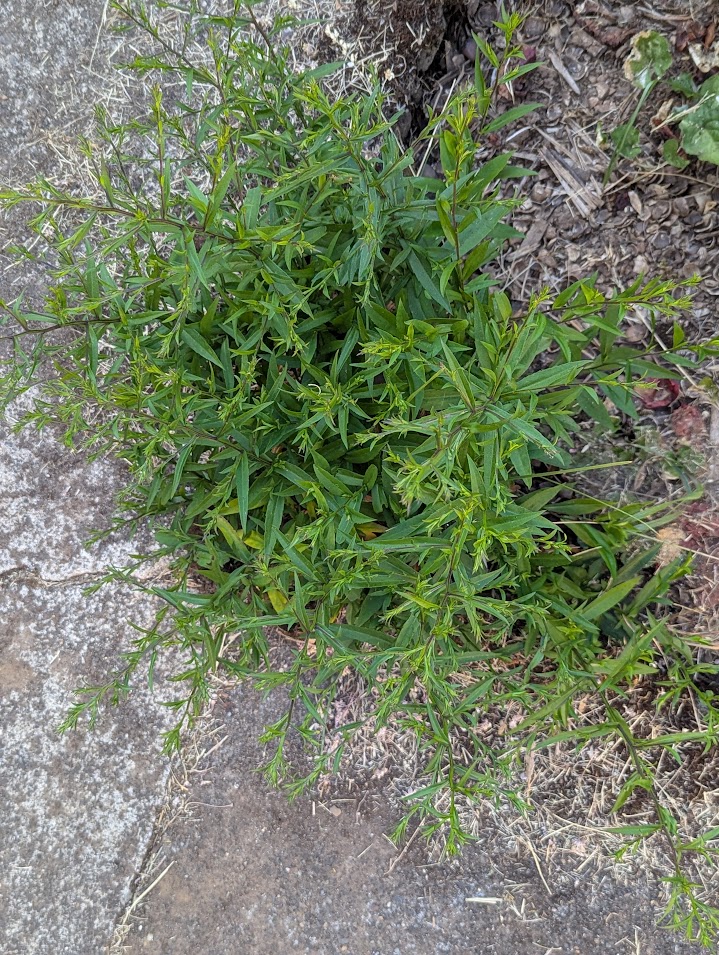
Gardening takes up the good weather season, and I have herbs hanging and drying up here as well. Herbs I have forgotten to label: sage, betony and bee balm, feverfew, self heal, horehound, peppermint, and nettle. I can smell the peppermint. The sage and horehound are easy: sage has a distinct aroma and horehound is also soft and grey. The feverfew is obvious with its white blooms as is the self heal with its purple ones. The bee balm and betony are probably the same, just one was labeled as “betony” and one was labeled as “bee balm” when I purchased the plants.
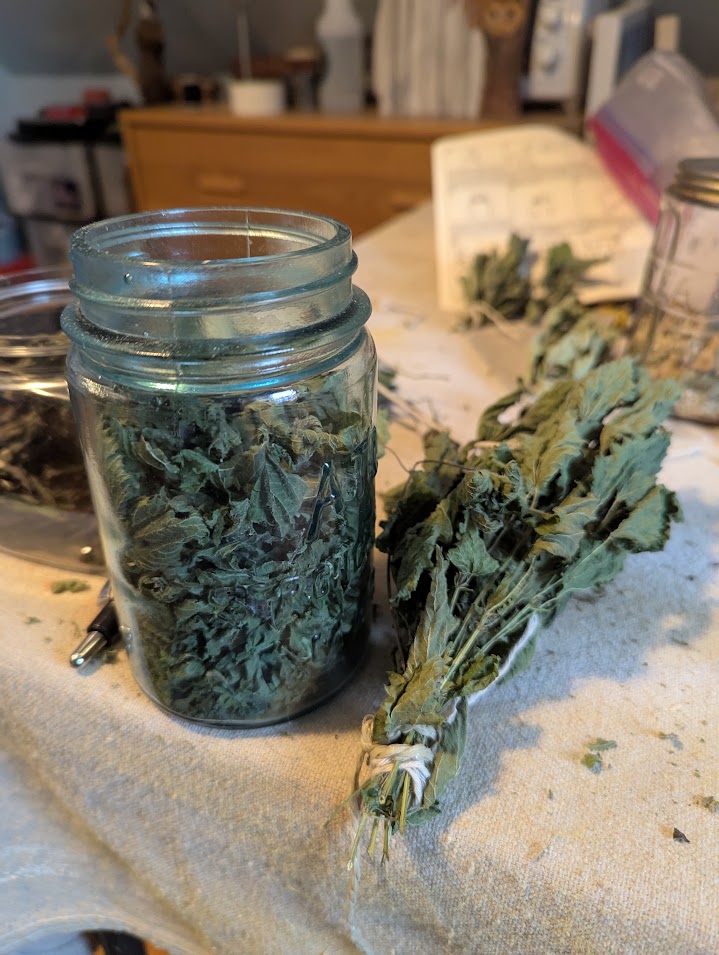
The nettle is the easiest to identify: despite being dry and the same color as the bee balm, nettle still retains a “sting” to its leaves. The sting isn’t close to what nettle feels like when it is alive and bare skin brushes against it; it is just an irritating little prick felt when stripping stems of leaves that soon disappears. I have more nettle than any other herb, mostly because I do not allow it to go to flower or seed: the plant I am growing is safe within the confines of a planter where one cannot accidentally brush up against it without protection.
Because, yes, I have experience with stinging nettle and it wasn’t pleasant. I once crawled on my hands and knees into a mess of it growing in an aspen grove on the side of Chocolate Mountain. The full-face effect was… well, stinging! (Why would I do such a stupid thing? We were at a large camp-out with many families, I was a preteen, I was probably hiding from a sibling, and I wasn’t thinking about the ever-present rattlesnake danger of my childhood in the high desert of Nevada. Maybe I was pursuing a garter snake? Or pretending to be a coyote or mountain lion. Who remembers such mundane details?
I remember the facial.
(Cover photo: Betony in Bloom) (All photos are mine unless otherwise noted. Just FYI)
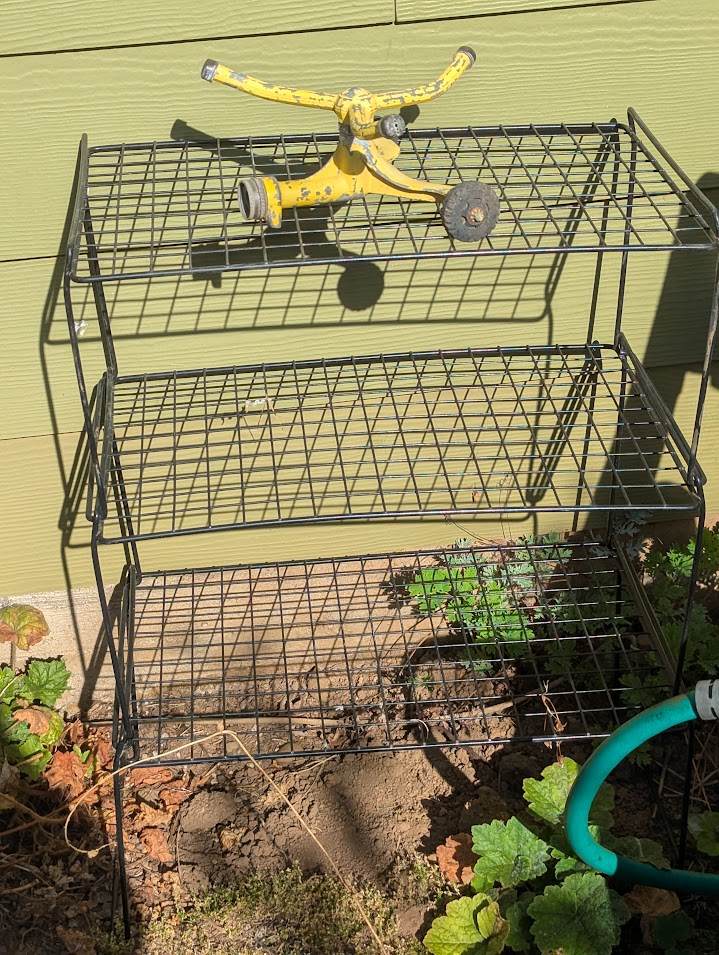
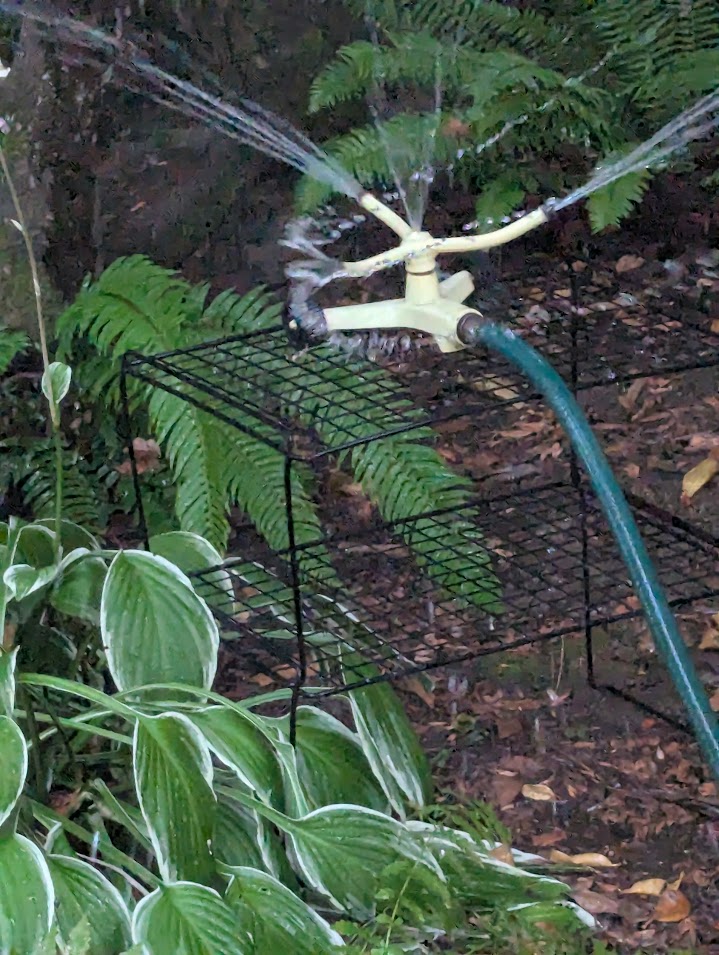
We’re in the middle of a hot three days, possibly reaching triple digits. Rather than try to write something, I decided to post pictures of sprinklers, the last one spouting water. Enjoy and stay cool.
I planted it many years ago. It never sprouted. Four years later, there was a tiny plant that looked suspiciously like a milkweed growing next to some peonies. I clipped a leaf off to see if it would ooze the sticky white sap that gives milkweed its name: it oozed. Excited, I let it grow. The milkweed plants are limited to a “triangle” between the garage and two sidewalks. I cut them down when the seed pods appear: I don’t need more plants. Also, I don’t want to wait another four years for the seeds to sprout when the plant does just fine by sending out runners from those very sturdy rhizomes.
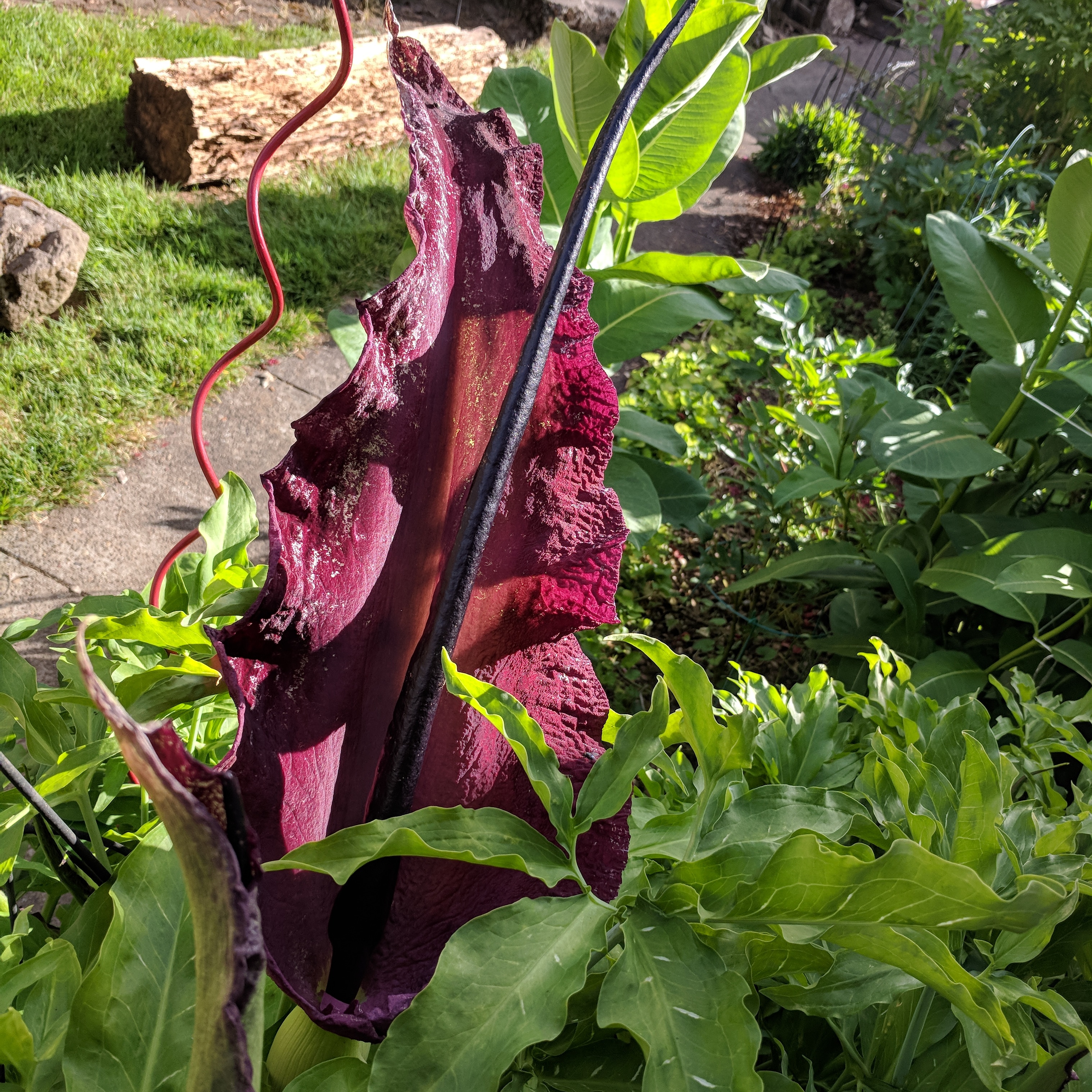
I was afraid the milkweed would crowd out the peonies and the asters. It doesn’t. The three plants grow together happily. What the milkweed did affect was my arum, dracunculus vulgaris, or “Dragon Lily”. The milkweed runners take up the space the lily’s bulbs are in and I’ve slowly lost many plants in that tiny garden space. There are a few left and this fall I will dig them up and move them to a better location, free of water- and space- hogging competition.
Unfortunately, milkweed does nothing to impede the growth of grape hyacinth, I don’t think anything short of a heavy-duty herbicide affects grape hyacinth (and I refuse to go that route). Every year I pull several hundred bulbs out of the ground and compost them. (Sometimes, I will give them away to a desperate gardener who doesn’t know better than to start them in their yard. I’m pretty sure I’m digging up bulbs to send to my brother in Reno this fall. “Hey, Bro, your yard needs some early spring color. I promise you won’t hate me in ten years…”)
Now, when the first purple grape flowers begin to bloom, I do my first – and only – weeding of the space. I cut hyacinths for a bud vase. I toss the ones that pull up with the ever-present grass. I do my best to rid the space of grape hyacinth bulbs while enjoying the aroma and color. Of course, I fail and the hyacinth prevails.
In the Spring, I cut back the old stalks of peony and aster just as the first new stems begin to push their way skyward around the fading hyacinth. Purple stems of peonies, green stems of aster, the spotted stems of Dragon Lily rise above the fading green and brown stems of faded hyacinth. Buds form on the peonies and soon the area bursts with pink and red peonies so thick I have to tie them to stakes to keep them upright.
The peonies fade and drop their petals just as the aster and the milkweed stalks begin to mature. The green of the aster is first to top out at 2-3’ tall. Milkweed will soon tower over the asters and all one will see will be the green stalks of milkweed.
But before it does, at the end of May and always on our anniversary on the 7th of June, the aroma of rotten hamburger wafts in the air: the Dragon Lilies have opened. Flies and beetles rush in to await their demise in bowl of this carnivorous beauty. The smell lasts a couple days. The flowers wilt and the entire plant begins to wilt and turn yellow.
Now it is the milkweed’s turn.
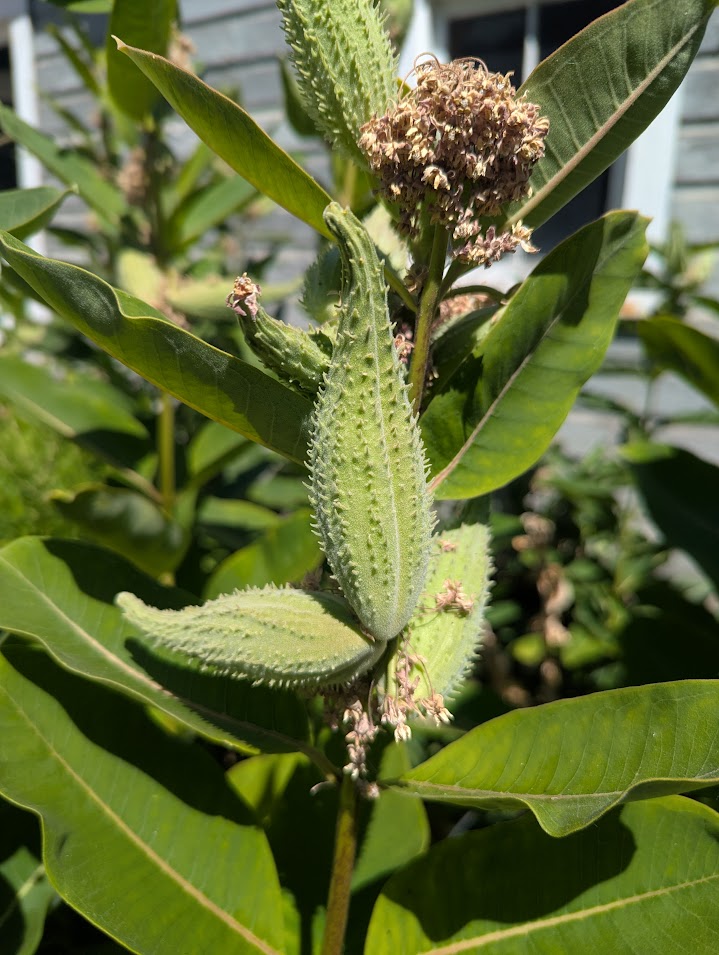
I have two varieties: Showy milkweed (Asclepias speciosa – native to Oregon) with pink florets and California milkweed (A. Californica) with white florets. The latter isn’t a native to Oregon, and it doesn’t grow as prolifically as the Showy milkweed does, but the blooms are pretty and the aroma is the same: sweet and enticing, the polar opposite of the faded Dragon lily.
I planted milkweed thinking I could attract migrating Monarch butterflies. I didn’t know then that this part of the lower end of the Willamette Valley is not on the migratory path for these beautiful and endangered butterflies. No worries: the value blooming milkweed has for other pollinators outweigh my misplaced intentions. Every early bee, butterfly, and tiny wasp brave the sticky edges of the flowers to get at the pollen inside. Occasionally, a honeybee will get stuck and will have to struggle free. A few plants wilt and die, host to the milkweed beetle which does exist in this half of the valley.
Below the tall stems that now tower between four and six feet, a junco might build a ground nest. The nests are soft grass circles, now much larger than the palm of my hand. We won’t know there’s a nest there until a fledgling bird hops out of the cover while the parent birds hover nearby.
The bloom of milkweed lasts a couple weeks giving us quite a show of pink and white, and busy pollinator insects. But then the flowers fade and the few that were pollinated will start developing seed pods. These are green and soft, and quite edible if you are not allergic (I am). When the pods ripen, they turn brown and hard then pop open to release thousands of sees hanging from wispy “umbrellas”. The wind catches the seeds and like the dandelion – well, you know the rest of the story! The ground is soon covered in tiny, milkweed parachutes looking for a home.
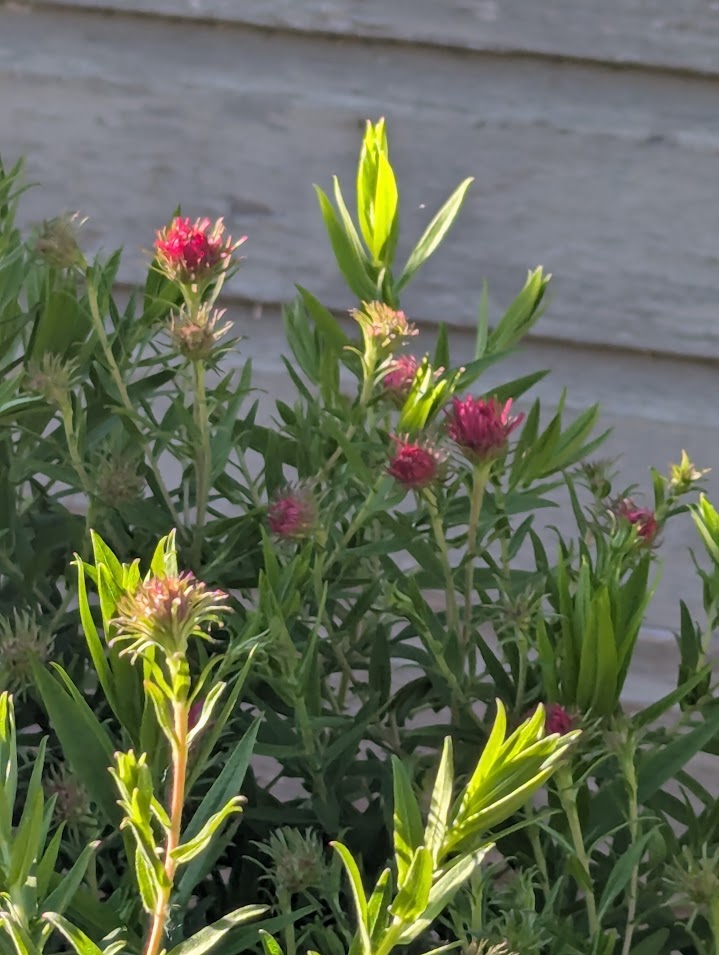
But I mow down the milkweed, not simply to avoid the parachutes, but because the milkweed towers above the asters. And the asters put on a late show of color lasting through August and into September. The tall asters are a riot of magenta pink. The aster that grows in the crack in the sidewalk puts out lilac-colored flowers. The tiny bees – those mining bees and other ground dwellers – love the asters.
The milkweed is gone now, and I wait for that last eruption of color. Too soon, the rain will come and everything will turn brown. (Photo is of a year I did not cut down the milkweed stalks and the seeds flew everywhere.)
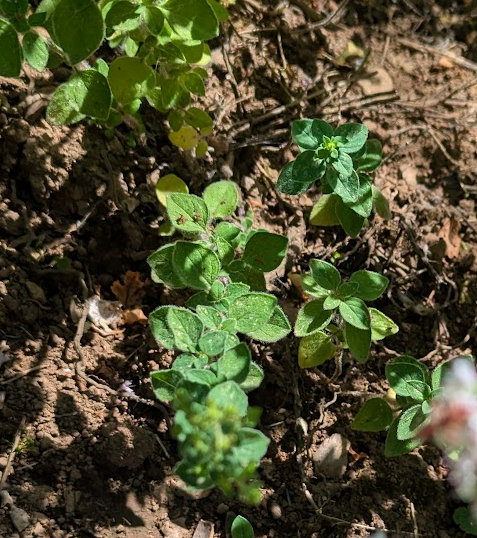
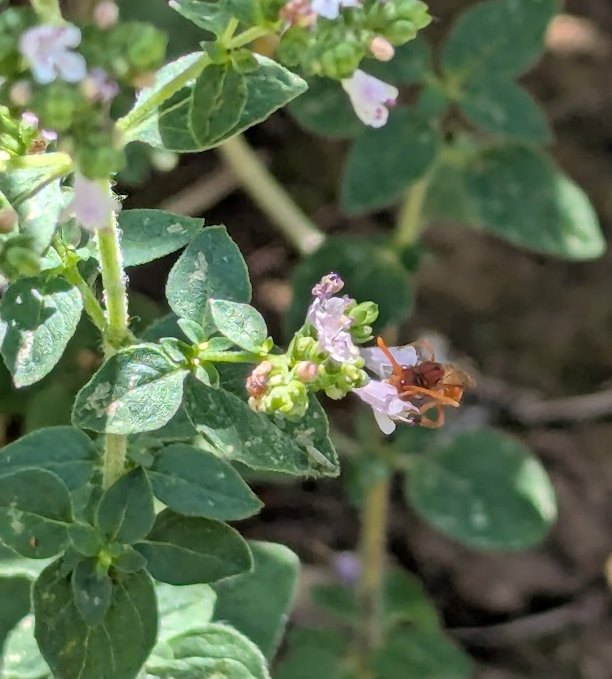
I don’t remember when I first planted oregano in my yard. We moved here in 2002 and I started carving out the “island” in 2003, so it was probably 21 years ago?
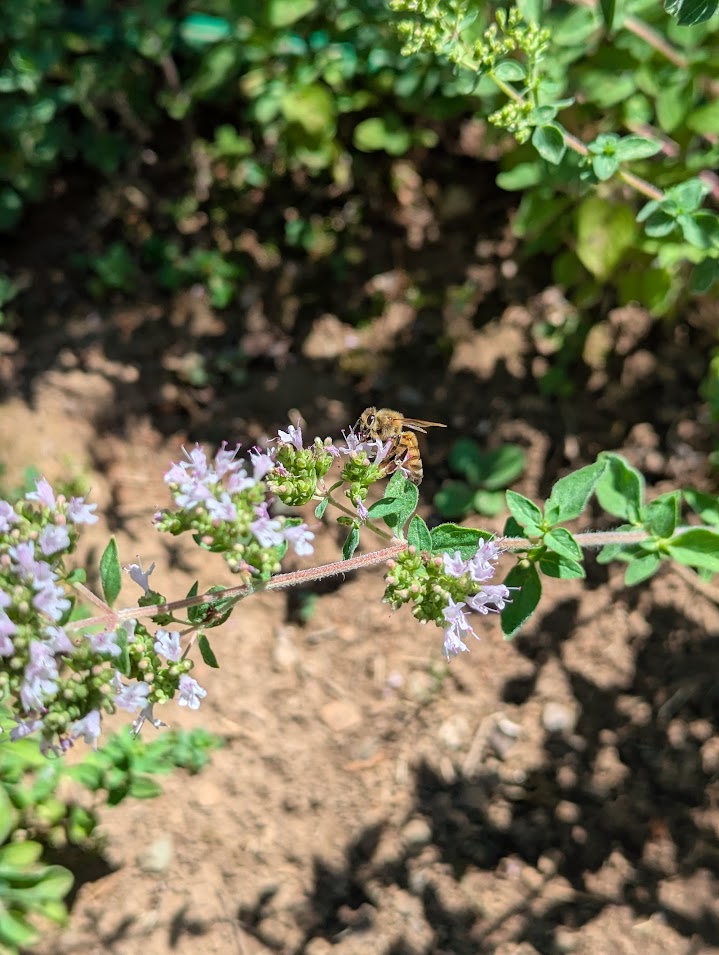
The “bed” of oregano has gone through some changes over the years: choked with that pesky grass, fenced off from dogs and to keep it upright, and it’s current incarnation that is 10x the original plant. I didn’t bother to rein it in this summer, but I did get rid of (most) of the pestilence grass.
We don’t purchase dried oregano in jars. Sometimes, I cut a handful of sprigs before it blooms, hang them upside down to dry, and scrape the dry leaves into an old jar that still has the original label on it: “Oregano”. We use it fresh during the spring and summer months when we can step outside and clip what we need off the plant. By Autumn it is fading and come winter, only dead stalks remain that I cut down and compost.
In spring, the cycle begins again.
I find new plants growing everywhere in the yard: oregano is self-seeding. I pull it with the other weeds, savoring the aroma as I do. I could allow it to grow everywhere and some day when I am too old to do my weeding by hand, that is probably what will happen: it will grow around the peonies, the rosemary, the lavenders, and the evening primroses.
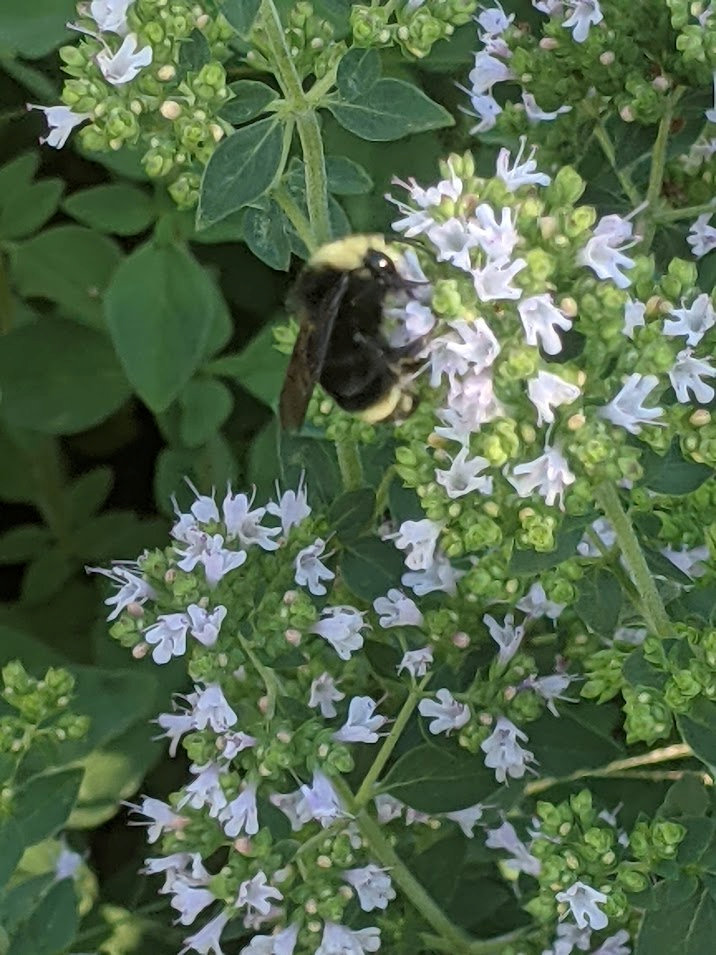
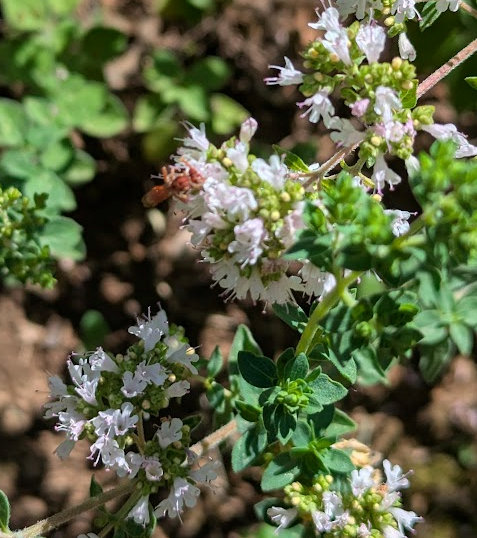
I wouldn’t mind and the pollinators would certainly benefit from the profuse tiny purple blooms. I wonder what oregano honey tastes like? Some honeybee keeper must know: as soon as it begins to bloom, the bed is covered with honeybees and other pollinators.
Our dogs (one at a time over the years) will stand with their noses deep in the aroma, snapping at whatever bees they see. They get stung and jump back, shaking the head furiously before wading back in to snap at another bee. Our mantra is, “Leave the bees alone <Ruger, Murphy, Harvey, Sadie>!” They leave, but they always return to the scene of the crime.
I wonder if the bees taste like honey or like a good Italian dish spiced generously with oregano?


































 Jaci Dawn