Feeds:
Posts
Comments

Posts Tagged ‘genealogy’

I am transcribing this from a 40-page typewritten photocopied document that was among my father’s research. I do not know the veracity of it all nor do I know how many posts the series will take up.  What is in italics is what I transcribed. My notes are not in italics.

In 1861 the war began. Four of her (Sarah Lord Wilox’s) sons enlisted; only two came back, one of the two shattered in health from a long imprisonment.

Sarah Wilcox died October 2nd, 1883.

Immediately after the firing on Ft. Sumpter (sic), came President Lincoln’s first call for troops. Wilbur I. Wilcox was at this time teaching. Willard J. Wilcox was engaged in making brooms. They immediately dropped their employment, and enlisted in the first company and first regiment that left Illinois for three months’ service – Co. A, 1st Regiment, Chicago Light Artillery. Willard was then 26, Wilber, 24 years of age. Saturday they went to Chicago and enlisted; Sunday they were journeying toward Cairo. They returned home on a furlough at the expiration of their enlistment, but re-enlisted for three years, or during the war, before returning home. After a few days at home they started again for Cairo and rejoined their battery.

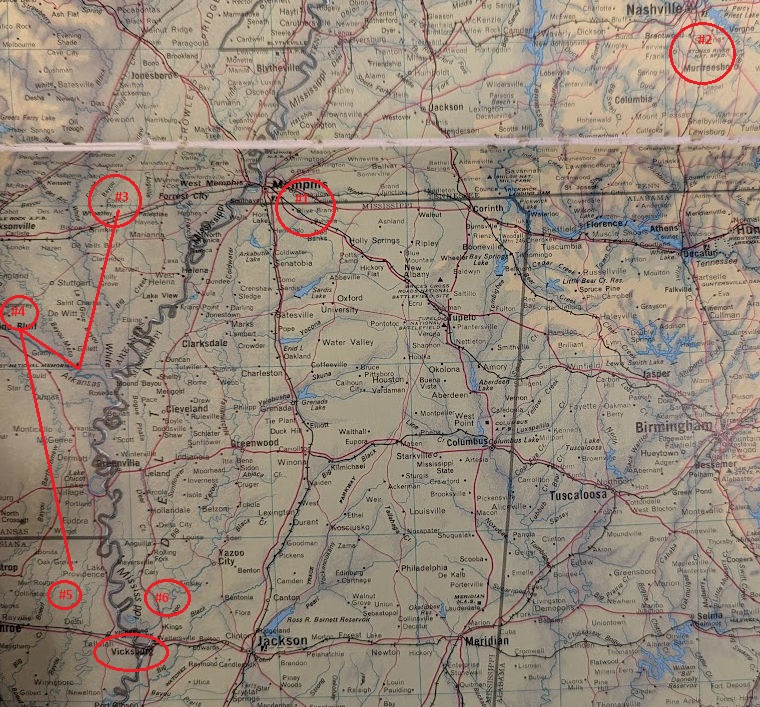
                Cairo (Kay-ro), Illinois, was where U.S. Grant based his operations out of.

Willard fell from a caisson in Dec. 1861. As soon as (he) was able to travel after this injury, he visited his mother, remaining with her until after the marriage of his sister Mary on Jan. 1, 1862.

Before his furlough had expired he was recalled to his company. He was with the company which moved from Cairo, Jan. 10, 1862, on a reconnoisance (sic)  into Kentucky, returning Jan 22nd. At the battle of Shiloh, Willard and Wilber were both wounded. Willard carried a minie ball* in his head the remained of his life in consequence of this injury.

During the advance on Corinth, Willard and others were sent out after horses, at which time Willard was again wounded, receiving six buckshot wounds in the shoulder, and back of the head.

                The Battle of Shiloh was a Union victory at heavy cost. It was one of the bloodiest battles in the war with nearly 24,000 casualties. My brain can’t fathom that number! Corinth is a short distance from Shiloh, across the border in Mississippi, and was a Confederate stronghold.

Wilber was Sergeant when killed July 22, 1863. (Vicksburg?)

Willard re-enlisted in the veteran corps after three years’ service. He received four hundred dollars and a 30-days’ furlough. He was sergeant when mustered out in July, 1865.

Thomas Wilcox enlisted Aug. 11, 1862. He joined Co. A Chicago Light Artillery at Memphis. He was taken prisoner at the battle of Atlanta, July 22, 1864. He was released at the close of the war.

John Wilcox enlisted Sept. 4, 1862, 1st Sergeant Co. K, 88th Ill. Infantry/ He was killed at the battle of Chickamauga, Sept 20, 1863. He is buried with the unknown dead at Chattanooga.

Unknown Civil War Dead Chatanooga (credit: Pixabay – giselaFotografie)

Daniel E. Barnard enlisted Sept. 4, 1862, Capatin Co. K, 88th Ill, Infantry; mustered out at the close of the war.

Erastus A. Barnard was drafted Sept 27, 1864; assigned to Co. H, 30th Infantry; mustered out June 4, 1865. He marched with Sherman’s army to the sea.

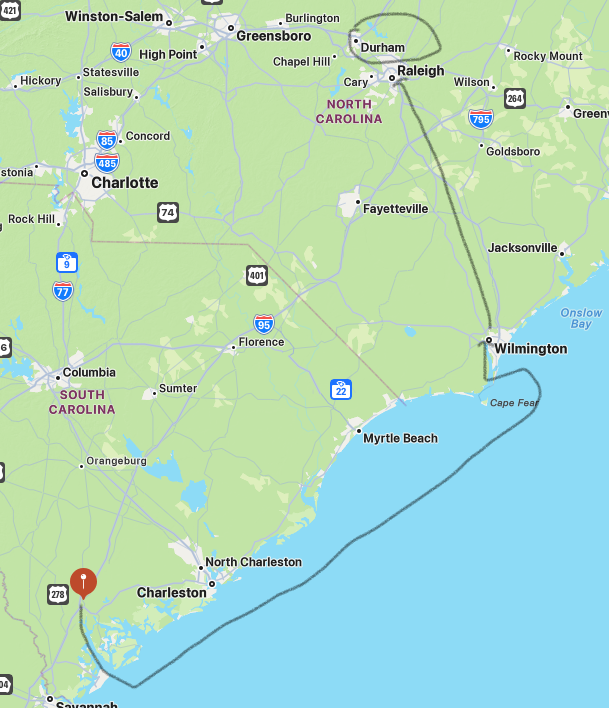
E.A. Barnard was taken ill during the march to Savannah. He remained with the army until Savannah was entered. He was in the hospital there from Dec. 24, 1864 to April 1, 1865. Thence he went to Pocotaligo; from there by boat to Wilmington; then marched to Raleigh and joined his regiment the day before Johnston surrendered.

General Joseph E. Johnston surrendered to General Sherman at Bennett’s Place, Durham’s Station, N.C., in April of 1865.

                Erastus A. Barnard married Mary L. Wilcox. Daniel E. Barnard was his brother.

                William Orson Wilcox (my ancestor) did not serve. I do not know why except, perhaps, he was left in charge of Sarah and his brother’s respective families.

*The Minié ball, or Minie ball, is a type of hollow-based. Invented in 1849 shortly followed by the Minié rifle, the Minié ball was used in the  American Civil War where it was found to inflict significantly more serious wounds than earlier round musket balls. (Source: Wikipedia)

Read Full Post »

In 2014, I had the pleasure and privilege to visit several cemeteries on the East Coast. My son lived in Fayetteville, North Carolina, at the time and I wanted to visit Bonaventure Cemetery because it was featured in some novel we passed around at work and I was fascinated. Since we were in Savannah, Georgia, we also visited the downtown area where the Colonial Park Cemetery is located. After I left my son’s family, I traveled to Richmond, Virginia, where I met up with two friends and we toured Oakwood Cemetery.

Bonaventure Cemetery lived up to the hype: it truly is a beautiful place. There are tombs, crypts, statues, and ever so much more. I took a lot of photographs with my DSLR and held the hands of my grandchildren as they wondered at all the headstones, crosses, and more. Over 500 Confederate dead rest there including some notable officers. A lot of war dead, period: we temporarily lost my son when he wandered into the World War dead section.

Colonial Park was a surprise and a bonus with its above-ground crypts. It was closed to burials before the Civil War but many heroes of the American Revolution are interred there.

Oakwood in Richmond has the richest Civil war history. One of my friends is a genealogist whose family fought on the Confederate side of the conflict (mine fought opposite hers). It is a pretty cemetery overlooking the James River, but it is also an oppressive place: the sheer numbers of men who lost their lives in that bloody conflict between the states is overwhelming, and I feel there’s a spiritual heaviness that comes with that kind of sacrifice.

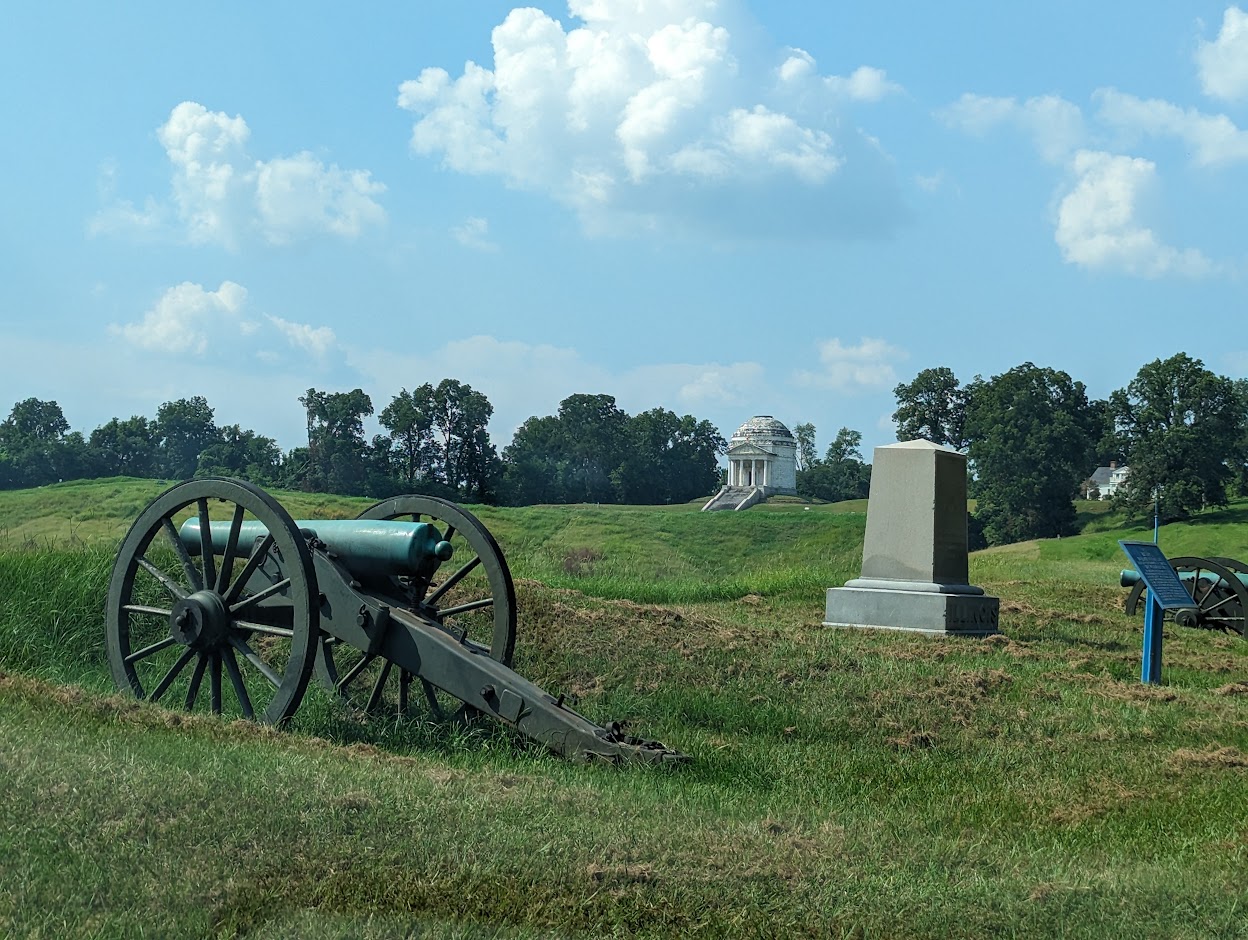
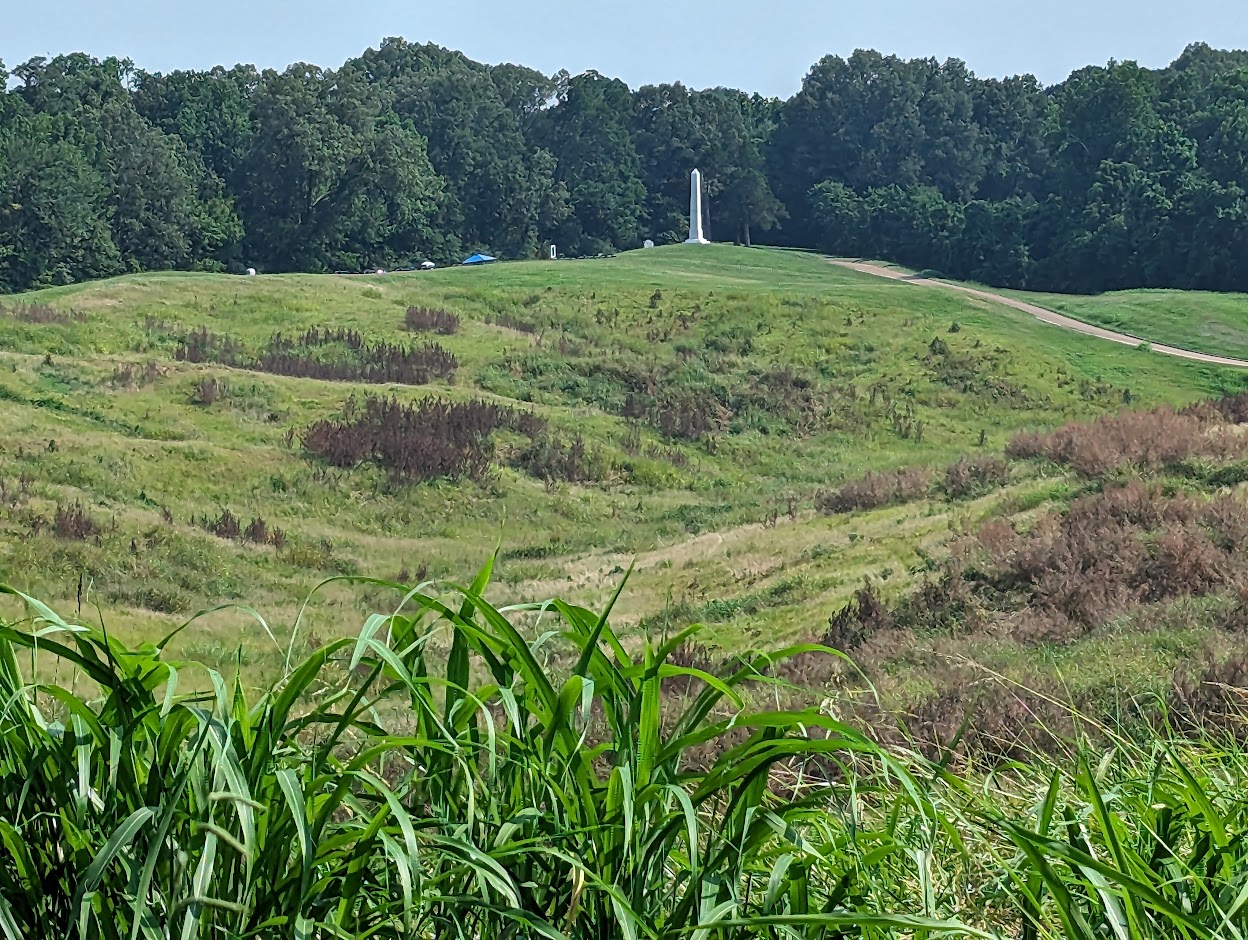
It is hard for me to verbalize what I sense when I read about or visit a Civil war memorial, a cemetery, or just rote history. In 2023, my brother and I drove across the country (he drove, I bummed a ride with). One of our stops was the Vicksburg National Military Park. The trenches between North and South were so close together that you could well imagine the words of one of my ancestors in a letter to his mother:

Camp near Vicksburg, June 23, 1863

“We have a new battery, five light 12-pounders and one 10 pound parrot gun. They will carry further than our old battery; our men are at work making approaches. They are within a few feet of the enemy’s ditch in several spaces, but there has got to be a parallel ditch dug to hold many men before they can storm it. Our pickets are in one ditch while theirs are in another. They used to talk a great deal, but that has been forbidden, so they write on pieces of paper and pass backward and forward. One of our boys threw over a part of a loaf of bread and they threw back a biscuit. You can talk to them quite easy from the guns where Thomas stays, when they are on their breastworks. ~ Willard Wilcox”*

I did not recall at the time that letter was written from the very same site where Terry and I stood in 2023, 160 years and one month later, but you could feel the tension and almost hear the cannons and smell the blood.  It was an eerie place, not in the sense that it was frightening, threatening, or even scary, but you could feel the death still hanging in the air. The air was heavy and we didn’t breathe easily until we were back on the road and away from that pivotal and bloody battle site. I write this to explain ahead of time: writing about the American Civil War is a truly heavy undertaking and I have forty pages of that history as it relates to the Wilcox sons of Sarah Lord Wilcox.

*Willard was the brother of my great-great grandfather, William Orson Wilcox.

Read Full Post »

I have some typed family history notes written by Alice Barnard.

Alice gives her relationship in her “Sketch of … Three generations”. She was the daughter of Miranda Wilcox, sister of William Orson Wilcox. Miranda and William Orson were among the seven children of William Wilcox and Sarah Lord.

Captain Thomas Wilcox and Abigail Shipman begin the narrative, although the author (Alice) is unsure is he served in the American Revolution or not I have more digging to do there, but I will sort it out. Eventually. I do know, by Alice’s account, that his heart gave out and Abigail died of consumption, having smoked most of her life. Alice write of how her mother, Miranda, would like Abigail’s pipe in her dotage.  Thomas and Abigail were the parents of William who was the father of Miranda and William Orson.

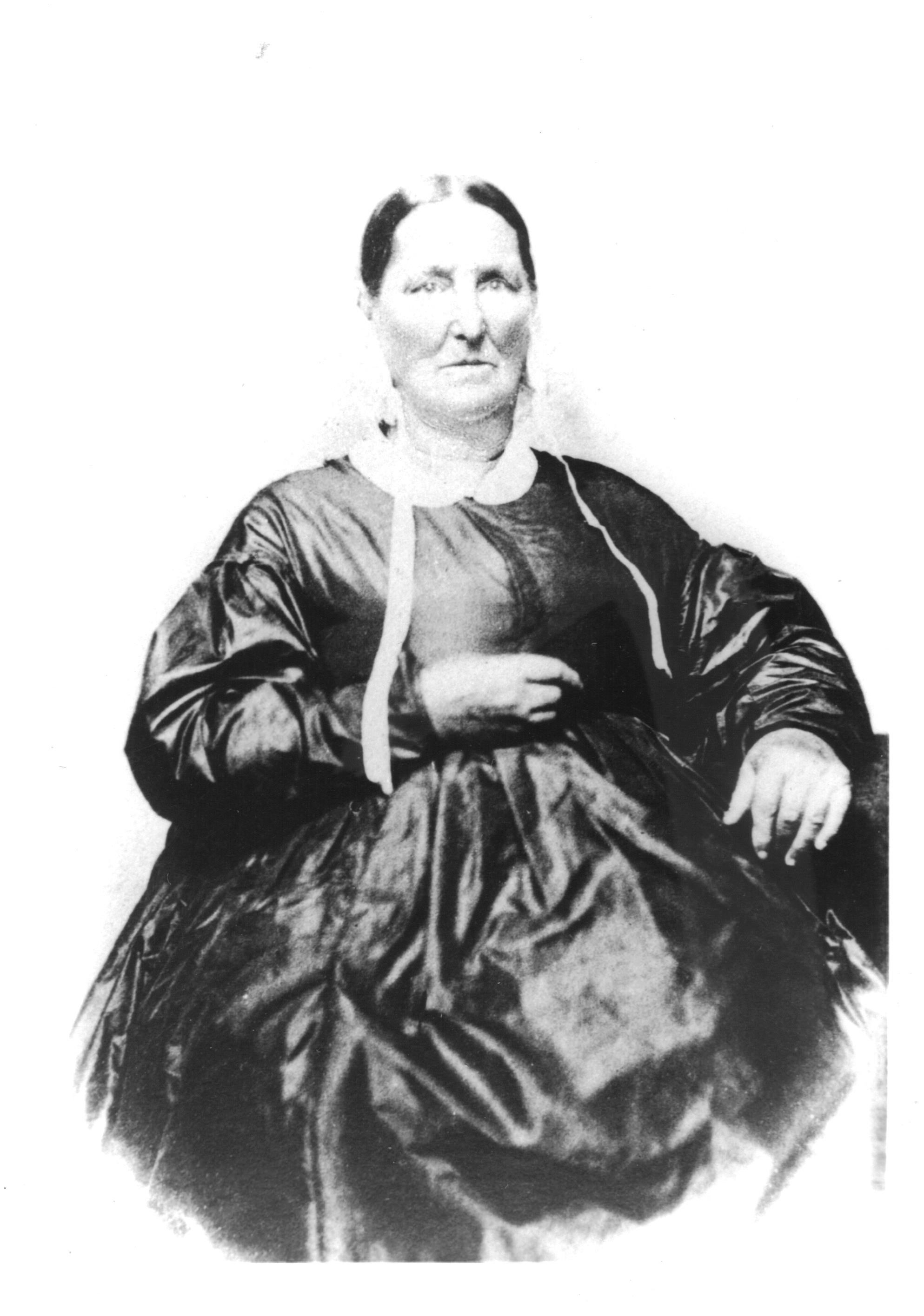
William emigrated from the East Coast to Illinois by wagon in 1844. His wife, Sarah, was an accomplished weaver. Sadly, William died within the year, leaving Sarah to raise seven children in a new territory with no friends or relatives. She must have done a stellar job because her photograph has been passed down generations and she’s always listed in the family tree as Sarah Lord.

William and Sarah’s children were: John, Jerusha, Thomas, Miranda, William Orson, Willard, Wilbur. And Mary L. Someone like the name “Will”… a lot!

Alice wrote her “sketch” in 1929 at the age of 75, so some of her memories were dim. She did not marry, so I have no cousins along her line, but she had siblings: William Wilcox Barnard, Emma Barnard (m. George Graham), and Mary E. Barnard (m. Edward G. Howe). Alice’s father was William Barnard (1821-1900). Alice’s Aunt Mary Wilcox married Erastus A. Barnard but their only listed descendant, Amy, died at the age of 20 in 1888.

Sarah Lord

Most of Alice’s memories center around Sarah Lord Wilcox. Sarah was one of many children but was apparently raised by her childless aunt, along with a brother, Levy. When her husband died, she lost nearly everything to his brother, Willard. She then took in boarders while her sons hunted for sustenance. They also kept sheep and farmed. Sarah had a stroke at the age of 65 but lived another 20 years.

Alice was my second cousin once removed: my great-grandfather’s first cousin. The paper I have (a copy) was in a letter to my great grandfather, John T. Wilcox, son of William Orson.

Read Full Post »

I had hoped to have a neat and orderly history of the Melroses all the way back to King Robert II of Scotland, but it was not to be. It got quite convoluted, in fact. Confusing. I think I have it all worked out now, but it is not the ancestry tree my cousin sent me. His data was downloaded from a reputable ancestry site but I’m the sort of person who has to see it for herself, so I tried to follow the same paths (or branches) and I ended up in a squirrel drey around the 15th Century.

A squirrel drey is a squirrel nest of broken twigs and short branches, usually high up in a tree. Like a similar nest of a crow or magpie, it is a bit of a mess. And that’s where I stopped right before Christmas. I wanted to shout, “I can’t figure this out!”

I made it back to our 13th great grandmother, Margaret Fraser (née Hay). Margaret was born in 1453 and died in (or around) 1500. She was married three times: Alexander Fraser of Philorth; Sir Gilbert Keith of Inverugie; Robert Douglas of Lochleven. Alexander Fraser is our ancestor.

The problem was (is) with Margaret’s mother according to the tree my cousin sent me: Lady Janet Elizabeth Douglass, 1425-1490. Lady Janet was supposedly the daughter of Lady Elizabeth Catherine Stewart, 1362-1446. By those dates, Lady Elizabeth Catherine was 63 yeas old when she gave birth to Janet Elizabeth. My brain just refuses to make that leap of faith, especially not in the 15th Century. Either we’re missing a link between the two women, or God granted a miracle of Abraham and Sarah level to the Stewarts of Scotland in 1425.

I removed Lady Elizabeth from my search to see if I could straighten out the squirrel’s nest.

I found a lot of those “hints” from other people’s research, but I kept coming up with the wrong husband (no one by the surname of Hay married to a Lady Janet Douglas) or those pesky birthdates were way off kilter. Example: “father” James 1st Earl of Morton Douglas, born in 1426. Hm: father at the age of 1? That’s unlikely.

What I kept coming up with was a William Hay as Margaret’s father. Now, hold that thought.

Getting as far back in time as Margaret was a fascinating venture. Sir Alexander was the son of Lord William Fraser (1473-1513)( Nov 13 1513 – Flodden Field Near Branxton, Northumberland, England) and Elizabeth Keith.

Flodden Field was a bloody battle that resulted in the death of the Monarch of Scotland dying in battle, King James IV. It was part of the War of the League of Cambrai and was a decisive loss for Scotland. History shows it as happening on the 9th of September 1513, but William’s death is recorded two months later. I will assume, for now, that he died as a result of his injuries but since it was two months after the battle, he is not listed among the nobles who died there.

However, there’s a William Hay, 4th Earl of Errol, listed as having given his life’s blood at Flodden Field and his name sparked a little research into the William Hay who is possibly Margaret’s father. What I learned through a variety of websites was that the First Earl of Errol, William Hay, married Beatrice (Beatrix) Douglas. Not Janet. William and Beatrice had 7 children, including the 2nd earl of Errol, Nicholas, and the 3rd Earl of Errol, William. Nicholas died in 1470 and William subsequently inherited the title. The youngest child was Lady Margaret Hay, married three times (Wikipedia).

The William Hay who died at Flodden Field was her nephew.

The key to this research is that Margaret’s father, William, was the grandson of Princess Elizabeth Stewart, second daughter of King Robert II of Scotland.

I still need to fill in the gap between grandmother and grandson, but the connection is there: we are related distantly to King Robert II of Scotland. And I learned a lot about the west coast of Scotland and how it relates to my paternal grandfather’s family tree. I also learned about the largest battle (in terms of troop numbers) in Scottish history and the devastating effect it had on Scottish nobility.  

Read Full Post »

I paused my research on my maternal side of the family to scan photos and documents from the paternal side. My father took the time to identify and label most of the photos and that has been a great help, but there are still a few unknowns waiting to be identified.

Speaking of identifying things: Dad identified more with his mother’s family than he did with his father’s family line. He told us how he was Irish, and he could even remember a few words of Gaelic when he was younger.  Sadly, the knowledge I have of his family ends with the first emigrant to America who sailed from Northern Ireland and who was Presbyterian by faith. My own DNA registers no Irish ancestors, but tracing ancestry by DNA is only as good as the pool of people (relatives) who also have their DNA tested.

I have a lead that might be my Irish ancestors, but it bears more research. If it pans out, they were originally from south Ireland and migrated to the north, possibly due to religious differences (again, the family was Presbyterian, not Catholic). Traditionally, Northern Ireland is Protestant and Ireland is Catholic. Orange vs. Green despite both colors being in the national flag.

Whatever the differences, the Cusick (possibly Cusack misspelled at some point in time) side of the family identified as Irish Nationals who emigrated across the Pond.

John Timothy Wilcox I

Dad’s immediate family was riddled with tragedy and not a little bit of mystery. He was a Wilcox, descendant of John Timothy Wilcox I. JT as I believe he was known, had several siblings but I never heard a whisper of cousins on that side of the family until I got into genealogy. As far as I knew, JT was an only child (he wasn’t). JT married Azema Kimmey and they had two children: Fred Orson “Fritz” and Mary Elizabeth. The latter died within a year or two of her birth.

FO “Fritz” Wilcox

Fritz, or Gramps as I knew him, was married three times. There may have been some affairs in between wives, Dad was never very clear. What Dad was clear on was that he very much resented his father, Fritz. A cousin recently told me why: apparently Fritz would come home drunk and then beat Dad for no reason. I think the marriages after the death of Dad’s mother had some bearing on the estrangement as well. But I am supposing and Dad is gone so I can’t ask him anymore.

Sylvia Cusick Wilcox

Fritz’s first wife was Sylvia Cusick, daughter of the Irish. All the photos I have show a very happy family. Oldest born was Mary Elizabeth (for Fritz’s baby sister) and then John Timothy Wilcox II (Jack, or Dad – to me). Sylvia contracted necrotizing faciitis at the age of 26 and passed away before my father was 2.  Today I am choosing to concentrate on this core family of four; more were added over the years through different marriages.

Mary E. and Jack 1929

Mary was the eldest, always. Dad was next. All the step and half siblings were younger (and are still a part of the family story). They were not a happy family, but they were a family and bonds were formed. Sadly, after Mary married and had her own first child, she was killed in a tragic drunk driving accident. Mary was barely 21 years old. Her death reverberated in my Dad’s heart and he named his third born after her: Mary Denise Wilcox.*

Dad had a half-brother and three step siblings. I have a little of the genealogy of Uncle Mike’s mother (Dad’s half-brother). I knew his step-siblings as Aunt and Uncles, and Gramps’ third wife, Thelma, as my Granny. Gramps and Granny were fixtures in my childhood despite my father’s ambivalence toward his father.

Jack Wilcox, Mary Wilcox, JR Bromley, Peggy Bromley, Mike Wilcox, Dick Bromley (Top to Bottom)

Top-Bottom: Jack Wilcox, Mary Wilcox, JR Bromley, Peggy Bromley, Mike Wilcox, Dick Bromley

*Deni died in 2000 just shy of her 41st birthday, but that is another story. Of note is that she died of necrotizing faciitis.

Read Full Post »

Switching Gears

I am gearing up for the last “pop-up“ market of the season while other people are gearing up for the big food event. My studio is littered with papers, feathers (yes, feathers), binders, acrylics, markers, and a few Christmas gifts that need to be wrapped and shipped. I have parsley hanging to dry, the last of the garden harvest I will hang this year. I am using this “down” time to catch up on genealogy.

My genealogy has waited for decades to be digitized. I’m not getting younger, and my memory is starting to fade. I have a pretty decent family tree started but I want to get done with the scanning and converting all my files to digital. Photos, old letters, old land deeds, and typewritten memories from my ancestors who also dabbled in family history. Get done with that, then convert my husband’s paperwork to digital.

Whew – I have a lifetime of work ahead of me. At least enough to fill the winter months for the foreseeable future.

I have already scanned all the deeds my mother collected whenever she happened to visit Wisconsin where her people were from. Mom did a lot of leg work, and I am reaping the benefits. She concentrated on the “newest” Americans: the Melrose clan. She never got into the Scotland roots, but I can understand why: every other son was named Phillip or John.

Phillip Melrose begat John Melrose who immigrated to the Americans before the American Civil War. John moved to Wisconsin and sired Phillip George Melrose. Phillip George sired two sons: Dale and John Vaughn Phillip Melrose. Phillip – John – Phillip – John. Dale died when he was young (see Letters From Dale in my archives). John VP Melrose fathered three girls, no sons: Phyllis, Donna, and Mary Lou (my mother). Phyllis was the closest he came to naming another child Phillip.

Mary Lou Melrose 1952

That original immigrant bought and sold quite a bit of land in Wisconsin and Illinois.

I came across some deeds that seemed to have nothing to do with my family line: A patent deed to Mary Eliza Drury (1878), Ormal Walker to Harvey Hakes (1889), and Preston King to Hiram Walker ((1860). That latter one is truly a puzzle, but I will get to it in a moment. It was the deed from Hakes to Walker that finally helped me figure it out (I think) because I have a second deed from Harvey Hakes to Phillip Melrose. Same property.

My hypothesis is this: instead of a “Title Search” as we know it in modern real estate transactions, the original deed was presented to the buyer as proof that the seller had the right to sell. I couldn’t find a deed from Drury to Melrose or Walker to Melrose, but those could simply be missing. Things got lost when Mom passed in 1995 or maybe she never acquired those deeds. Makes sense to me.

It doesn’t explain the original land deed from Preston King to Hiram Walker, signed by the 84th President of the United States. On parchment, hand signed, with a seal. Preston King was deeded the land after the Black Hawk War (a nasty piece of history). He was a private who served under Captain Campbell’s Illinois Militia.

I framed it. It has been folded and stored incorrectly for decades. I think it deserves wall space and maybe one day I will solve the mystery surrounding why I own it.

Read Full Post »

Where was I? Oh, researching the Scots. Got a little side-tracked by the Germans, but discovered some exciting things about my family history through those little shaking leaves on Ancestry.com. Like how German I am.

I pulled up some military records for my 3rd Great Grandfather on my maternal side: Henry B. Rowe was a Private in the 18th Division, Wisconsin Infantry, during the Civil War (that’s on the North side for those of you not familiar with history).

Both 6th Great Grandfathers up the same maternal line were Privates in the American Revolution: Benjamin Reigel (or Riegel, there’s some discrepancy in spelling so it’s either pronounced with the long I (Reigel) or the long E (Riegel). Benjamin was a Private in the 1st Battalion, Northampton County Militia (Pennsylvannia). Peter Kern was Private 2C1 under Captain Arndt’s Company, 1st Battalion of Associators, Northampton (also PA).

Peter Kern is where I ran into trouble with those cute little fluttering leaves of hints. I could accept the data leaves with verifiable written history, but the “other ancestry trees” veered way off course. I had to back way the heck up.

Start with his wife, one Catharine (Catharina) Deshler, born 11 JAN 1746 and died 11 Hmmm… February of 1825 or November of 1815. Wait… She might have been born 11 JAN 1751. Oh, and her maiden name may have been Hoffert. What the…?

I’ll explain in a minute, after I tell you about Peter.

Peter Kern was born either 11 April 1741 or 23 July 1741. He may have been known as John Peter. He died either 31 May 1820 or 25 May 1820. And his surname may have been Daudistel.

I can’t accept those”hints” because I have no record tying them together. Someone did a lot of interesting research, but how did they tie those names (and dates) together? What records?

Or did someone do what I did ONCE (and one time, only) on Ancestry? Just blindly accepted a hint because the dates were similar and the names were “close enough” that maybe there was room for doubt?

STOP.RIGHT.HERE.

Do NOT accept those hints. Back off. Find another way to verify this person is your ancestor. I now need to find the birth records, marriage records, death records – the actual verifiable bits of history to tie up the loose ends of the Kern/Deshler connections. The children are right and the siblings match, but where the heck did those alternate surnames come in?

UGH. I have a headache just thinking about untangling that web of misinformation.

On the other hand, I as able to follow the hints into the Rheinland down that same maternal line by veering into a paternal line. 6th great Grandfather Benjamin Riegel’s father, Matthias, immigrated from Rheinland-Pfalz, Germany during the early 1700’s. His spouse, Maria Margaetha (Unknown) immigrated around the same time from Rheinland-Palatine.

BINGO: family came out of the German Palatine immigration.My husband’s ancestors also immigrated from the same area around the same time (darn! We might be related outside of marriage – haha). I know another family line came out of the same area (too tired to look it up, but it was up a patriarchal line on my father’s side).

What is interesting to me is how much more connected I am to the Scots/Irish connections than to the German, although the German probably played a greater role in my DNA. Considering how religious the Palatine Germans were, when did that heritage drop off and the Irish/Scots Protestant kick in? (Pretty certain my German ancestors were Protestant, although many were Catholic).

I’m excited about the possibilities even though I feel I’ve reached a dead end up this particular family line as Ancestry has proven ambiguous. But never trust in a single source. I’ll just have to go old school on this line, so I am tabling it for now.

I did save documents about occupations (a lot of carpenters in there), military records, and how people died. Certain records are historic proof.

Oh-Oh-Oh! Rose became Rau the closer I got to Germany. Heinrich Rau was my fourth great grandfather, but the spelling of his surname quickly changed to Rowe, and his son, Johannes, became John. I can trace that and the names are similar enough to make that transition.

Common names often went through a period of misspellings: Presley/Priestly/Pressler/Pressley or Willcocks/Wilcox/Willcox. Johannes is the same as John in German. Rau to Rowe is a simple hop. Americanization. Assimilation. I even noted one stenographer who interpreted the hand-written “ROWE” signature to be “RONE” (I looked at the record. It’s clearly ROWE to me).

But Daudistel to Kern??? Or Deshler to Hoffert??? That’s not a simple leap. And the disparate birth/death dates are a huge red flag.  I’m backing way the heck off on that one until my brain quits hurting.

Read Full Post »

“I know what I’ll do! I’ll put together that scrapbook of Mom’s memorabilia. She’s only been dead since 1995…”

I’ve been stuck in the Vortex for the past four days. First, there was the sorting out all the scrapbook materials between my mother, myself, my father, and my mother’s family (Great Grandma Melrose saved everything and her sister, Great-Great Aunt Gert was a prolific writer of letters to both my mother & grandmother). Mom was pretty good at collecting things herself, as am I.

As was my father, his mother, and his father’s mother. But I wasn’t dealing with Dad’s stuff just yet. Or mine.

I have scanned over 42 documents of varying size, from old letters to land deeds – anythng too fragile to take to a printing place and try to copy.  I use Scanbot, an App on my Smartphone. It allows me to scan multiple pages as .pdf files and will automatically send those to my Google Drive, inserting them in the folder I want. It does take a lot of time, but I’m not standing in a printing place, trying to unfold delicate documents and keep them from falling apart. Using Scanbot, I could take several photos, combine them, and save them. While they loaded to my Drive, I carefully put the documents into acid-free clear sleeves so they can be stored safely.

I also put together 98 pages of scrapbook – my mother’s clippings, saved poems, and loose memorabilia. I didn’t bother with the fancy scrapbooking they do nowadays: I scrapbook the old style, like my ancestors did. No special notes, just things of importance to my mother – and no judgment of what she saved. I’m talking about things she saved from the mid-1940’s until her death.

The land deeds were items Mom collected on various genealogical trips back to Wisconsin to trace her father’s family (Melrose). She also has copious notes she shared with a cousin & fellow genealogist who traced the family back into id-1500’s Scotland. That was no mean feat as the family preferred certain names: Philip Melrose would beget John Melrose who would beget Philip Melrose who would beget John… And often, one baby would die so they would reuse the baby’s name on the next son so there were two Philips in one family but only one who grew up to beget the next John (or two).

It gets further confusing because my Great-great-great Grandfather Philip Melrose married Euphemia Brown in Scotland before immigrating to the States. My Great Grandfather Philip Melrose married a Mary Brown, no relation to the afore-mentioned.

They often had very large families and often more than one marriage (I had to explain this to my husband who found that odd: the first spouse often died, so there was a remarriage and a blended family of half-siblings. My Great-great Aunt Gert (the letter writer) was the half sister of my Great Grandmother.

Genealogy is not just collecting the names of one’s ancestors, it is also about finding the stories. I’m fortunate to have a Family Bible handed down through the Melrose clan and the scrapbooks created by women – and men – who felt their history should be preserved. The collection of deeds and war records tells other stories. The letters, homey and warm for the most part, detail day-to-day events as well as the hobbies and interests of the people who make up my DNA pool.

Great-Grandmother’s brother, Newton Brown, surveyed much of Wyoming in the 1920’s and 1930’s. Great-great Aunt Gert had a U-Pick in Vancouver, Washington (and I am forever addicted to Boysenberries as opposed to any other variety of blackberries because she allowed me to just pick and feed my at little face). Great Grandmother saved every one of Dale’s letters, detailing his life in Oregon and subsequent death at Fort Lewis in 1917 (scarlet fever).


And that’s just my mother’s side of the family. That file cabinet in the photo above is the information I have on my father’s side of the family, dating back to the earliest ships to sail for the Colonies from Great Britain.

Oh, yeah, Mom’s side can be traced to the Mayflower as well. The Melroses were recent immigrants, coming here in 1860, just in time for the civil unrest to drive them to the wilds of Wisconsin (besides, the weather in North Carolina wasn’t fit for the Scots — so says a note that I scanned today). The first American John Melrose had to sign a document stating her would not choose sides in the war between the states.

I do need to sit down and work on the actual name-collecting part, where I fill in the blanks on a family tree that includes the names of half-siblings, second spouses, and distant cousins. But my brain is dead currently, and all I can do right now is bind everything up into scrapbooks and acid-free sleeves in a binder. I think I need a fire safe for the Wisconsin land deeds.

Mostly, I just want to get as much of this digitized as soon as possible.

Read Full Post »

I made no headway in de-cluttering. Seriously, I have a hard time parting with things. But I did a heck of a job cleaning & organizing. I just wish it didn’t wear me out so much.

002

009

The loft is our library. I have never counted how many books we own and they’re only semi-organized into groups. There are more books downstairs and in my studio, and more in the boxes I packed at my father’s house in 2011 and left in storage.

026

There are more books in the left-hand corner of the photo (out of sight). I tried to group things so when I do have the time and energy, and that television is gone, I can sit down with a copy of the Dewey Decimal System and organize the books. No, I am not going to number the shelves, nor am I going to try to catalog what we own.

006

Yes, that is a cauldron full of rocks. No, I don’t know what I am going to do with those rocks. I hate to throw rocks out where the moss and mildew consume their natural beauty, know what I mean?

OK, so you don’t know what I mean. It’s just hard to part with rocks. I’ve pared it down to this bucket.

007

These are rocks, too, but at some point in time, a human being formed, chiseled, and used these rocks until they wore down to fit the hand that wielded them: grinding stones of different sizes and shapes and one coup stick. I try not to think of the heads the coup stick was used on.

008

Old pottery and insulators. We have a lot of old insulators. We do not have a lot of old pottery.

That bookcase seeds to be stripped and repainted. I’ve been hauling it around for more than 30 years, it has been painted 3 times and never stripped, and the paint is peeling. I tell you: I hate to part with anything practical, even if it is presently ugly.

021

Pewter. The pewter lid in the bottom of the photo is actually a can opener for canned milk. On the flip side, there are two sharp points for indenting the can of milk. The ornate lid at the top is an anomaly. I wish I had the entire pewter set. That lid is ornate and beautiful.

The ice bucket has been in my family for years. A legend is attached to the bottom of it: “Jaci, I don’t know how old this ice bucket is. It was around when I was a kid, pre-WW2. Dad.”

016

Ignore the horse. It’s a project. I need to get some galvanized tine & try to beat out new forelegs for it. I have one of the legs for a pattern. It is *not* an antique, anyway, but a replica. No, the treasure here is the trunk.

017

The trunk came from Scotland in the early 1880’s when John Melrose immigrated to the United States of America. He had to sign papers that he would not take sides in the American Civil War. The Melroses are hard to trace because Phillip begat John who begat Phillip who begat John who begat Phillip who…

In Scotland, Phillip was born. He married and in 1826, John was born. John came to America. He married and in 1861, Phillip was born. Phillip married and in 1901, John was born. John was my grandfather and he had no sons, only daughters.

This trunk was my mother’s treasure and she passed it on to me, along with all of her genealogy work.

013

I probably should take this down. It is hard to contemplate taking it down. The day is still raw in my memory. My son enlisted because of this day in history. This day in history is to my generation what December 7, 1941 was. The only difference between those days is that in 1941, the enemy not only declared himself, but took full credit. I’m not certain we will ever know who, exactly, was the enemy on 9/11/2001. But whoever the enemy was, a lot of heroes gave their lives on both dates. Some were soldiers and some were First Responders.

It may be awhile before I can take this down, fold it up, and retire it.

028

From left to right: Arwen, with newborn Javan. Above: Sylvia Cusick Wilcox with her two children, Mary & Jack, and a beloved family pet. Sylvia died within a year of this photo due to complications from the streptococcal bacteria. My dad believed – and I do, too – that she died of flesh-eating bacteria, the same as my little sister. Necrotizing faciitis. She died in Salt Lake City in 1930 and there are no longer any records.

The dog in the last photo was someone’s beloved pup. I found the photo at a Goodwill store. He looks a little like my childhood pet, Butchey, but I think this dog is purebred Cocker Spaniel. He meant something to someone because they had his photo enlarged and framed, and probably hung it on their wall until they passed away and someone from the younger generation didn’t know who the dog was.

So I bought the picture and I hang it on my wall because it reminds me that every generation has had at least one beloved pet that was worthy of a framed photo on a wall.

(That’s a candle holder right above the dog. Goes in a mine, most likely. The long, sharp end is hammered into the wall & the sconce is at the top. I have it hanging sideways to how it would be used.)

025

Godot approves of my new arrangement upstairs.

024

Zith is thinking about it. She’s not sure about being relegated to the inside of an antique school desk…

022

When the TV is moved out, I’ll be able to get better photos of the pump. It’s an old water pump for use with a large dredging system. It sat in the alley behind a girlfriend’s house for decades. When Don & I rented the house, we cleaned up the property. Don converted the pump into a Very Heavy Coffee Table. It takes two men to lift it and move it. That pump is all cast iron.

You wouldn’t believe the offers we’ve had on that monstrosity.

029

The entry to my studio now looks pretty and clean.

011

THIS is next weekend’s project: dealing with the clutter in the rest of the loft. I wasn’t up to this mess this weekend. This is going to require storage boxes and serious decluttering. Wish me luck.

(No animals were harmed in the collection of those antlers. They are all shed antlers).

The End. Or: The End until I bring the rest of the books home and I sit down and organize the books. That’s a scary thought.

Read Full Post »