Feeds:
Posts
Comments

Posts Tagged ‘flowers’

I spent several hours in the garden today. It is mid-October and things are slowing down. I haven’t watered in a few weeks, trusting the rains to come and do the work for me. The rain has been sporadic but comes often enough that even the planters remain green and growing. The rain barrel is full and soon I will have to close it off for the winter. I lost one rain barrel to a late winter’s freeze when I forgot to drain it, I don’t wish to do that again.

I cleaned one birdbath, the one the crows drop pieces of dog excrement in as they search for undigested peanuts. It’s a battle: the dog wants the bird peanuts, but he doesn’t even chew them: he swallows them whole, shell and all. The crows have learned there are nuts to find in shit, and they soften said shit in the water they (and other birds) are supposed to use for drinking and bathing. I console myself that they are no longer leaving me gifts of newly hatched birds in the water. Crows or raccoons: someone has to wash their food.

I try to get a late edging around my flower beds to discourage the spring growth of grasses (plural) which make spring weeding miserable. Grass and wood sorrel, my chief enemies. I cut the peonies to the ground now. I leave the evening primrose stalks of rich seeds along with the Russian sage and black-eyed Susans: the goldfinches, house finches, juncos, and chickadees will feast of them throughout the winter. So, too, the oregano. The rosemary is just beginning to bloom and honeybees swarm it in the waning Autumn sun.

I have finished most of my flower beds already. Mentally, I note where certain plants are that need to be moved in the spring, and which ones will need to be moved later in the Fall, when the stalks have died back, and the rhizomes or bulbs are left. I divided my Dutch irises a few days ago, today I dug up a couple dozen rhizomes of the purple ones and set them on the corner in a box marked “free”. I have more than enough purple Dutch irises, ones my father gifted me many years ago from my mother’s garden. I keep the blue and white ones, my favorites.

Once, someone on an Internet forum tried to school me on how to take care of irises. I was wrong, he said, to state that irises are basically weeds and need little care. I laughed. My irises came from 6500’ elevation in Nevada. My mother had them planted in gravel, on the southwest side of the garage, under the shadow of the motorhome. She died in 1995. My father hated irises and left them to die. Sometime between 2002 and 2003, he dug them up, threw them in a box, and shipped them to me, here, in the fertile Willamette Valley. I have divided them three times since then and given countless ones away. Irises are basically weeds and can survive a lot of abuse, drought, ice, snow, and even slugs, the latter being their greatest enemy in my garden.

I do kill some plants. Sometimes I do it intentionally and sometimes they just don’t like the way I treat them. Houseplants are usually the first to turn brown leaves upward and refuse to put out new roots, but I am getting better at keeping them green. I don’t always know why a certain plant will not take off in my yard, especially when I have had some degree of success with the plant in the past. Flowering currant, a native to the Willamette Valley, is one such failure. I grew it at another house, but it has failed to take root in this yard, and I have tried numerous times. But it took me over three years to rid my garden of comfrey and Japanese anemonies, and I am still battling fireweed (although not too fiercely, as I rather like fireweed).

This past summer I experimented with growing more native herbs. I already had several herbs in the ground but expanded. I planted nettles in a planter and kept them cut back so they could not go to seed and spread in my yard. I harvested leaves, dried them, and have already tried them in tea. I wore long sleeves and gloves when I harvested them: I have memories of crawling into a nest of nettles under the aspens in the Ruby Mountains when I was a girl. It was not pleasant. I don’t blame the nettles, but the little girl who didn’t pay attention.

I harvested yarrow and feverfew. My husband wants me to grow colorful yarrow next year, not the plain white stuff of our childhood. I will no doubt oblige. I have Lady’s Mantle, Holy Basil, Elencampe, sage, lavender, wild sorrel (I didn’t plant that, it has taken over our “lawn”), mallow, thyme, hyssop, elderberry, and more.  Sometimes, I just sit and stare into my garden and the many flower beds and wonder what all I have planted and what I can harvest and what I should get rid of or introduce.

My garden is a canvas. I have plants I dislike and some I even hate: grass is one. There are many kinds of grass, and I despise most of them. I like sedges. There are a couple ornamental grasses I can live with. But grass as a whole, I despise. I am allergic to most grass. If I could have a yard free of grass, I would be in Heaven. And for that reason, I grew flax this past summer. I hope to sow flax seeds into the lawn, mixed with the false dandelions and wild sorrel. I am slowly cutting out more and more of the lawn area for flower and herb beds. I don’t think about the color or composition as much as I think about eliminating the grasses.

I reached a place where I must quit garden work. The largest flower bed has been cleared and most of all the other ones are winter-ready. I still have peonies to cut back, and asters that are just now fading which will need to be dead-headed before the cold sets in. There is one tree peony that I hope to dig up and transplant into a container, separating the grass from its roots and (hopefully) giving it a new start at life. It is probably fifty years old and I wish to be very careful.  I moved one tree peony two years ago and it is happy in its new location. I can do this.

Photo: climbing nasturtium that took all blessed summer to grow and is finally climbing and blooming right before the rains come.
Read Full Post »

It is that time of year when an organic gardener’s thoughts turn to soil amendments, natural slug repellent, and turning compost so that the soil at the bottom of the heap can be used. We also turn our heads and slam on the brakes at every plant sale we see, especially if there might be native plants to be had. We know if our garden spots are shade, wet, well-drained, full sun, part sun, clay, or well worked topsoil. My flower beds are all of those listed.

I have a list of plants I want. I always have a list of what I want to do in my flower beds. The vegetable garden belongs to my husband. He always has a list of the vegetables he wants to grow. Have list, will shop.

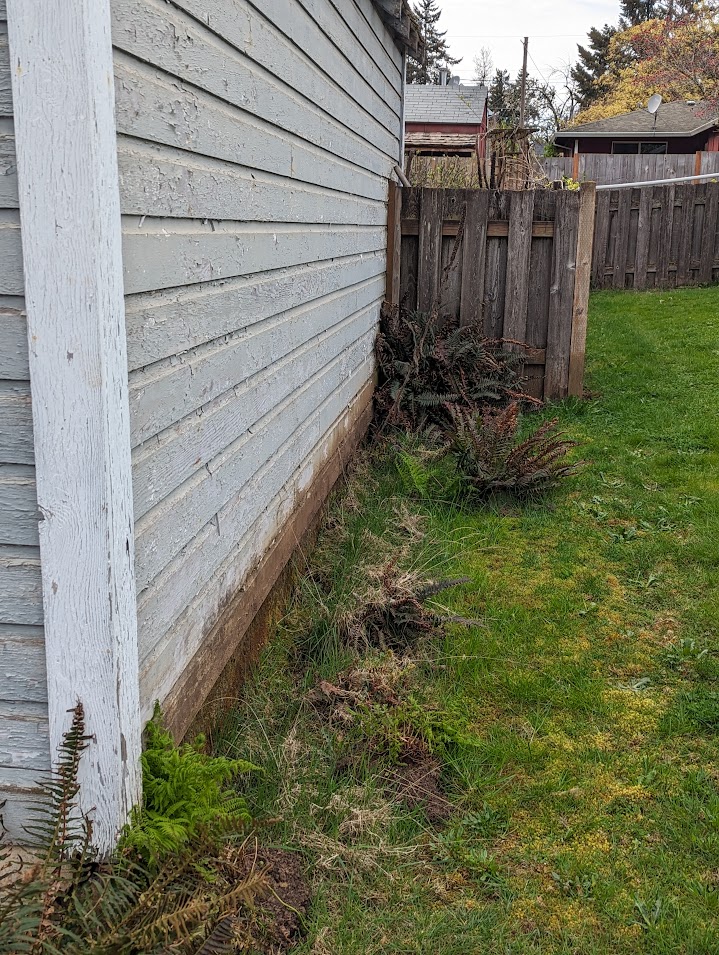
This year one of my goals is to completely fill the useless spot just north of our garage with sword ferns. It’s a three-foot mandated distance between our garage and the adjacent property line. No one wants to mow it. Full shade. No available water. The only true solution is to plant sword ferns and allow them to fill in the spot, kill the grass, and end the need for mowing. I have been adding small ferns to the spot over the years but this year I have four large sword ferns donated by a friend from his pasture. If I plant them now in the cool weather they will be established by summer and there will no longer be a need to mow north of the garage. Minimal maintenance, win-win for both parties.

Last fall I filled in the sunny portion of that piece of property with orange day lilies. I also have a magnificent yucca plant growing there. I picked the yucca up out of a FREE pile in front of a house one day. The orange day lilies were given to me by someone. There are daffodils growing there as well, a gift from the previous owner of this house. No more mowing a section of our lot that is difficult to get to and maintain. Ta da!

Minimal maintenance.

I took my list to a plant sale last weekend. It was a fund raiser for a State Park nestled in Lake Oswego. The prices of the (mostly) natives was more than I cared to pay, so I walked out empty-handed and right into the arms of a group giving away bare root saplings of “native” trees and shrubs. I turned down the witch-hazel (and later learned it is not a native to Oregon, although it is indigenous to parts of North America). I already had a mock orange that is two years old and establishing itself. There were a couple others that I questioned as to whether or not they were truly natives. I settled on three bare root plants: black gooseberry, a dogwood, and Indian Plum.

The dogwood is not the native Pacific dogwood, but a Florida import. Say, what??! Oh well, it was free, and I picked out saplings small enough that my husband can work his Bonsai magic on them. I was the only person standing around that had any idea what I was getting with the gooseberry. I’m more familiar with the yellow kind from the more arid side of the State, but this is a native from the Oregon coast – and a gooseberry promises tart berries perfect for a pie. I may have to make a gooseberry/huckleberry pie: I have an evergreen huckleberry (also native to the coast) that produces tiny berries in the late fall.

The Indian Plum is not a plum but produces tart berries that look similar to plums. It was a subsistence plant to the tribes of the Pacific Northwest and is one of the earliest flowering bushes which is a boon to the native pollinators. I’ll figure that out if and when it bears fruit. It can just be an ornamental for now: a native ornamental and attractant to pollinators.

My list incudes two lavenders: a Spanish lavender and a French lavender. I had both in my garden and they both died. My Spanish lavender was over 15 years old. I think I simply had the French lavender in the wrong part of the yard. I also want to get a second campanula, toad lily, phlox sublate (McDaniel’s Cushion), curry plant, and Chinook hop. I need a new rhubarb: the one I have doesn’t grow tall now produce long juicy stems. I’d like to add oxalis and bunch berries to the shade flowers. I also have some annuals on my list: petunias and climbing nastrutiums.

I purchased 19 packets of herb seeds from Mountain Rose Herbs. Those are waiting to be sown. Not for today. I bought the nasturtium seeds from Reneé’s Garden. The Chinook hop from Thyme Garden. The rhubarb is coming from Gurney’s. And the rose I bought from Jackson Perkins is showing some signs of life… (All of my English tea roses are from J&P, this one was a replacement for a floribunda I didn’t like. The floribunda went to a good home. This rose is also on probation until it starts growing…)

Today was the first day of Garden Palooza, a large plant sale south of here, almost to Salem. It is held at Bauman’s Farm & Garden in Gervais. I set aside a certain dollar amount and hope we don’t go over budget, but this year we were way under budget and came away with more plants!

I found both lavenders. My husband found the tomato starts he wants. He also found a pretty campanula for me. The one I currently have is a blue color: Serbian bellflower (campanula poscharsky). The new one is Birch’s Campanula and it will be a pretty purple color. Bauman’s also had so many pretty petunias! I found a full sun ground cover called Creeping Baby’s Breath (gypsophila cerastiodes). Drought tolerant. I need so many ground covers, they do a much better job than bark mulch at keeping the soil moist and weed free. Also, as perennials, the ones I pick out will last longer than bark or hazelnut shell mulch.

Oh, but the best buy of the day? Don found a tree peony for $24. Not $240 or $140, but $24. Tree peonies are not inexpensive even in a year without inflation. There are three old ones in the yard presently along with at least 80 other peony plants. I’m told the yard had more peonies but that was when Barney Schultz lived here, and he died over 30 years ago. The house sat empty, was purchased and flipped, and the grass killed so many peonies during the years of neglect. Then we bought it and I have single-handedly cleared all those peony flower beds, carefully divided tubers, and coaxed those beauties to new life. In short, I don’t need another peony or tree peony.

But $24. Gallon pot. Paeonia lutea var. Ludlowii (Tibetan Tree Peony). It’s young and I may have to wait a few years to see the large yellow blooms it promises. My other tree peonies are white, cream, and pale yellow fringed with red. Of course I bought it.

Our friend gifted us with two filbert trees as well as the ferns. We already have one filbert but the hazelnuts have never produced nuts. You learned you need more than one filbert. (Side note: the trees are filbert trees, the fruit is referred to as a hazelnut.)

So much planting in the near future. And making of larger flower beds to accommodate the 19 varieties of plants I purchased in seed form from Mtn. Rose Herbs.

The next big plant sale is the first of May.

Read Full Post »

We went from a cold and drizzly April to a dry and sunny May. The garden has “popped” as they say. Flowers galore. The daffodils faded and the grape hyacinth followed them closely, then the blue and white hyacinths. The heat came on and the peonies reached for the heavens. The heat turned down and the peonies are hanging on to their blooms: blood-red, deep magenta, salmon pink, cotton candy pink, yellow, and white. Bomb peonies, doubles, triples, and tree peonies. Now the irises are clamoring for their time in the limelight: purple, blue-and-white, purple-and-yellow, yellow. Dutch, wild natives, Japanese, and flag. Out front, the geraniums and Solomon’s seal are in full array of pink and white and green.

The tiny flowers as well are in their glory. The native forget-me-nots and the commercial ones, the inside-out flowers, the bishop’s weed, and the poached egg flowers (meadow foam) are all on display. The native camassia has bloomed and faded now. Heucheras, or coral bells, wave their tiny fronds of mini blooms in the breeze, along with the fringe cups. Speedwells have blossomed and faded along with the sweet woodruff.

Pushing up from the ground to make the next display are the sages: pineapple and Jerusalem, as well as the phloxes, the Peruvian lilies, the crocosmia, the Shasta daisies, cornflowers, bachelor buttons, and dahlias. Then will come the milkweeds and the evening primroses with the scattered sunflowers. The four roses out front have swollen buds while the rhododendrons are finishing off their array of colors. The heavy scent of the lilacs has already faded with the memory of their color. The orange daylilies will put on a show in just about a month. The Rose of Sharon has greened out and will soon bloom with reddish-purple blossoms.

If I am fortunate, the mock orange with blossom this year. I am fortunate: there are eleven spikes of flowers in the bear grass clumps. The hostas will take their turn as well as the lilies: Easter lilies and Martha Washington white lilies. The honeysuckle is striving for its place in the glory of bloom.

There are few bumblebees, and this concerns us: the giant solitary ones are house hunting but the littler ones we have are scarce. But the tiny ground dwelling bees and the mason bees have been plentiful, and we have noticed honeybees here and there. The paper wasps have returned home – they are important pollinators. We always have a plethora of tiny, winged pollinators on hand, from hover flies to yellow jackets.

Birds. The crows built their nest just to the south of our fence. We’re certain they will fledge any day and our hope is that the little ones will not end up on the street below the nest or in our yard where the dog might find them. The juncos that nested on the ground beneath a peony have raised one fledgling. It now can make short flights and avoid the dog easily. The lesser goldfinches are building a second nest for the next brood of babies. We haven’t seen the wrens for a while but have heard them: hopefully they also raised some new babies. The secretive spotted towhee comes in daily for a bath in one of the many baths for birds.

This season of flowers and warm days is my favorite time of year: Spring into Summer in the Pacific Northwest. I ache to be on knee pads with my hands deep in the wormy soil, pulling weeds and coaxing new flowers out of the loam – one more week of being careful after surgery and I will be back at it. I will plant some annuals before then: my usual petunias and pansies need to be purchased and planted in baskets. My fuchsias over-wintered and I have planted nasturtium seeds in the hopes of watching those pretty (edible) flowers will soon grace my yard.

There are issues that need to be addressed: brown spot, aphids, black spot, fungus in the soil, bushes that are half-dead and hanging on that need to be pruned and babied back to life and moving plants from one area to another to better facilitate their needs. I will be doing that in June.

Don is prepping the vegetable garden for the rototiller. We need to build a retaining wall around two sides of that garden (I bought the stones in February of 2022). The apples need to be protected from flies and worms (we have special nylon “socks” for that). The crazy grapevine is bursting with little green blossoms that portend a great harvest later in the summer (I share liberally with birds and with the neighbor whose fence helps prop up my vines). Sadly, I lost my “blackcap” raspberry in 2022 and that needs replaced this year – I live for my raspberries!

OH! Did I mention my strawberries? No, I did not but I will now: I have two urns full and an accidental little strawberry patch by the A-Frame (where we hang bird feeders out front). LOTS of berries are coming on! Sweet Hood strawberries, the best in the world. I just need to keep the slugs at bay.

<SIGH>

Read Full Post »

It’s cool and getting ready to rain right now, but for the past three days I have taken my coffee outside to sip while I watch the world around me grow. Some mornings were a tad chilly, but a towel on my bench and a blanket over my knees, hot coffee in hand – who cares as long as the sun peeps out from behind clouds?

The birdsong this morning drowned out the ambient sounds of the city (the distant freeway, traffic on the street beyond our fence, the drone of airplanes): “Cheery Up! Cheery Up!” sang robins delineating their territories and calling their mates. The familiar “Brr-Whirr” of the Spotted Towhee told me that they are nesting nearby.

The past few days, a male Anna’s hummingbird has been doing it’s dangerous aerobatics over our heads: it flies thirty feet up into the air, hovers, then makes an arcing dive. Ten feet above the ground, it abruptly changes directions back toward the heavenlies and the wind through its wing feathers creates a loud “CHIRP!” overhead. He’s courting a mate, but often she’s nowhere in sight. (It is a startling sound if you don’t know it is coming and he lets loose his miniature version of a sonic boom just over your head.)

My computer is being crazy slow today and my photos are not loading properly.

IMG_5745I’d love to show off the new flower bed I created in front of the house, where I have planted my rose (which is showing no signs of life!), a Rose of Sharon, and left room for many more perrennials while cutting down the need for lawn mowing. Purple anemones, Vinca Minor, hens-and-chicks, above the wall, Lady’s Mantle and orange daylilies below, on the city right-of-way.
Along the back fence, I pulled and cut and swore at English Ivy that has entrenched itself over the past 15 years (the last wild spot in our yard). I’ve weeded and planted – no more than three hours per day (my mind wants to keep doing but my hands and back rebel – especially my hands! – and I have to give the work up. Still, I have accomplished more in April of this year than any single year in the past – yay for retirement and the freedom to be out there when the air is clear and the day is still cool enough to work!

IMG_5735

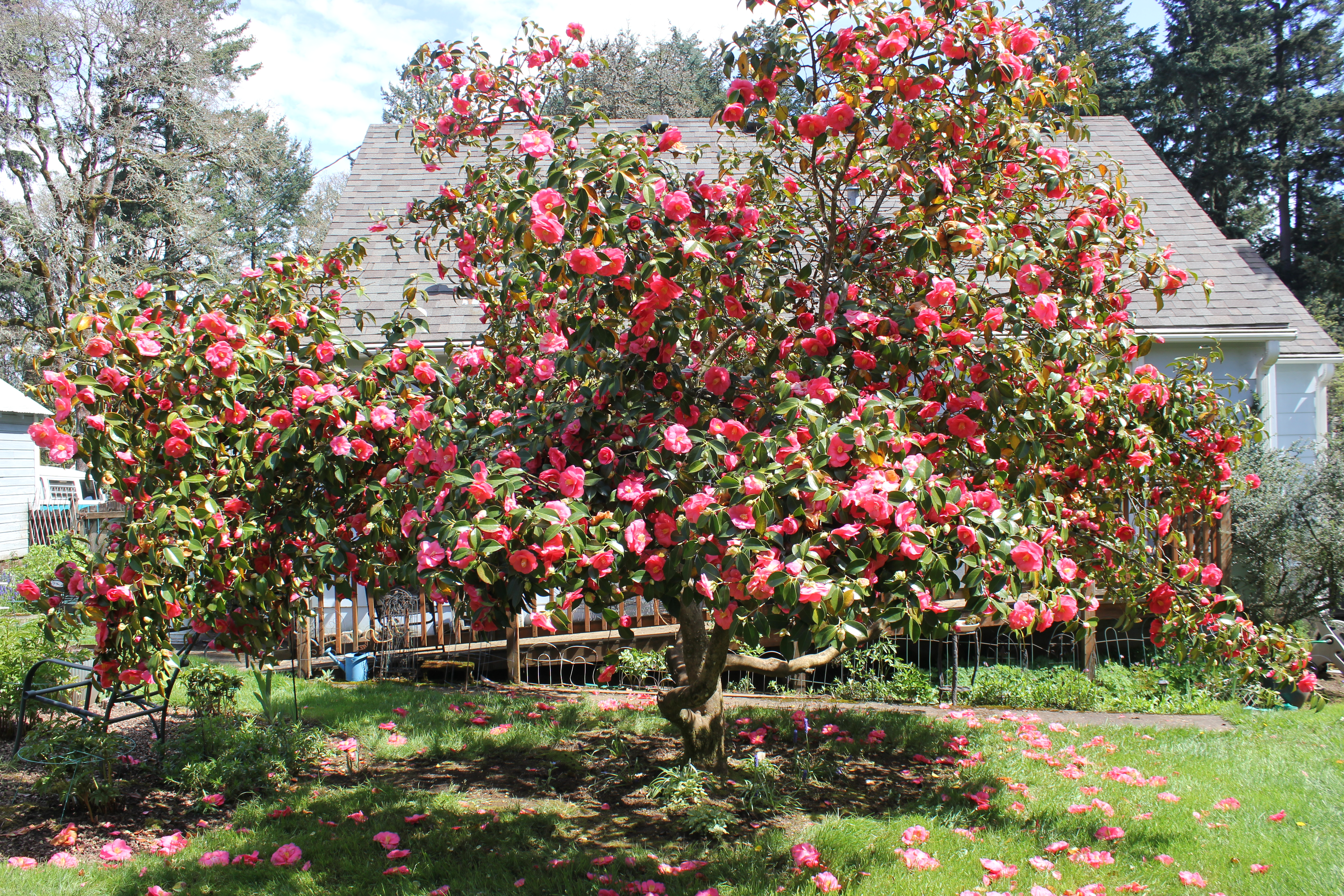
The crazy Camellia is over-laden with blooms, a cacophony of pretty pink-and-yellow flowers, new green leaves, dying yellow leaves, and messy wet fallen blooms. I hate it when it looks like this, the limbs drooping low with all the weight and the slippery mess underneath.

IMG_5744

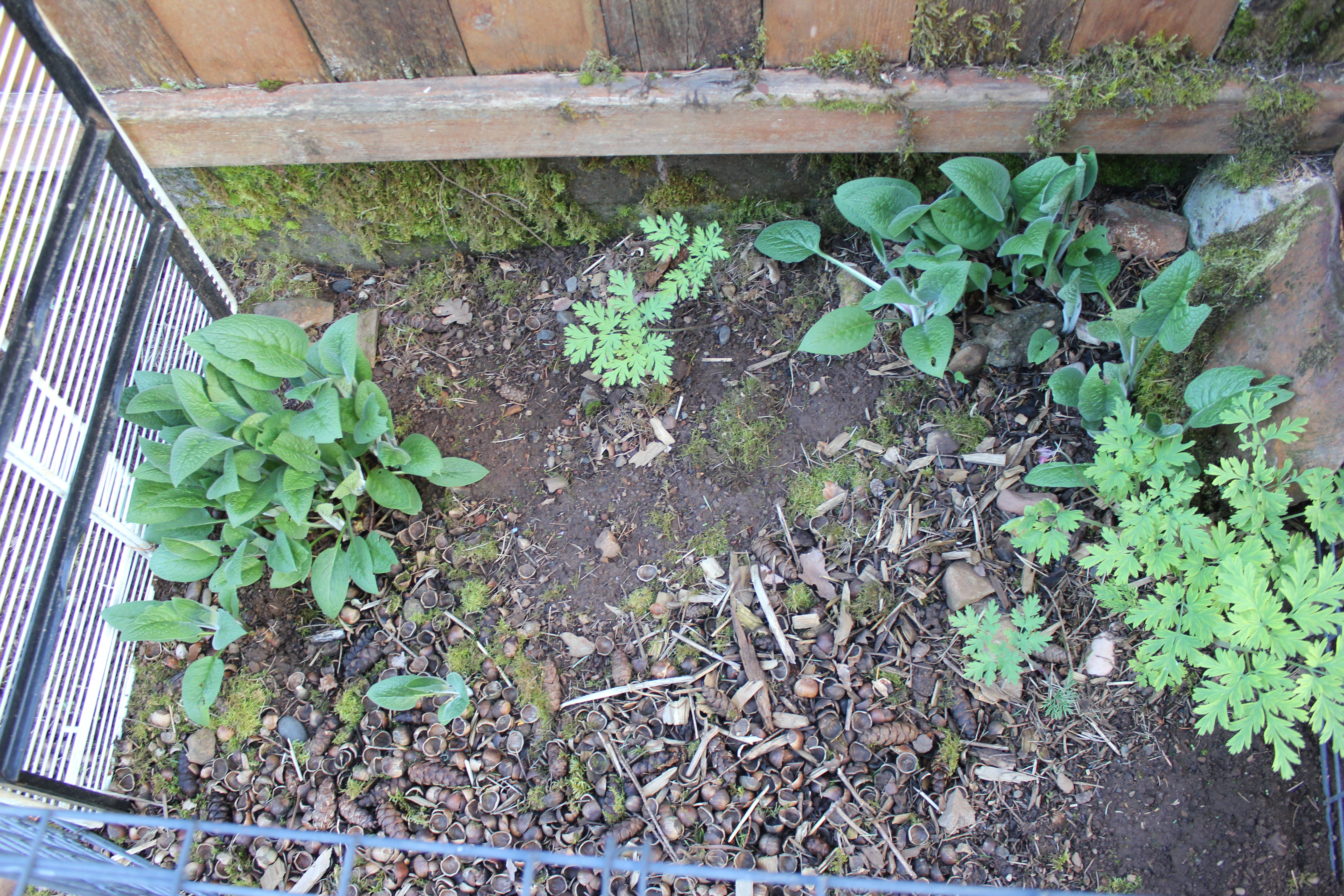
My husband broke my garden bench (it was rotting through). I’m excited about this corner because I have Comfrey that will try to push past its boundary of weird metal grating – a perfect bee flower I have to gold in check because it *is* invasive and it can cause caustic reaction to skin. I planted a blue elderberry to the right of the comfrey (behind the yew), a blue huckleberry just to the left of the white grate and a red flowering currant behind the bench. COLOR! (The black plastic is killing the nasty Oregon Grape). I plan to encourage the forget-me-nots to fill in a neglected space – but I also love them right where they are in this photo, blooming bright blue and covered in mason bees.

IMG_5743

It looks sweet and tiny here, inside its cage, but that broad-leafed plant will be six feet tall by mid summer: Comfrey.

I love this time of year, my hands in the dirt, the small insects and invertebrates (except the slugs!), and the myriad of birds who come to visit. Mesmerized by diamond-dew drops in the early morning, I sip my coffee and know I will not get anything done inside the house on such a day.

Read Full Post »

May Finds

The first weekend of May has been blustery, cold, and wet: not exactly inspiring weather. Still, I managed to get a few things planted – in pots. I planted potted plants because I could do it inside. What a wimp.

004

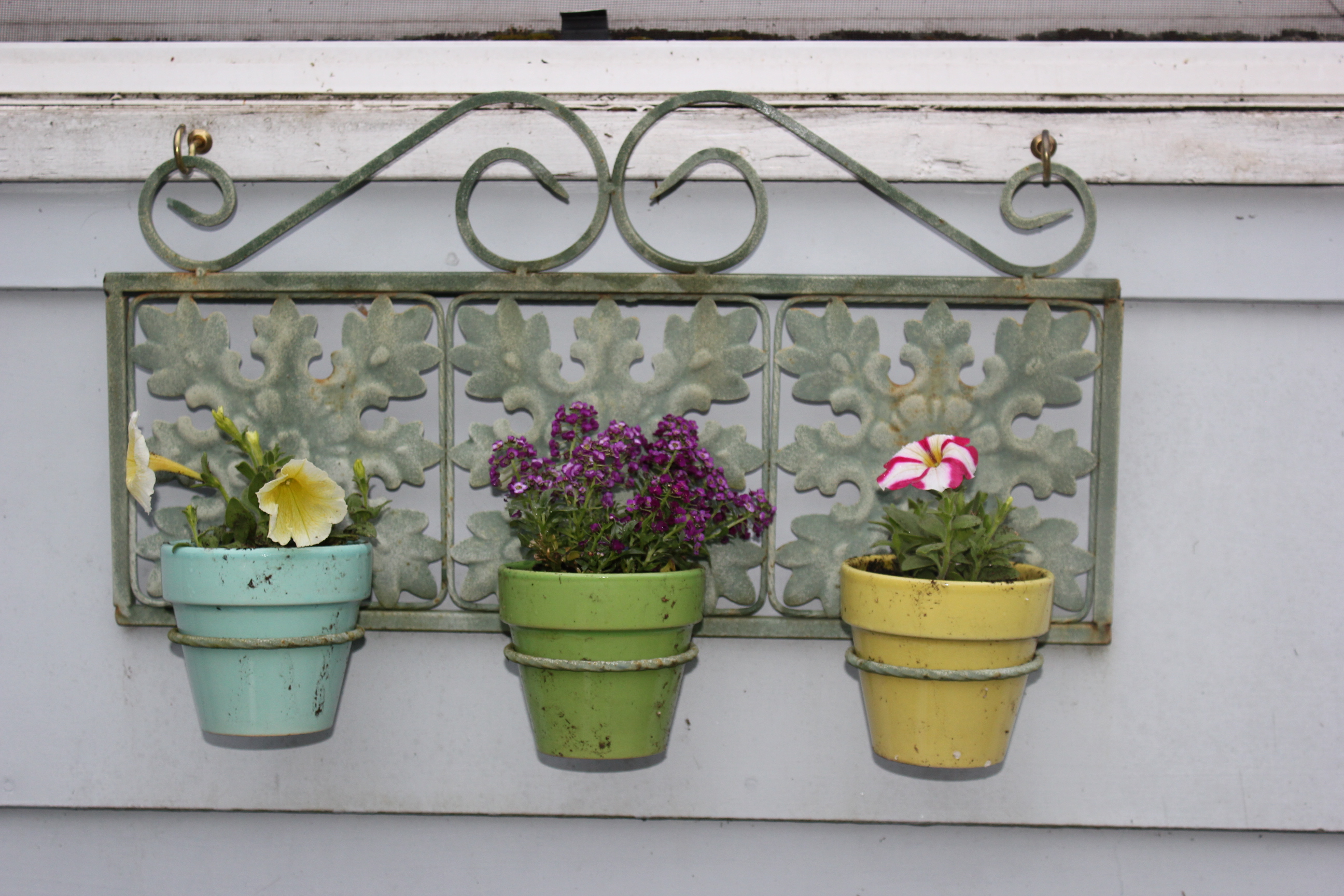
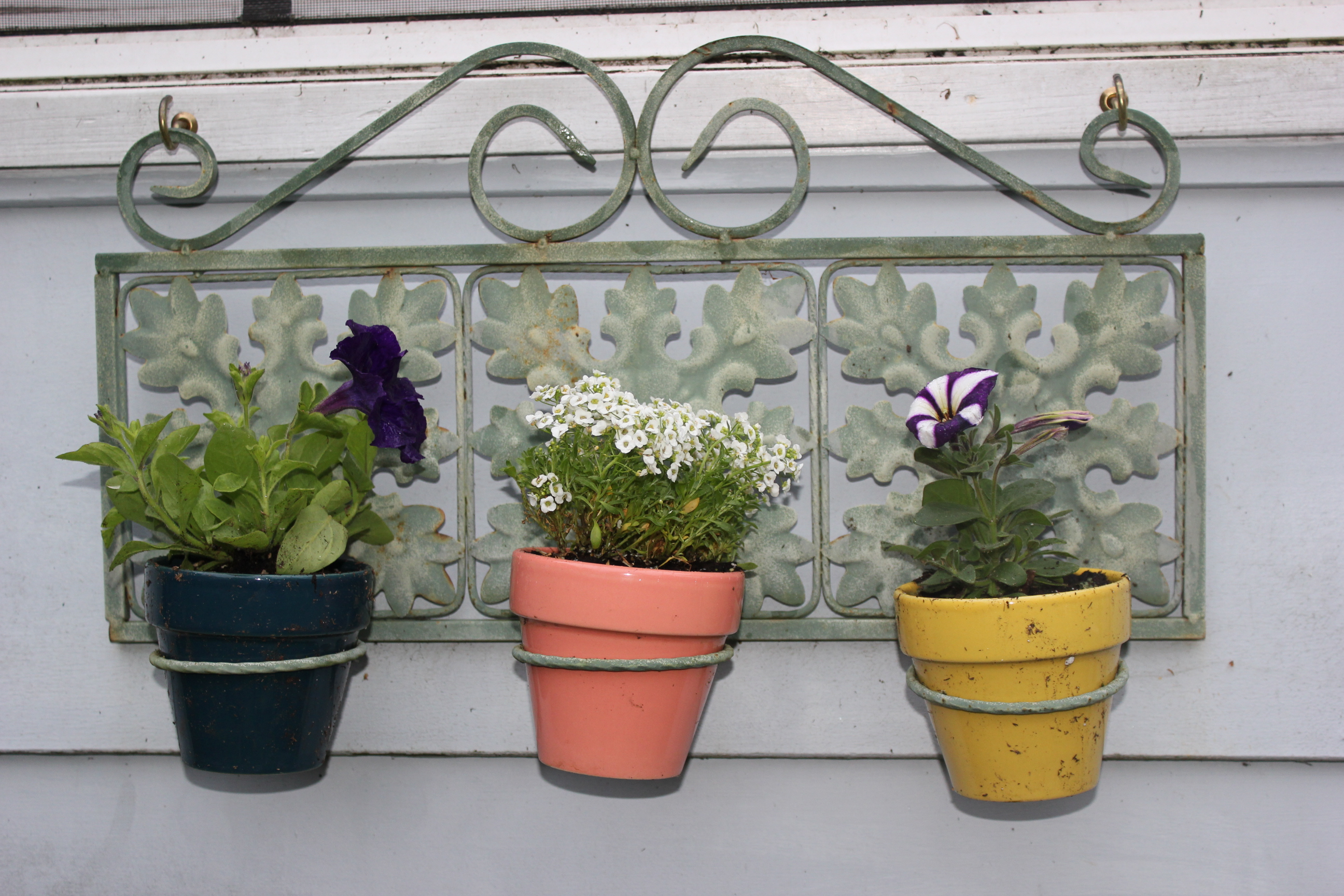
These hangers are my concession to annuals. The pots are too small to encourage perennials (4″ pots), and so every year I have to find some small hanging basket type annuals to stuff into them.

005

The petunias are a shout back to a woman who was pretty much my second mother when I was growing up, whether or not she wanted to be. Mrs. T. always had petunias growing in the long planter in the front of her house. This year, I decided I would plant petunias in honor of Mrs. T. The alyssum in the middle is just because I like alyssum.

001

This finally opened up (after my last post, obviously). I stepped out the back door on Saturday and was greeted by this fiery orange Oriental poppy. COOL.

003

Isn’t it gorgeous?? It has several other buds swelling. I hope to let it go to seed at some point and (hopefully) have many, many more such beauties in my garden in the years to come.

I also managed to fit in a trip to the local thrift store with a friend. I scored a few things (as usual).

I found two bud vases. Well, one is a real vase & the other is a tiny little tea cup for a cheap child’s tea set (I guess).

003

The one on the left has: hawthorne, luminaria, columbine.

002

The one on the right has – oh shoot! Don’t you hate it when you forget what that is? It’s OK –  I still have the plastic stake in the ground by it so if I was serious about identifying it for you, I could go down the stairs, out the door, into the cold rain, and look it up. I’m not serious. Variegated something that is evergreen, grows like a ground cover and a shrub. It’s pretty. The point is: I have a tiny vase for short flowers.

005

I still have Fish Woman. She makes an excellent bud vase. The golden alyssum makes the perfect flower to surround her.

That’s my story and I’m sticking to it.

I did find other things, but they’re itemized over on my art blog. Yeah, that blog. The one I rarely write on. The one I should be serious about.

Read Full Post »

« Newer Posts