Feeds:
Posts
Comments

Archive for the ‘Uncategorized’ Category

My daughter (our oldest daughter) is visiting with her four children She purchased cheap butterfly nets for her kids and they came home ready to hunt, especially the one child interested in Natural History. Of course, it was hot and few insects were out and about, except the honeybees and bumblebees.

The Naturalist among the four caught a miller (moth) in the grass, and I identified it to him. He wanted only to return it to the wild, so I let him. They (two grandsons) continued the “hunt”. They knew not to hunt bees or wasps, and as it was hot, not many other insects were out.

Then there was the pale Tiger Swallowtail that dipped into the milkweed garden. A sudden, “Grandma! I got one!”

J. held the net over the butterfly. It, being a cheap Dollar Store net, was not one you could turn and capture the insect. But I wanted minimal damage done to the butterfly, so I put my hand under the net and allowed the butterfly to grasp onto my hand. I folded my thumb over iy so it couldn’t fly, but in a way that did not harm its wings.

J. gently lifted the net away and looked at our beauty. I know he saw what I saw” the beautiful abdomen, the wings, the delicate scales. I offered to let him hold the butterfly, but he declined – in part, I think, out of his innate respect for the insect. When we talked later, he understood about he fragility of the scales on the wings of a butterfly and how you don’t want to damage that.

I knew the butterfly: a pale tiger swallowtail. That was enough for J. he didn’t want to keep it a prisoner, only to know what it was.

This kid also picks the wild black-cap raspberries I grow in my yard and devours them. He talks about needing “mementos” to “remember this vacation”. He’s collected a maple leaf, rattlesnake buttons, an arrowhead, and a ceramic frog (which may be replaced it he catches a real snake or frog and gets a shed skin or…). He’s my Naturalist child.

He’s the one who will remember raspberries in the same way that I remember my Great Uncle Frank and my Great Aunt Gert (not related): for the raspberries. But his siblings will remember it, also, for the lessons in Natural History. They just don’t realize it now.

Teach your children well.

 https://youtu.be/ztVaqZajq-I

Read Full Post »

I tossed a few milkweed seeds onto the ground back in… oh, 2012, I think. Maybe 2013. Nothing came of it. The winter of 2012, I put a packet of milkweed seeds into the freezer and then pulled them out the next spring, once again sowing them in the little triangle by the garage. Nothing came of it.

In 2014, some weeds popped up in the triangle that looked slightly sturdier and somewhat like what I remembered milkweed looked like. And, yes, when pinched, they oozed milky white sap, thick and sticky. Success! Only they didn’t grow very tall and they didn’t flower at all. I think that was the year they did a special on Oregon Public Broadcasting about how you really should start milkweed from a root cutting, not from the seed.

So why sell the seeds? ARGH.

By 2015, I knew that you really should plant milkweed that is native to your area if you want to attract Monarch butterflies back into the region. Oh dear… What had I planted?? I kept the seed packet from the second sowing: Showy milkweed. Score! Native to the Willamette Valley.

That summer, I had around six plants poking up through the ground! They were spaced along the back of the triangle, in the hottest, driest bit of soil, and while they grew to about 24″ tall, there was not a hint of flower on them. But now my hopes were kindled: every year, without fail, something had sprouted. I hoped that the roots were getting established, and subsequent years would prove my crop. The Monarchs were reportedly showing up in backyards around the Willamette Valley, as well.

I have a little history with Monarch butterflies. We lived on a street facing a dry creek bed in Northern Nevada in the 1960’s. The ditch ran in the winter and during thunderstorms (“Don’t play in the culverts! Watch upstream! A flash flood could happen any time!” – my mother’s words echo in my ears to this day), and in the summer, it was host to gophers, milkweed, monarchs, the occasional Black Widow in the culvert, and maybe a stray rattlesnake. You don’t think about the dangers when you are a kid (but your mother’s words will echo forever in your ears, long after she’s gone: “Don’t crawl in the culvert! Watch for snakes! Look upstream always!”).

Every summer, we kids would go and collect Monarch caterpillars and harvest as much milkweed as we could stuff into a jar. As the milkweed was devoured, we added more. Then, one magical day, the caterpillars would crawl to the top of the jar or a branch of the fading milkweed, and they’d hang upside down. The yellow-and-black skin would shed to reveal an emerald green chrysalis. And we’d check the chrysalis daily to see if the little gold dots were being added to. Then, one day, the chrysalis would change from green to a clear shell, and we could see the butterfly trapped inside. Oh, how we’d hover over those precious shells, waiting for them to crack open and the new butterfly to emerge!

There’s a magic in holding your hand out for the Monarch to climb onto it, wings still wet and pliable. The butterfly would walk around your hands, drying out its wings, until they were stiff, scaly, and fragile – and then you set the creature free to find a lover, lay more eggs, or fly back to Mexico for the winter.

In the late 1960’s, the City of Winnemucca covered up the ditch and put in culverts, presumably to keep us kids from getting caught in there during a flash flood (hadn’t happened, but , you know, people sue, and Joni Mitchell was singing this radical song about paving paradise and putting up a parking lot (Big Yellow Taxi). My dad wouldn’t let me go out there and lay down in front of the bulldozers in protest, and all that milkweed habitat was lost forever.

I regret that I didn’t rebel against him and make a scene. I read a Xerxes Society article a year ago that they couldn’t find any milkweed in Northern Nevada. I was only 12. I remember when the northern half of the state was covered in Monarchs.

I digress.

I had a minor success with milkweed in 2016: more plants came up (maybe 9) and some even budded. Unfortunately, the flowers never formed and the stalks withered and died. I did find a milkweed bug on one, so I knew the news was getting out in the insect world that we were growing milkweed. I also read about someone who only had nine plants, had caterpillars, and couldn’t find enough milkweed to satisfy the little rogues – she was begging people for plants to sacrifice to the caterpillars. I think she did succeed in getting some to butterfly stage.

This spring, 2017, my little triangle was suddenly infested with milkweed!

012

That’s milkweed all along the back, between three and five feet in height (.9 to 1.5 meters).

It gets better.

011

I knew I planted the Showy Milkweed four years ago. It’s pink, fragrant, and native to the Willamette Valley.

009

I planted the narrow leaf milkweed about five years ago. Also native to the Willamette Valley, but white and fragrant.

I have two varieties!

No Monarchs (yet), but I have their food source.

The other flowers in the triangle bloom earlier (peonies, dragon lily) or later (aster). I can dig up and move the peonies and aster as needed. I can also dig up the milkweed root stalk and move to other areas of my yard. I expect by next year, I will have a grand crop, not to mention the seed pods (oooo -arts and crafts!). I will probably be able to give others root stalk.

See where I am going with this? I am totally making up for being 12 and helpless in the face of “progress” and I am creating a new habitat.

I am so jazzed!!

And – a word to those who wish to follow in my footsteps: it takes patience. Years. Nurture. Bees.


Read Full Post »

This is a short post on how NOT to undersell yourself.

I only dabble in photography. I once had a dream of being Ansel Adams’ replacement, but I have come to a more pragmatic view of my art. I can take good photos, but it’s not my passion. Not anymore, that is, or not at this current state of my life.

That said, I consider it a serious hobby, and an extension of my artistic expression.

So, at first, I was really excited when our corporate office asked for photos of our region to use in their updates of personalized presentations for our agents. I have some really nice photos of our region, and – specifically – of the city I live in. But, then, I began to think like an artist.

My boss asked for photos at a recent sales meeting and I asked, “Will they pay royalties?”

I know they pay royalties to Getty Images (don’t start me as an artist!).

The looks around the room were blank stares. My boss said, “No.”

“Huh. Then I have no photos to offer.”

More blank stares,

Look, folks, I am serious. No more FREE. You want to use my images? You pay.

Now, my company might pay. My boss simply is not educated in artistic license. She may not even know it exists. *I* know it exists, and *I* am making the stand. Fellow artists, you should be proud of me.

NO MORE FREE.

My work costs me. My work is serious.

Read Full Post »

A week ago, my husband and I celebrated our 37th wedding anniversary. It wasn’t much, just a quiet time together, watching a movie. I didn’t spend much time on social media, just curled up in my recliner and enjoyed the time with my best friend. Went to bed, slept, and woke up to the alarm.

And a good-bye message from a dear friend who felt I had intentionally slighted her by not clicking on the “like” button next to her comment under my anniversary video, even though I had clicked “like” on all the other well wishes. I couldn’t even go and look to see if I had actually done the deed: she was already gone. I felt like I had been punched in the chest: all my air expelled. Surely, I hadn’t missed her comment? Surely she didn’t believe I’d done so intentionally?

I apologized, explained it was merely a misunderstanding, an accident. I didn’t get the impression she believed me, but I followed up with an email and a hand-written card. I don’t expect her to ask me to be her friend again, not on social media. Perhaps, she felt as if all the air in her lungs had been expelled when she saw that missing little blue “thumbs up”. Certainly she felt it was rude of me, and had I done it intentionally, I’d have to agree.

There may still be a letter from her as we live some distance apart, and we have always communicated better on paper. But in the meantime, I have been mourning the loss of someone I have loved very dearly. It comes at a time when all the loss of the past 22 years is hitting me. It comes exactly a year after another long-time friend blocked me in a mess of taunts that I still haven’t figured out and probably never will.

(To be fair, I once unfriended someone in the heat of an online spat. Shortly after, I came to my senses and messaged her that I was an ass, and to please forgive me for being an ass, and we could remain un-friends. She forgave, and we remain unfriends. It was my bad.)

When it isn’t your bad, when you have no idea you’ve brought offense, when you haven’t done what the accuser says you’ve done (or at least, you are certain you clicked all the little blue thumbs, so how could you have missed that one?)… How do you recover that lost trust? The deep friendship you thought you shared?

For me, my very inner worth was shattered. Oh, last year, I could shrug that off. That person had clearly an agenda of hate and anger, and she got the expected result: the severing of our relationship. But this year, the friend was – is – someone I admire, and the insult, while unintentional, must surely have devastated her as much as it did me. Only I am confused as to how it happened. Or why.

I texted my youngest last night about Father’s Day and got a reply from a stranger who now has the last known phone number I had for my girl. I just saw her in February, so I know the phone number was right. I didn’t misdial. She has closed all her social media accounts and has no online presence. No forwarding phone number. I sort of know where she was living in February, because I’ve been to her apartment several times (but I don’t know the actual number – I’ve always met her on the street and been escorted back to the apartment).

So, taken with the loss of a friendship (I’m actually hoping I’ll still get a letter telling me that it’s just on social media that we can’t be friends), the anniversary of the last such fiasco, the anniversary of my mother’s passing (Saturday, June 17th, 1995. It will be 22 years on Saturday, June 17th, 2017), and discovering my youngest has disconnected herself from us – I was an emotional mess the past week, and most of today.

I write this knowing that it may all be sorted out by the end of next week, and the world will not seem such a cruel and confusing place. A friend of a friend may have my youngest’s current phone number, and we’ll connect. She’ll be all right, just couldn’t retrieve all her old phone numbers. I may get a letter from my dear friend explaining that she felt hurt and confused, but after reading my heartfelt apology, she realized it was an accident (that I didn’t even know I made). The heart-rending anniversary of my very best friend’s death will have passed, and my emotions will balance back out. I’ll be able to breathe again.

The voices of recrimination, despair, and self-hate will retreat to a corner in my head, and I will be able to resume my quest to become God’s dream of me; to be the woman I was created to be; to embrace the worth in my soul that God wants me to see. Today, I am just thankful for two older kids who talked me off the ledge, and who reminded me that I can’t take on “someone else’s problem.”

To wrap this up, I read this the other day about offenses: “A person’s wisdom yields patience; it is to one’s glory to overlook an offense.” Proverbs 19.11

I’m praying for wisdom right now.

Read Full Post »

I was reminded of Mrs. Polkinghorne the other day when one of my real estate agents whispered to me to “check out so-and-so’s body language”…

It was awful. So-and-so had apparently never been tutored by Mrs. Polkinghorne or any other expert on body language and “how a lady should sit in proper company”.

We can make fun of Mrs. P. , but she had a serious point. Many years after having been one of the subjects of her charm class, I sat in the audience as a famous speaker called six people onto the platform and summarily dismissed them simply by the way the sat on the stage. I had his back: I immediately identified the woman who sat with her legs crossed at the knee as being the most offensive in “high society”.

Not that I’ve ever been in high society, but Mrs. Plkinghorne made certain that I knew if I was ever in that position, that I would know that if I was, I would know that a lady only crosses her feet at the ankle, *if at all*.

I think we were between fifth and sixth grade, We were Methodists. It was December. Mrs. Polkinghorne was known as a substitute teacher to most of our friends (and a bad one, at that), but she was known to us as an elder in the Methodist church. And she wanted to teach us all how to maneuver in polite society.

We were not in the least interested,

Let me back up and give you an overview of Mrs. Polkinghorne (whom we would never have shortened to “Mrs. P”). She was elderly. She was large. She wore a brown wig that was ill-fitting. Her grey hair showed under her wig. She never seemed to be “all there”. We giggled behind her back. Once, in 5th grade, someone put a tack on her seat and she never felt it. Seriously. The class held their breath and waited for her to stand up and exclaim, and she never did. It was awful.

She was also a church matron, and when she suggested that our 5th grade class be taught “manners”, I suspect it was in retaliation to the tack. None of us set the tack, but we were of that age. And some of us were in that classroom.

She had an artificial Christmas tree: one of those silver-leaved trees with a light underneath that switched from red-blue-yellow-green. It was 1967. I don’t remember who suffered in the class with me.

We learned how to set a table for fine dining. We learned how to unfold out napkin onto our lap. How to sit. How to cross our legs (or not). How to hold a tea cup. How to open a door for a lady and how to get into a car without revealing too much. We learned class.

Let me repeat that: we learned class.

A lot could be said about Mrs. Polkinghorne, and none of it flattering, but there is this: she taught a certain 5th grade class of Methodist students the concept of class. Sit up straight. Look people the eye. Don’t slouch.

She taught us that we were more than whatever upbringing we had. We had CLASS. She knew what we thought of her. She’d put up with that for decades of students. She didn’t care. She just wanted this one generation to understand what would be asked of them in polite society.

Mrs. P. deserves a WIN. I don’t even think I hated her then: I just didn’t understand her.

Read Full Post »

She was fourteen. I was going on seventeen. We hated each other, and we fought. She was out of control, spiraling away from family. I was making plans to leave home forever as soon as graduation rolled around the following spring. She was drinking heavily, immersing her pain in drugs and sex. I blamed her for the anguish I saw in our parents’ eyes when they searched for her or she stumbled home, drunk, again, long after curfew.

There’s a lot I blame myself for: I was the older sister. I should have been an ear for her, but she never felt safe confessing her troubles to me. I was as much an enemy as the parents were, or maybe more: I was everything she was not: the A student, the over-achiever, the college-bound, the “good” girl. I took advantage of that, as only a teenage older sister can.

But there was this one night – this one hallowed evening. She was grounded. There was a carnival in town. She wanted to go; I didn’t. Frankly, I get motion sick and carnivals are *not my thing*. But my parents told me I could take her to the carnival (as if it were a great favor bestowed upon me). So I made an effort: we’d be like we were before drugs, alcohol, sex, and the move to a new town blew us apart. We’d be sisters. We’d have fun.

I can tell you exactly how much Sam cost, 43 years later. The smell of cotton candy. The sounds of the Carnies hawking their games. The array of plates you had to land your dime on to win a prize (and that prize was somewhere in the pen below, peeping and frightened: a duckling).

“I want one,” she declared.

“Dad will never let you keep it.”

“He will if I cry.” She had large, dark brown eyes. She’d gifted me a kitten a couple of years earlier, and I got to keep him because I shed alligator tears and Mom went to bat for me. It was possible, I reckoned.

“I’ll try.” I tossed dime after dime. At ten dimes, I began to hesitate.

“Pleeeze…”

“Okay, but only two more dimes. No more.”

He cost $1.20. He fit into a 16-ounce paper cup. He bonded instantly with the human carrying him. She named him “Sam”, after herself. She’d been “Sam” since a backyard baseball game when she was four, and the umpire (a neighbor) gave us all boy names so we could play baseball with the boys (“They’re girls! They can’t play!!”). My “boy” name never stuck, but hers did: she was ever afterward, “Sam”.

And now her duck was Sam.

And Dad was not happy.

And no amount of alligator tears, pleas from me, or any other begging gesture would sway him: the duck would GO. NO DUCK.

It ripped a tear into our family fabric that took ages to mend. Dad took the duck (forever named Sam) to a rancher friend of his, some 60 miles away, near Baker, Nevada. Sam would live and grow old with the ducks in the pond. My sister continued to spiral out of control, feeling unloved, lost, and betrayed. It took me years to understand and forgive Dad myself: what’s a duck worth? Yeah, Dad had the duck’s future in mind, but did he have my sister’s future in mind?

Did my parents understand the small gesture that might have swayed her out of her self-destruction? Did I?

I’ve never forgiven myself for those 12 dimes. I knew better. I knew Dad would not bless the duck. I merely hoped. And I so wanted to have a fun night with my little sister, a moment to remember – fondly.

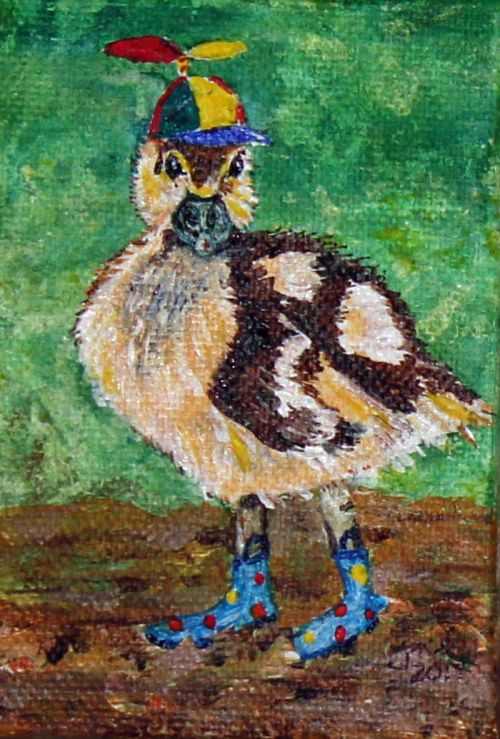
Tonight, when I was painting this duck, he began to speak to me.

Sam - image is smaller than seen on the screen: 2x3"

I’m forgiven. By my sister and by the duck.

She died before we ever sat down and talked about The Damn Duck (as I refer to him in my memory). I assume she and Dad came to a place of forgiveness as well, as they were close when she died.

They are all gone now: Dad, Deni, the Duck. Sam, however lives on in my mini painting. And my heart. Because at that moment, at age 17, I never meant to betray my sister’s trust. It took me a long time to forgive our father for that betrayal. I got the reasoning right away, but the emotional impact…

I’m not sure I understand his reasoning tonight. It was a duck. It imprinted on my sister. It probably would have had a shortened life if we had kept it and she had to care for it, but… maybe it could have changed her life. Her self esteem.

But if her self esteem had been elevated, would I be aunt to the amazing nieces and nephews i am aunt to?

Maybe Sam was the sacrifice that had to be made for my nieces and nephews to exist. That would be a good reason for a duck to be hatched, sold to a carnival, and purchased for $1.20 in dimes.

Read Full Post »

I have written numerous posts about the dead. Happy Mom’s Day to my mother or Happy Father’s Day to my father. But I do have living in-laws, and they have supported me for over 36 years.

Happy Mother’s Day, Mom.

It wasn’t easy – at first – to call you “Mom”. I saw how much it meant to you by your face and your body language. You wouldn’t be happy if I just called you “Carolyn”. It had to be “Mom”. We were family now.

The first time I met you, you had a huge vase of flowers on your kitchen table, a gift from your ex-husband – my husband’s father. Your boyfriend (soon to be husband) didn’t seem bothered that the flowers were there. I was impressed by how you both handled the flowers.

The first time I met you, I was afraid of almost every dog that moved on the earth and you had a very large Doberman Pinscher. Very.Large. And an ancient Dachshund cross. I could deal with “Peppy”, but “Sam” scared the bejeezus out of me. He was BIG. He was sleek. He was In.My.Face. The months before you had to put Sam down hurt me. I remember kneeling in your kitchen and scratching his head, knowing that he would NEVER hurt me, and knowing that his days were numbered. He was beautiful. He was one of the first dogs to come into my life because of you; dogs who would teach me that I didn’t need to be afraid of dogs.

You adopted me. Loaned me books. Told me stories about your early marriage to my husband’s father. Told me how you still loved him, but could never be married to him again (and why – I totally get that!). You love my children and my grandchildren.

I just sent you some photos of the greats. I don’t know how they will print out for you or if you will just want to save the CD to look at. There are so many greats now! I hope and pray that you will get to meet each and every one of them sometime soon.

Mom, my kids are trying to come out here this summer. I hope they can. I hope it will work out so you can see as many of the greats as possible. It’s the pits that some of them have other parents they ave to be with, you know?

I love that you brought me into the family of your second husband (who was your boyfriend when I met Sam). My kids thinks of him and “Grandpa Terry” with much fondness. My husband’s step- brother and sisters became my friends. Thank you.

Oh, and there’s your son. That guy I married. The one who brought me into your family. Thank you for him. I know he calls you almost weekly. I am glad he has that relationship with you. It’s beautiful.

Love you, Mom.

Mom


Read Full Post »

It isn’t often that I am surprised by someone else’s lack of knowledge about poetry; it is a taste that some folks never develop. I do, however, assume that everyone knows the names of the great poets, like Robert W. Service.

Who is that, you say? You’d be joining the ranks of my associates at work, and several of my Facebook friends.

But how can you *not* know who he was? Don’t they read “The Cremation of Sam McGee” in school these days? Oh, wait. I didn’t read it in school, either: my father quoted it to me, and I begged to see the book it was written in. A life-long love affair with “The Bard of the Yukon” was born (and while “Sam McGee” is his most quotable poem, “The Spell of the Yukon” is his most beautiful ode to that wild, untamed, brutish land where most of his poems are set).

Poetry gets a bad rap, face it. I had a college professor who hated Robert Frost; I love Robert Frost (he was not adored by his contemporaries). I’m not a fan of Ella Wheeler Wilcox, but snippets from her poems are found in greeting cards everywhere. There are some who find John Donne tedious, but if I can bury my nose in his Holy Sonnets:

“Batter my heart, three-personed God; for You

as yet but knock, breathe, shine, and seek to mend;” (Holy Sonnet 14).

Thomas Carew wrote a moving poem upon the death of Dr. John Donne:

Here lies a king, that ruled as he thought fit

the universal monarchy of wit;

Here lie two flamens, and both those the best:

Apollo’s first, at that the true God’s priest.” (flamens: a crown of bays or laurel)

Some poems are so quotable that you might think everyone would know them (I’m coming back to Robert W. Service here):

There are strange things done in the midnight sun

By the men who moil for gold;

The Arctic trails have their secret tales/that would make you blood run cold;

The Northern Lights have seen queer sights,

but the queerest they ever did see

was that night on Lake Lebarge

I cremated Sam McGee”

Every kid can quote “The Raven” by Edgar Allen Poe (at least I assume they can!) but he wrote poetry that was not so macabre as well.

I don’t know when I fell in love with poetry, but I do know when I discovered Langston Hughes. 1973. I bought a poster with a poem of his on it. In later years, I read his biography and all of his poems from “Hold Fast to Dreams” to “Harlem”

What happens to a dream deferred?

Does it dry up/like a raisin in the sun?

Or fester like a sore –

and then run?

How about this freestyle from Lawrence Ferlinghetti, titled “Dog”:

The dog trots freely in the street

and sees reality and the things he sees 

are bigger than himself

and the things he sees

are his reality

Poetry covers every aspect of human life. Emily Dickinson, Sylvia Plath, Robert Browning, Thomas Gray: Ode (On the Death of a Favorite Cat, Drowned in a Tub of Goldfishes), Henry David Thoroeau, Walt Whitman, Rudyard Kipling, William Butler Yeats.

What of William Blake?

The Tyger

Tyger! Tyger! burning bright

In the forests of the night,

What immortal hand or eye

Could frame thy fearful symmetry?

These are but snippets of favorite poems, many forgotten in the dusty attic of my memory. And I have so many more books of poetry to read.

But let me return to Robert Service one more time. My friends who read Sam McGee were highly entertained and realized there was something more to be said about the world of poetry.

I want to leave them with this classic, written by The Great ANONYMOUS (and, despite that name, this poem is a classic in all regards): The Whore on the Snow Crust:

Bastards are not at all time got

In feather beds, we know;

The strumpet’s oath convinces both

Ofttimes it is not so…

If I fell in love with poetry because of Rudyard Kipling or William Blake, and then proceeded to devour my way through Shelley, Longfellow, Marianne Moore, T.S. Eliot, Ezra Pound, and e.e. cummings, then I am, perhaps, guilty of a sort of elitism way of thinking. Of course you know who this was!!

Let me leave you with this visual from Carl Sandburg:

The Fog

The fog comes
on little cat feet.
It sits looking
over harbor and city
on silent haunches
and then moves on.


Read Full Post »

I saw a commercial on the TV tonight that made me want to reflect back upon the good teachers I had as a youth (there were quite a few bad ones, too). I’d also like to redeem myself to the teaching community, who often sees homeschoolers as people who hate public school teachers. Not so – we hate the system that teaches to the test, puts children in boxes, and produces the afore-mentioned bad teachers. But I’m not going to talk about them, at least not tonight. Tonight is about the teachers who influenced me.

There was Mrs. Roberts, principle of Sonoma Heights Elementary School. She was my stand-in when my parents did not come for Parent’s Day. She also stood on the playground as a playground guard and fixed my unruly hair for me. I was painfully shy, embarrassed by my parents’ “no show”, and without any words spoken, she told me that I was worth something. I was in Second Grade.

Mrs. Rackley came next, in the order of good teachers. Fourth Grade. New Math. An entire classroom of children so confused as to how math could change overnight from 3rd Grade to 4th Grade, and what the heck were decimals? I was excited to bring my parents to Parent Night, so they could see the picture of quail that I drew. Mrs. Rackley pulled them aside and told them the cruel truth: I lied about being finished in a required subject so I could be excused to draw (but the drawing was excellent).

Mrs. Christianson hovers on the line between the worst and best. She was young, newly wed, childless. We were her first group of 5th graders, and she didn’t quite know how to draw the line. Hence, I peed my panties in class because I wasn’t allowed to raise my hand to be asked to be excused. My parents nearly had her fired, poor woman. After that, however, she often stopped to fix the bobby pins in my hair and to encourage me in my artistic endeavors. Alas, I was absent that last two weeks of school when she discovered that having us pass our workbooks to our friends for grading was a very, very grave mistake.

Mrs. C. gained immortality because of a novel. Trudi started it, and Peggy and I shared in the writing of it. It was all about our adventures with Mrs. C., whom Trudi adored and admired. I don’t know whatever became of the novel.

The best was yet to come: Mrs. Haskell. She could not pronounce “Alfalfa”. She called it “alfa-alfa” much to our range-bred humor. She passed little balls of mercury around the classroom so we could see how it rolled, divided, and regroups. Yes, bare hands. Hey, who knew? And then we read about mercury madness (poisoning) among the early silver miners. But it was what Mrs. Haskell did when she saw me getting teased in the playground that forever etched her in my heart as The Best Teacher Ever.

D.M., a popular boy, made me dump half the Valentine’s cupcakes I had carefully crafted. they landed frosting-side down in the gravel. He laughed. The popular clique laughed. I wanted to cry. Mrs. Haskell cleaned the gravel out of all but one cup cake. When time came to hand them out, she told me what to do with the gravelly cup cake, and I can’t say I didn’t gloat just a little as I set the damaged item on D.M.’s desk. He threw up his arm and called out. “Look what she put on my desk!”

“What’s the matter, D? You dumped it in the gravel. Isn’t that how you like your cupcakes?”

Oh my Lord – if every picked on kid could have a Mrs. Haskell in their life! She was there for me so many times over, never allowing me to back down.

Mrs. Foster came next. The woman who instilled in me a love of history and of writing. I later asked her to write a college recommendation letter for me. I don’t remember her specific classes or anything she said, but only that her stern hand and her direction toward the classics forever left an imprint in my heart and mind. She knew the sordid history of the haunted house I lived in, and could share stories of the construction of it. She had a wicked sense of humor.

And if a substitute teacher can have a spot, Mrs. Elgis. “Eagle Eyes and Elephant Ears” we called her behind her back. She taught some kids’ parents, and some of their grandparents. She was OLD. Ancient. She could hear a note passed when her back was turned and she knew who passed it without ever turning around. If you tried to signal your girlfriend while her back was turned, she’d say, “Put the antennas down girls,” without ever turning to look. When a boy irritated a girl in 5th Grade, I remember Mrs. Elgis looking up and saying, “Loretta, take this book and hit him on the head.”

She had no mercy. She missed nothing. She was an artist who corresponded with me briefly after I moved to another community. She took interest.

I had two wonderful college professors, too, but I no longer remember their names – probably because I was not cut out for college and dropped out after my freshman year. One was an art teacher (Design 102) and the other was my humanities professor who instilled a life-long love of poetry in me (specifically John Donne) and a continuing fascination with classical mythology.

I doubt that I could have been brave enough to homeschool my children without the influence of these teachers, especially Mrs. Foster. I didn’t always like them. But when I think of how they shaped my life – yes. Even Mrs. C. makes the list because she loved the arts, and she encouraged our entire class in the arts. And she was a nice person despite her silly first-year-teacher rules.

Thank you, Public School, Private School, and Homeschool Teachers.

Read Full Post »

Yesterday, I turned to my husband and said, “There must be something wrong with me.” I didn’t get any further because he started laughing and said, “Um, yes – there is something wrong with you.”

Gee, thanks.

What I wanted to say was “I have so much frenetic energy. I have to be ‘doing’. I don’t know how to relax.”

(It’s OK – he took me for a lovely walk and bought me ice cream half-way through.)

But this energy. This need to be doing. I need to be achieving. Where does that come from? Why can’t I just relax on a sunny Sunday afternoon? Why do I feel like I have to be doing something?

Here’s what I was doing while I was “relaxing”:

I was spraying several coats of primer on an old real estate sign. I primed a wrought iron vintage planter holder. I plotted a Pinterest project. I never stopped thinking or doing.

It’s my father. I had to do things to earn his approval (or so I thought). Achievement meant acceptance. Approval. A report card full of A’s and B’s meant I was worth something.

I tell you this, not because that always rules my life, but sometimes it carries over into other areas, even when I think I have conquered that demon. I was working on two mini portraits for my art website (and to sell, eventually),

I had to walk away from both projects last night, because I was trying too hard to make the art work. I can’t paint like that. the art has to speak to me. It needs to flow. I knew what I wanted to happen, but it was clearly not happening. I was painting in a frenetic energy, trying to create something to meet the approval of an unseen audience.

I took photos of it at that point and walked away from it. I knew what was wrong, and I didn’t wish to feed into that energy any more. I just don’t know how to stop that demon from haunting me and driving me.

I did come back and finish those two pieces this evening. I’ll post them on my website later this week.

I shortened the cape and revealed more of the mara (that’s an animal) and I changed the color of the ribbons. She’s Mara Mapuche, an elder of the Mapuche Indian people of the Patagonia.

Maxine was a difficult portrait: my first instinct was to put her in leggings, but I decided that was *not* happening (or maybe she told me so). Fuzzy pink sweater, pill box hat, and a little bling. Office Manager of the month.

I should mention that is my job title. And Maxine is named after my husband’s paternal grandmother whom I loved dearly. Might even be a slight resemblance (God rest Maxine’s soul).

I need to work on my website. Frenetic energy is often a disguise to keep me from doing what is needed – like updating a website!!

Read Full Post »

« Newer Posts - Older Posts »