It is that time of year when an organic gardener’s thoughts turn to soil amendments, natural slug repellent, and turning compost so that the soil at the bottom of the heap can be used. We also turn our heads and slam on the brakes at every plant sale we see, especially if there might be native plants to be had. We know if our garden spots are shade, wet, well-drained, full sun, part sun, clay, or well worked topsoil. My flower beds are all of those listed.
I have a list of plants I want. I always have a list of what I want to do in my flower beds. The vegetable garden belongs to my husband. He always has a list of the vegetables he wants to grow. Have list, will shop.
This year one of my goals is to completely fill the useless spot just north of our garage with sword ferns. It’s a three-foot mandated distance between our garage and the adjacent property line. No one wants to mow it. Full shade. No available water. The only true solution is to plant sword ferns and allow them to fill in the spot, kill the grass, and end the need for mowing. I have been adding small ferns to the spot over the years but this year I have four large sword ferns donated by a friend from his pasture. If I plant them now in the cool weather they will be established by summer and there will no longer be a need to mow north of the garage. Minimal maintenance, win-win for both parties.
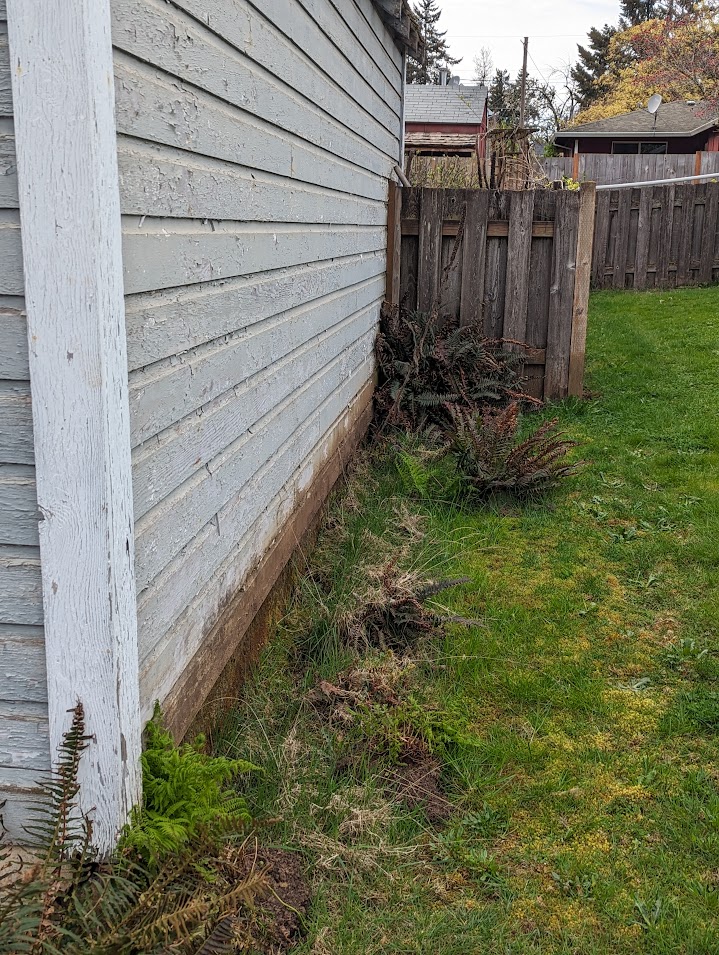

Last fall I filled in the sunny portion of that piece of property with orange day lilies. I also have a magnificent yucca plant growing there. I picked the yucca up out of a FREE pile in front of a house one day. The orange day lilies were given to me by someone. There are daffodils growing there as well, a gift from the previous owner of this house. No more mowing a section of our lot that is difficult to get to and maintain. Ta da!
Minimal maintenance.
I took my list to a plant sale last weekend. It was a fund raiser for a State Park nestled in Lake Oswego. The prices of the (mostly) natives was more than I cared to pay, so I walked out empty-handed and right into the arms of a group giving away bare root saplings of “native” trees and shrubs. I turned down the witch-hazel (and later learned it is not a native to Oregon, although it is indigenous to parts of North America). I already had a mock orange that is two years old and establishing itself. There were a couple others that I questioned as to whether or not they were truly natives. I settled on three bare root plants: black gooseberry, a dogwood, and Indian Plum.
The dogwood is not the native Pacific dogwood, but a Florida import. Say, what??! Oh well, it was free, and I picked out saplings small enough that my husband can work his Bonsai magic on them. I was the only person standing around that had any idea what I was getting with the gooseberry. I’m more familiar with the yellow kind from the more arid side of the State, but this is a native from the Oregon coast – and a gooseberry promises tart berries perfect for a pie. I may have to make a gooseberry/huckleberry pie: I have an evergreen huckleberry (also native to the coast) that produces tiny berries in the late fall.
The Indian Plum is not a plum but produces tart berries that look similar to plums. It was a subsistence plant to the tribes of the Pacific Northwest and is one of the earliest flowering bushes which is a boon to the native pollinators. I’ll figure that out if and when it bears fruit. It can just be an ornamental for now: a native ornamental and attractant to pollinators.
My list incudes two lavenders: a Spanish lavender and a French lavender. I had both in my garden and they both died. My Spanish lavender was over 15 years old. I think I simply had the French lavender in the wrong part of the yard. I also want to get a second campanula, toad lily, phlox sublate (McDaniel’s Cushion), curry plant, and Chinook hop. I need a new rhubarb: the one I have doesn’t grow tall now produce long juicy stems. I’d like to add oxalis and bunch berries to the shade flowers. I also have some annuals on my list: petunias and climbing nastrutiums.

I purchased 19 packets of herb seeds from Mountain Rose Herbs. Those are waiting to be sown. Not for today. I bought the nasturtium seeds from Reneé’s Garden. The Chinook hop from Thyme Garden. The rhubarb is coming from Gurney’s. And the rose I bought from Jackson Perkins is showing some signs of life… (All of my English tea roses are from J&P, this one was a replacement for a floribunda I didn’t like. The floribunda went to a good home. This rose is also on probation until it starts growing…)
Today was the first day of Garden Palooza, a large plant sale south of here, almost to Salem. It is held at Bauman’s Farm & Garden in Gervais. I set aside a certain dollar amount and hope we don’t go over budget, but this year we were way under budget and came away with more plants!
I found both lavenders. My husband found the tomato starts he wants. He also found a pretty campanula for me. The one I currently have is a blue color: Serbian bellflower (campanula poscharsky). The new one is Birch’s Campanula and it will be a pretty purple color. Bauman’s also had so many pretty petunias! I found a full sun ground cover called Creeping Baby’s Breath (gypsophila cerastiodes). Drought tolerant. I need so many ground covers, they do a much better job than bark mulch at keeping the soil moist and weed free. Also, as perennials, the ones I pick out will last longer than bark or hazelnut shell mulch.
Oh, but the best buy of the day? Don found a tree peony for $24. Not $240 or $140, but $24. Tree peonies are not inexpensive even in a year without inflation. There are three old ones in the yard presently along with at least 80 other peony plants. I’m told the yard had more peonies but that was when Barney Schultz lived here, and he died over 30 years ago. The house sat empty, was purchased and flipped, and the grass killed so many peonies during the years of neglect. Then we bought it and I have single-handedly cleared all those peony flower beds, carefully divided tubers, and coaxed those beauties to new life. In short, I don’t need another peony or tree peony.
But $24. Gallon pot. Paeonia lutea var. Ludlowii (Tibetan Tree Peony). It’s young and I may have to wait a few years to see the large yellow blooms it promises. My other tree peonies are white, cream, and pale yellow fringed with red. Of course I bought it.
Our friend gifted us with two filbert trees as well as the ferns. We already have one filbert but the hazelnuts have never produced nuts. You learned you need more than one filbert. (Side note: the trees are filbert trees, the fruit is referred to as a hazelnut.)
So much planting in the near future. And making of larger flower beds to accommodate the 19 varieties of plants I purchased in seed form from Mtn. Rose Herbs.
The next big plant sale is the first of May.

 Jaci Dawn
Leave a comment